
In the socio-cultural architecture of Southwestern Nigeria and the contiguous Yoruba-speaking regions of Kogi State, traditional rulers are not mere men in elaborate beads and crowns. They are the Alase Ekeji Orisa—the custodians of heritage, the human bridge to the ancestors, and the final moral arbiters of their people. Historically, a king or chief emerged from the rigorous, sacred consultation of the oracle, ensuring that whoever sat on the throne possessed the spiritual legitimacy to lead.
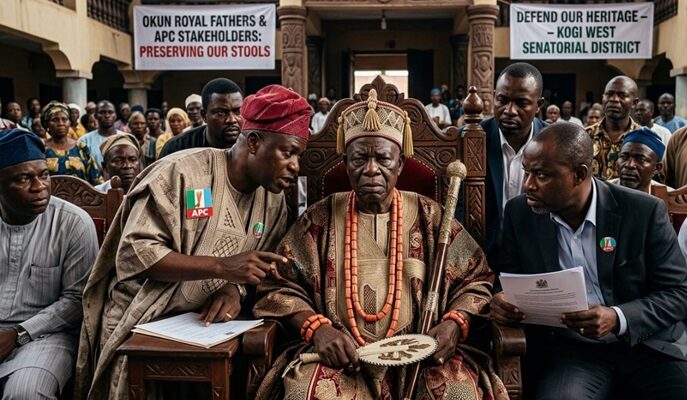
Today, however, a quiet but deeply unsettling storm is blowing through Kogi West. In Okunland, the sacred boundaries between ancient traditional stools and cut-throat partisan politics are blurring at an alarming rate. Revered Royal Fathers—Majesties and Highnesses alike—increasingly find themselves walking a tightrope, seemingly reduced to political emissaries and critical stakeholders of the ruling All Progressives Congress (APC).
What we are witnessing is not just a shift in administrative roles; to many indigenes and cultural purists, it looks like the systematic desecration of traditional stools.

The Tyranny of “Government Magnanimity”
To understand the quiet desperation among some of these traditional rulers, one must look at how they ascended the throne.
Historically, kingship was an absolute product of lineage and divine selection. But contemporary political experiments in Kogi State have flipped the script. Today, a significant number of traditional rulers owe their staff of office not to the unassailable declaration of the oracle, but to the “magnanimity” and executive fiat of the government house.
When a monarch’s crown is a gift from a governor rather than a right validated by his people’s history, survival becomes a game of absolute loyalty. The apprehension gripping Okunland is rooted in this reality: monarchs who exist at the pleasure of the “powers that be” cannot afford to say “no.” To retain their titles, protect their domains, and survive the onslaught of political intimidation, they are forced to participate in partisan absurdities—playing host to political alignments, endorsing specific candidates, and acting as buffers for the ruling party.
The 11th Senate and the Ego of One Man
This experimental weaponization of traditional institutions raises a critical question for every well-meaning Okun son and daughter: Why?
Why is so much state machinery, effort, and resource being channeled into turning monarchs into APC campaign managers?
The answer, whispered loudly in the political corridors of Lokoja and Abuja, points to a highly calculated proxy war. Observers note that this intense mobilization is designed to massage the ego of an influential political actor whose singular, overriding obsession is to control the chessboard of Kogi politics. Specifically, the goal appears to be ensuring that no strong, highly ranked, or independent-minded Senator emerges from Kogi State in the upcoming 11th National Assembly.
By forcing traditional rulers to align strictly with a specific political faction, the masterminds of this strategy hope to systematically crush dissent, dictate who represents the zone, and ensure that whoever goes to the red chamber is a pliable puppet rather than a fierce defender of Okun interests.
The Cost of Compromise
The tragedy of this experiment is that while political actors come and go, the damage done to the traditional institution lingers. When a Royal Father becomes a “Critical Stakeholder” in a political party, he ceases to be the father of all his subjects. He loses the moral authority to settle disputes, speak truth to power, or defend his people when state policies push them to the wall.
Okunland has a rich history of intellectual pride, independence, and cultural dignity. The current trend where thrones are converted into political footstools is a direct threat to that identity.
If the oracle continues to be replaced by executive appointments, and if our Royal Fathers remain cowed by the fear of deposition or starvation, the stool will lose its last shred of reverence. The political actors playing these games must remember that power is transient. Massaging an individual’s ego today at the expense of a people’s ancient heritage is a debt that history will harshly reclaim.
For Okunland to thrive, the crown must be extracted from the mud of partisan politics. The stools belong to the ancestors and the people, not to the party secretariat.
– Ponle Adeniyi
ponleadeniyi457@gmail.com