
Stakeholders in Kogi State’s built environment sector have called on the state Government to urgently enforce the Kogi State Urban and Regional Planning Law of 2010, warning that continued neglect of the legislation is fueling unregulated development, environmental degradation, and urban disorder across the state.
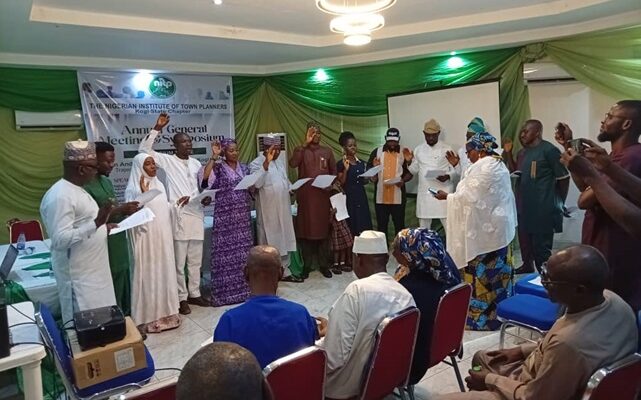
The call was made during the Annual General Meeting (AGM) and Symposium of the Nigerian Institute of Town Planners (NITP), Kogi State Chapter, held in Lokoja. The event, themed “Urban and Regional Planning in Kogi: Trajectory, Legal Issues and Prospects,” brought together town planners, policymakers, academics, and other professionals in the built environment to discuss strategies for sustainable urban development.
Speaking at the event, the outgoing Chairman of the institute, Tpl. Stephen Nden, lamented that although the Nigerian Urban and Regional Planning Law of 1992, as amended, was domesticated in Kogi State in 2010, it has remained largely inactive. He urged the government to immediately implement the law to enable professional town planners effectively guide physical development and curb the growing trend of uncoordinated urban expansion.

According to him, “The implementation of the Urban and Regional Planning Law will empower town planners to effectively guide the physical growth of our urban centres and ensure orderly development. It is unfortunate that a law domesticated over a decade ago remains inactive despite the enormous benefits it offers.”
Nden stressed that achieving sustainable development requires collective efforts from all stakeholders in the built environment sector.
“The responsibility of building a planned and sustainable Kogi State does not rest on town planners alone. Architects, engineers, surveyors, environmental experts, government agencies, community leaders, and residents all have critical roles to play. We must work together to ensure compliance with planning regulations and discourage developers from bypassing established procedures,” he said.
He further urged members of the institute to uphold professional ethics and strengthen collaboration with government agencies, local government councils, and academic institutions.
Also speaking, a resource person at the symposium, Tpl. Ramatu Baba, expressed concern over the state’s failure to fully implement planning laws, noting that several environmental and developmental challenges, including illegal mining activities and indiscriminate construction, are linked to poor planning and weak enforcement mechanisms.
She said, “The absence of effective planning frameworks has contributed significantly to illegal mining activities and environmental degradation. Government must strengthen planning institutions and ensure strict compliance with development control regulations.”
Tpl. Baba also decried the shortage of qualified town planners and other professionals in the sector, warning against construction on natural waterways and flood-prone areas.
“Building on water channels and drainage corridors continues to expose communities to flooding and environmental hazards. These practices must be discouraged through effective enforcement and public sensitization,” she added.
Chairman of the Planning Committee, Dr. Baba Adams Ndalai, emphasized that without the full implementation of planning laws and the establishment of a functional Urban and Regional Planning Board, cities and towns across the state would continue to witness chaotic growth.
He stated that Kogi State possesses immense potential for sustainable urban development if the right policies and political will are deployed.
“Despite these challenges, the prospects for physical planning in Kogi State remain enormous. With strong political commitment and professional dedication, our settlements can be transformed into orderly, resilient, and economically vibrant centres.”
Dr. Ndalai advocated the adoption of smart city initiatives, climate-resilient infrastructure, and inclusive spatial planning systems, adding that Geographic Information Systems (GIS) could significantly improve land administration and increase internally generated revenue.
“The future of Kogi lies in embracing technology-driven planning solutions. Through GIS-based planning and land management systems, government can improve development control, monitor land use changes, reduce disputes, and strengthen revenue generation,” he said.
Chairman of the occasion and former National President of the NITP, Chief Isah Ichaba, urged members to remain united and committed to advancing the planning profession.
He noted that stronger collaboration among professionals would enable the institute to play a more effective role in shaping government policies and promoting sustainable development.
At the end of the AGM, members elected a new executive council to lead the affairs of the Kogi State Chapter. Tpl. Sani Daniel emerged as Chairman, while Femi Ayanleye was elected Vice Chairman. Other officers include Aishat Mohammed Jamiu (Secretary), Enikanolaye Isaac Adebowale (Assistant Secretary), Zainab Salau (Treasurer), Abdullahi Shaaban Aminu (Financial Secretary), Atodo Kerim Smaila (Auditor), Oshamehin Deborah (Public Relations Secretary), Yakubu Umar Onimisi (PRS II), Samuel Afolagbode (Social Welfare Secretary), Stephen Jonathan Nden (Ex-Officio I), and Michael Alhassan (Ex-Officio II).
In his acceptance speech, the newly elected Chairman, Tpl. Sani Daniel, pledged to provide inclusive and result-oriented leadership aimed at strengthening the institute and advancing physical planning across the state.
“We will pursue an all-inclusive administration that promotes professionalism, collaboration, and advocacy for sustainable urban development. Our focus will be on ensuring that planning issues receive the attention they deserve at all levels of government,” he said.
Daniel disclosed that the AGM adopted several recommendations, including the preparation of comprehensive master plans for Lokoja and other major urban centres, implementation of the Urban and Regional Planning Law of 2010, development of a state-wide regional development plan covering all 21 local government areas, recruitment of more planning professionals, establishment of stronger institutional coordination mechanisms, integration of climate adaptation and post-mining reclamation strategies into planning policies, and full deployment of GIS technology in development control activities.
He added that the institute would collaborate with other professional bodies to create a stronger built environment advocacy platform capable of supporting government efforts in achieving sustainable urban development and making Kogi State a more attractive destination for investment and tourism.