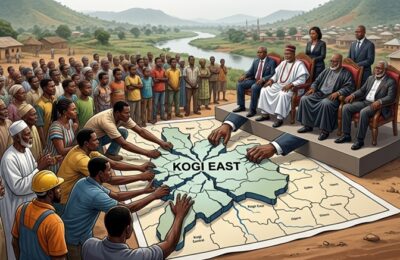
Political history often returns as a question rather than a conclusion. In Igala land, the memory of Prince Abubakar Audu remains one of those unresolved questions that continue to shape political imagination. His era is recalled not merely for electoral contests, but for the sense that leadership once carried both ambition and visibility on a scale that transcended local boundaries. Today, the question persists whether such a figure is a product of fate, or of a political culture capable of renewal.
To understand the weight of that question, one must first recognise that leadership emergence is rarely accidental. It is usually the outcome of intersecting conditions, timing, institutional openness, social trust, and personal political craftsmanship. Audu’s rise was not isolated from his environment; it reflected a period when regional politics allowed strong personalities to consolidate influence through party structures and state centred authority. The landscape that produced him was both competitive and structurally permissive.
However, the present political climate tells a different story. The architecture of influence has shifted toward fragmentation, digital visibility, and constantly renegotiated alliances. Political capital is no longer accumulated solely through party loyalty or administrative records, but also through perception management and rapid communication cycles. In such an environment, producing a figure of comparable magnitude requires more than nostalgia; it requires a reconfigured system of political grooming.

For the Igala political elite, this shift presents both challenge and opportunity. The challenge lies in the gradual weakening of unified political direction, where competing interests often dilute collective ambition. The opportunity, however, lies in the possibility of intentional leadership cultivation, where emerging figures are strategically supported, mentored, and positioned within broader national frameworks. Without such coordination, political talent risks remaining dispersed rather than developed.
Yet, beyond structures and strategies, there is the deeper question of political will. Societies often reproduce the kind of leadership they collectively imagine and actively support. If the aspiration for a figure like Abubakar Audu remains confined to memory rather than action, then it becomes a symbolic reference rather than a living possibility. Faith in leadership must therefore translate into institutional commitment, otherwise fate alone cannot carry the burden of expectation.
Ultimately, the question is not simply whether Igala land can produce another Abubakar Audu, but whether it is willing to construct the conditions that make such emergence possible. Fate may open the door, but faith, organised, deliberate, and sustained, determines whether anyone walks through it.
– Inah Boniface Ocholi writes from Ayah – Igalamela/Odolu LGA, Kogi state.
08152094428 (SMS Only)