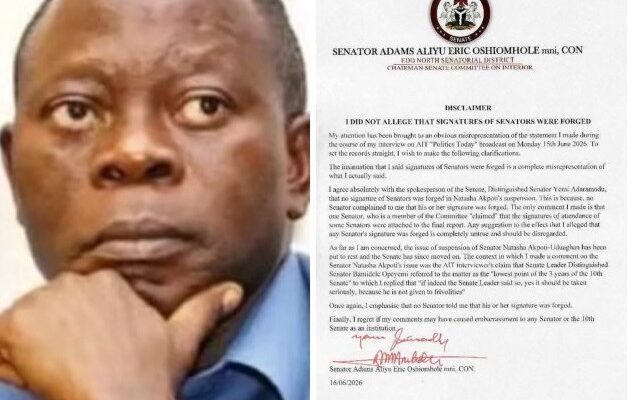

The public disclaimer issued by Senator Adams Oshiomhole has reignited debate over the circumstances surrounding the suspension of Senator Natasha Akpoti-Uduaghan, bringing renewed attention to questions about transparency, documentation, and due process within the Nigerian Senate.
In the statement dated June 16, 2026, the former Edo State governor firmly denied ever alleging that senators’ signatures were forged in connection with the committee report that led to Senator Akpoti-Uduaghan’s suspension. However, his clarification has inadvertently reopened public scrutiny of the procedures adopted during the controversial disciplinary process.
Oshiomhole acknowledged that concerns had been raised by a member of the committee regarding whether some signatures attached to the final report accurately reflected attendance at the meeting in question. While he emphasized that no senator personally informed him that his or her signature had been forged, political observers argue that the clarification itself raises important questions about record-keeping and procedural compliance within the legislative process.

The development has fueled fresh discussions among political stakeholders, with critics contending that the issuance of a formal disclaimer suggests that conflicting interpretations of key events have emerged within the upper legislative chamber. Supporters of Senator Natasha Akpoti-Uduaghan insist that the latest revelations strengthen calls for a comprehensive review of the procedures that culminated in her suspension.
Beyond the immediate controversy, the matter has also sparked broader concerns about accountability and institutional transparency within the National Assembly. Analysts note that even the perception of irregularities in legislative documentation can erode public confidence in democratic institutions and parliamentary proceedings.
Although the Senate leadership has maintained that no signatures were forged and that the matter has effectively been settled, opposition voices continue to demand greater disclosure regarding committee attendance records, deliberations, and the processes that produced one of the most contentious disciplinary actions of the 10th Senate.
What may have been intended as an effort by Oshiomhole to put the controversy to rest has instead renewed public interest in the circumstances surrounding Senator Akpoti-Uduaghan’s suspension. The development has once again placed the Senate’s internal procedures under intense scrutiny, raising broader questions about transparency, procedural integrity, and institutional credibility within Nigeria’s highest legislative body.
As debates continue, the controversy underscores the growing public demand for openness and accountability in legislative affairs, particularly on matters that have significant implications for democratic governance and public trust.