
By Abdul Mohammed Lawal
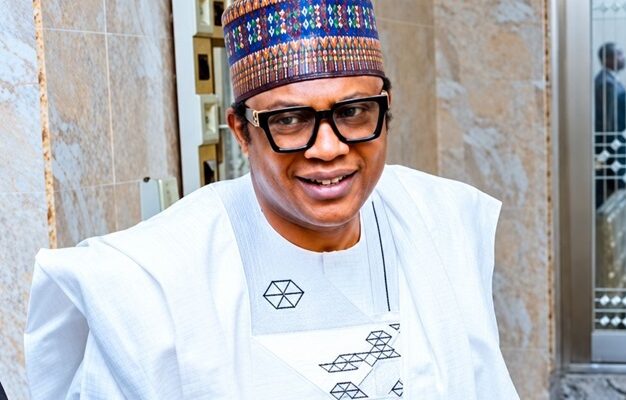
There are moments in the life of a community when a new chapter begins. At such moments, the living look to the future while the ancestors seem to remind them of the values that must not be forgotten. Every community hopes that when such a chapter opens, it will be led by someone whose story, experience and vision reflect the hopes of its people. For Gbobe, that moment may have arrived in the emergence of HRH Alhaji Yusuf Momoh Adama, as the new Anaja of Gbobe.
An academic, researcher, peacebuilding practitioner and administrator, he has spent more than two decades building a career around education, research, peace, leadership and service. His professional journey has taken him through different institutions and places, but now his attention has turned fully towards home.

His story began far from the shores of Gbobe. Born on 29 April 1974 in Moscow, Russia, Yusuf is the third child of the late Momoh Adama Abawa and Hajia Rekiya Momoh Adama, both of Gbobe. He spent his early years in Moscow, Lagos and Idah, growing up with values of discipline, hard work, honesty, service and respect for traditional institutions. His birthplace may have been far from home, but Gbobe never became distant from his identity.
Yusuf comes from the Ohiemi-Ikaka (Ogodo) Ruling House of Gbobe. He is a grandson of the late Alhaji Adama Abawa, whose family played an important role in the effort that led to the restoration of the Ikaka Ruling House to the rotation of the Anaja of Gbobe stool. That history was affirmed by the Kogi State Government White Paper of 15 May 2007.
His connection to the community has also been practical, not merely ancestral. Before his appointment to the traditional stool, Yusuf served as Secretary of the Adama Abawa Family, a position through which he worked to strengthen unity and understanding among the different branches and generations of the family. It is therefore difficult to tell Yusuf’s story without telling part of Gbobe’s story.
Yusuf’s academic journey has been long and purposeful. He began at the Federal Polytechnic Staff School, Idah, where he obtained his First School Leaving Certificate in 1988. He later attended Federal Government College, Ugwolawo, completing his Senior Secondary School Certificate in 1993. The journey then continued at Kaduna State Polytechnic, where he obtained his IJMB Advanced Level certificate before gaining admission to Ahmadu Bello University, Zaria. There, he obtained a B.Sc. in International Studies in 2002.
His interest in peace and conflict later took him to the National Open University of Nigeria (NOUN), where he obtained a Postgraduate Diploma in Peace Studies and Conflict Resolution. He is currently completing an M.Sc. in Peace Education and Conflict Management at Nasarawa State University, Keffi, with completion expected in November 2026.
This academic path is important because it tells a story beyond the accumulation of certificates. It reflects a sustained interest in understanding people, institutions, conflict and the difficult task of building peaceful societies.
Those interests would later become central to his professional life.
Yusuf began his professional career in 2002 during his National Youth Service at Liyafa Palace Hotel in Katsina State, where he worked in administration and hotel management. But in 2004, he joined Bilmar Tours and Travels, Kaduna, as Assistant Manager. There, he gained experience in travel management, administration, communication and working with clients. In 2005, he moved into investment management as an Investment Officer at Sea Dust Nigeria Limited, where he was involved in investment decisions, financial assessments, project reviews and risk management.
Then came the career that would define much of his professional life.
On 14 February 2008, Yusuf joined Kaduna Polytechnic. He has remained there since then, building a career as a teacher, researcher, mentor and administrator. He currently serves as Chief Instructor in the Department of Social Sciences, College of Administrative Studies and Social Sciences. His responsibilities include teaching peace studies, conflict management and governance, supervising student research, mentoring students and younger colleagues, coordinating academic activities and contributing to curriculum development.
For Yusuf, however, education has never been simply about standing in front of a classroom. His interest in society extends into research and public affairs. His research has focused on peace, leadership, governance, religion, development and public administration. Among his published works are studies on leadership and sustainable development in Nigeria, the place of religion in nation-building and revenue generation at the local government level.
He has also carried out studies on academic capacity and the ability of academic departments to generate income.
Perhaps the most important part of Yusuf’s professional story is his belief in dialogue.
His approach to leadership is built around honesty, professionalism, inclusion and consultation. He believes in listening to people, building agreements and bringing different interests together rather than forcing decisions on others. This is a leadership philosophy that could become particularly important in his new role because traditional leadership, after all, is not only about occupying a stool. It is about bringing people together, protecting the identity of a community and collectively helping to create the conditions for its people to prosper.
And this is where Yusuf’s professional journey meets his vision for Gbobe.
For all the places Yusuf has lived, studied and worked, Gbobe remains at the centre of his story. His vision for the community is captured in a simple but powerful phrase:
“Turning Geography into Livelihood.”
Gbobe is an island at the meeting point of two major rivers. Yusuf sees this not simply as a geographical feature but as an opportunity waiting to be developed. To him, the water around Gbobe can become more than part of its landscape. It can become a source of jobs, businesses, skills and income for its people. His vision rests on five main priorities: bringing the skills home, building a marine and blue economy, promoting tourism and culture, investing in young people, and attracting government support.
It is a vision that seeks to turn what many may see as a geographical limitation into an economic advantage.
Yusuf wants the traditional institution, Local Government and State Government to work together to bring infrastructure and development to Gbobe. But beneath all these plans is a simple concern: the future of the young people of Gbobe. They need opportunities, skills and jobs. And, perhaps most importantly, they need a reason to believe that they can build meaningful lives without having to abandon their community.
That is the heart of Yusuf’s vision.
The significance of Yusuf Momoh Adama’s emergence as Anaja of Gbobe therefore goes beyond the traditional title itself. He brings to the stool the experience of an academic, the perspective of a researcher, the patience of a peacebuilding practitioner and the responsibility that comes with being a son of the soil.
Indeed, it is a new chapter for Gbobe.
HRH Alhaji Yusuf is married to Hajia Asmau Tani Musa, and they have two children.
For the new Anaja of Gbobe, leadership is about what can be built from the stool. It is about using knowledge to solve problems, using tradition to unite people, using the community’s natural resources to create opportunities and giving young people a reason to believe that their future can be built in Gbobe.
Perhaps, ultimately, that is what makes this moment different.
The sun has risen in Gbobe.
And what matters now is what the people choose to build in its light.
– Abdul Mohammed Lawal writes from Lokoja.