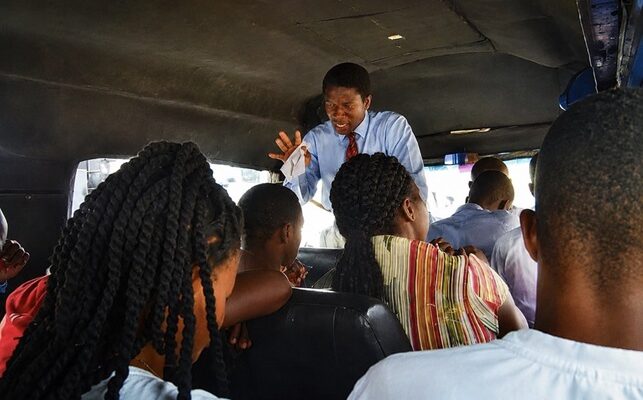

Nigeria does not lack problems. It lacks the luxury of pretending that its most urgent problem is a preacher standing inside a commercial bus.
A nation wrestling with insecurity, unemployment, poverty, failing infrastructure, energy shortages, food inflation, institutional weakness and an economy that continues to squeeze ordinary citizens does not need its legislature to discover its sense of urgency inside a moving bus. Yet here we are: the Senate has passed a bill proposing a ₦50,000 fine for preaching, hawking or trading inside commercial vehicles, ostensibly as part of a road safety framework.
The question is not whether drivers should be distracted. They should not. The question is whether Nigeria has suddenly reached the point where the most imaginative solution to distraction is to legislate against the preacher. If preaching, hawking and trading inside buses create a genuine road safety concern, then regulate the conduct that endangers passengers. Do not casually transform a safety intervention into a broader contest over religious expression.

This is where the controversy becomes larger than the bus.
A commercial bus is not a private convoy. It is a moving public space in which passengers with different beliefs, backgrounds and temperaments share a confined environment. There can be legitimate rules against conduct that obstructs the driver, harasses passengers, creates disorder or compromises safety. But the legislative language matters. Once the state begins identifying a religious act itself as something deserving punishment, the conversation moves beyond traffic regulation into the dangerous territory of civil liberties.
Nigeria’s Constitution protects freedom of thought, conscience and religion, including the freedom to manifest and propagate one’s religion. That protection is not a licence for anyone to disrupt public safety. Neither, however, should public safety become a convenient vocabulary through which legitimate expression is unnecessarily constrained.
The distinction is fundamental.
If a preacher blocks the driver’s vision, demands money from unwilling passengers, causes disorder or interferes with the operation of a vehicle, punish the dangerous conduct. If a trader obstructs movement, regulate the obstruction. If a passenger incites violence, enforce the law. But if the offence is reduced to the mere fact that someone is preaching, Nigeria should pause before celebrating the efficiency of its legislative pen.
Because a government that can silence a preacher today must still answer the constitutional question tomorrow: where exactly does legitimate regulation end and unnecessary suppression begin?
And then comes the uncomfortable question that Nigerians are entitled to ask: who preaches to a private convoy?
The political class does not experience Nigeria from the same physical geography as the ordinary passenger. The politician moves through security escorts, official vehicles and protected convoys. The ordinary citizen squeezes into buses, waits at overcrowded motor parks, negotiates potholes, survives traffic, battles transport fares and watches his income disappear beneath the rising cost of food and basic necessities.
The preacher is inside the bus because the bus is where the people are.
That reality deserves more attention than ridicule.
For millions of Nigerians, the commercial bus is not merely transportation. It is a miniature republic. The market woman sits beside the student. The mechanic sits beside the civil servant. The unemployed graduate sits beside the trader. The Christian sits beside the Muslim. The elderly passenger sits beside the young. Arguments begin. Laughter erupts. Political opinions collide. News travels. Prayers are sometimes offered. Life happens.
To imagine that national order can be restored by removing one category of human expression from that moving republic is to mistake a symptom for a disease.
There is an even deeper concern.
Legislation should not become theatre.
A serious legislature must distinguish between what is urgent, what is important and what is merely visible. Nigeria has no shortage of existential questions demanding parliamentary oxygen. Why are citizens still battling insecurity in communities where fear has become a permanent resident? Why does electricity remain unreliable in a country endowed with enormous energy resources? Why are millions of young Nigerians confronting unemployment and underemployment? Why does food remain unaffordable for families whose incomes have not kept pace with prices? Why do roads deteriorate faster than governments can repair them? Why does public infrastructure routinely collapse under the weight of neglect?
These are not philosophical questions. They are daily emergencies.
Nigeria’s citizens do not wake up wondering whether a preacher will enter their bus. They wake up wondering whether they will return home safely. They wonder whether their salaries will survive the month. They wonder whether they can afford school fees, medicine, food and transportation. Farmers wonder whether insecurity will prevent them from reaching their farms. Small businesses wonder whether they can survive another increase in operating costs.
These are the fires.
Yet the national conversation is suddenly being dragged toward the pulpit inside a bus.
There is something profoundly unsettling about that mismatch of priorities.
A legislature earns relevance not by legislating the most controversial thing in the room, but by confronting the most consequential thing in the country.
This is why the Senate should welcome scrutiny rather than dismiss public criticism. Nigerians are not unreasonable for asking whether the proposed measure is proportionate, constitutionally sound and genuinely necessary. A democracy does not become stronger because citizens remain silent. It becomes stronger because institutions can withstand questions.
And there is another question that deserves an honest answer: is this about safety, or has safety become the convenient wrapper around a much broader attempt to control public expression?
That question should not be answered with outrage from either side. It should be answered through the actual text of the legislation, constitutional analysis, public hearings, evidence and transparent legislative reasoning.
If the evidence shows that preaching inside moving vehicles materially contributes to road accidents or driver distraction, let the evidence speak.
If the real problem is obstruction, harassment or disorder, write the law around those behaviours.
If the concern is fundraising, regulate fundraising.
If the concern is interference with drivers, prohibit interference with drivers.
If the concern is the safety of passengers, protect passengers.
But if the law ultimately punishes religious expression simply because it occurs inside a bus, then the Senate must confront a much harder question: whether it has travelled too far from regulating conduct into regulating conscience.
Religion has always been complicated in Nigeria. It can inspire charity, courage, community and moral responsibility. It can also become intrusive when imposed upon unwilling people. The answer to that tension is not necessarily prohibition. It is the disciplined management of competing rights.
A passenger should not be compelled to listen.
A preacher should not be permitted to endanger passengers.
A driver should not be distracted.
But neither should the state treat peaceful religious expression as though it were inherently a public menace.
There is wisdom in restraint.
Nigeria does not need a legislature that merely reacts to whatever generates the loudest public argument. It needs one capable of looking beyond the noise and identifying the structural crises beneath it.
The country needs lawmakers who will interrogate insecurity until citizens can sleep without fear. It needs lawmakers who will scrutinise economic policies until growth becomes meaningful beyond statistical reports. It needs lawmakers who will fight institutional decay, examine public expenditure, strengthen infrastructure, confront unemployment and demand accountability from the executive arm of government.
It needs Parliament to stare at the country’s largest wounds.
Not merely its smallest controversies.
The preacher in the bus may be noisy. The nation itself is louder.
Listen to the farmer who cannot safely reach his farm. Listen to the graduate who has spent years searching for work. Listen to the parent who cannot keep pace with school fees. Listen to the commuter whose wages disappear into transportation. Listen to the family whose dinner table has become a monthly calculation. Listen to the community that has learned to sleep with one eye open.
Their cries are already a sermon.
And unlike the preacher inside the bus, they cannot simply be fined ₦50,000 and sent home.
Nigeria’s greatest danger is not that somebody may preach inside a commercial vehicle. It is that the country may become so accustomed to legislative distraction that it begins to confuse activity with achievement.
A parliament can pass many bills and still fail the people.
It can generate headlines and still produce little relief.
It can regulate the smallest corner of public life while the largest national questions remain unresolved.
That is the real danger.
So, before the preacher is silenced, let the Senate speak to the nation.
Tell Nigerians why this measure deserves legislative urgency. Show them the evidence. Demonstrate the road safety connection. Explain the constitutional safeguards. Define precisely what conduct is being prohibited. Prove that the measure is narrowly tailored to safety rather than broadly directed at religious expression.
And while doing so, remember that Nigeria is not short of problems worthy of the Senate’s attention.
The nation is bleeding from wounds much deeper than the sound of a sermon in a moving bus.
Do not silence the preacher while ignoring the national emergency.
Because when a government becomes more interested in controlling the noise inside the bus than repairing the road beneath it, Nigerians are entitled to ask whether the problem is really the preacher—or whether the nation’s priorities have lost their way.
– Inah Boniface Ocholi writes from Ayah – Igalamela/Odolu LGA, Kogi state.
08152094428 (SMS Only)