
By Barr. Eleojo Amedu
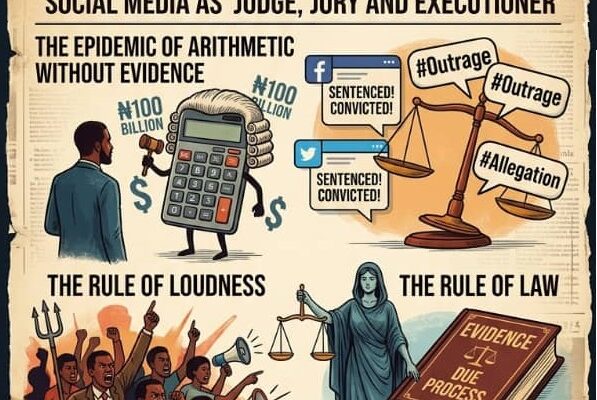
There is a peculiar Nigerian disease that arrives every election season. It is the epidemic of arithmetic without evidence. Somebody announces a spectacular figure, ₦100 billion, ₦500 billion, ₦1 trillion and before breakfast, social media has already conducted investigation, prosecution, conviction and sentencing. In our republic, calculators have become judges while Facebook posts now masquerade as forensic audit reports.
Permit me to disappoint the professional merchants of outrage. Democracy is not sustained by loud allegations. It survives on louder evidence.

I read yet another public declaration demanding explanations over an alleged ₦100 billion. The headline screamed with the confidence of a prophet descending from Mount Sinai with fresh tablets of stone. But somewhere between the thunder and the hashtags, I kept searching for that stubborn little companion called proof. It never arrived. Instead, I encountered estimates dressed as facts, assumptions wearing the agbada of certainty, and political rhetoric pretending to be audited accounts.
You must remember that accountability is too important to be sacrificed on the altar of political theatre. If public funds have indeed been diverted, let the documents speak. Let procurement records speak. Let budget implementation reports speak. Let contract registers speak. A democracy worthy of its name investigates first and concludes later. Only a mob concludes first and hopes investigation will eventually justify its emotions.
Now let us examine the curious logic before us. The author asks, “Where is our ₦100 billion?” A legitimate question becomes meaningful only after establishing that ₦100 billion was actually allocated, received, managed by the authority being accused, and remains unaccounted for. Otherwise, the question resembles a village elder demanding the whereabouts of ten cows nobody has established ever existed.
He labels legislators “rubber stamps.” Perhaps they deserve criticism; perhaps they do not. But democracy is not improved by replacing evidence with insults. Oversight is measured by committee reports, hearings, recommendations and legislative records, not by the creative vocabulary of political frustration.
He issues a seven-day ultimatum. Nigerians have developed an unhealthy addiction to ultimatums. We issue seven days as if governance were a reality television competition where contestants are eliminated after commercial break. Institutions do not function according to social media countdown clocks. Anti-corruption agencies investigate petitions, documents and witnesses, not Facebook deadlines.
Then comes the fascinating demand that government should prove projects worth at least one percent of an estimated amount. Notice the intellectual acrobatics. The conclusion has already been reached before the investigation begins. The accused is now invited to prove innocence rather than the accuser proving guilt. Our criminal jurisprudence must be weeping quietly in one corner.
The most amusing line is always, “This is not about politics.” Whenever a Nigerian politician or activist announces that something is not about politics, kindly secure your wallet and hide your common sense. It is usually politics arriving in borrowed robes. Genuine civic accountability welcomes facts wherever they lead. Political performance prefers conclusions before questions.
Do not misunderstand me. Public officials owe citizens transparency. Every government should account for every naira under its stewardship. Budgets should be open. Procurement should be transparent. Citizens should ask difficult questions. That is not merely a democratic right; it is a democratic obligation.
But there is an equally sacred obligation placed upon citizens and public commentators: intellectual honesty. Accountability built on speculation is no accountability at all. It merely transforms public discourse into a marketplace where rumours trade at a higher value than verified facts.
Our tragedy as Nigerians is not simply corruption. It is our selective relationship with evidence. When accusations favour our political preferences, we suspend the standards we demand from our opponents. We become judges without trials and historians without archives. We forget that today’s reckless allegation may become tomorrow’s dangerous precedent.
History teaches uncomfortable lessons. Societies decline not only because leaders fail but because citizens gradually lose respect for truth itself. Once facts become optional and outrage becomes sufficient evidence, democracy slowly mutates into permanent suspicion. Every governor becomes guilty before inquiry. Every opposition figure becomes a saint until elected. Then the cycle begins again.
So by all means, demand accountability. Petition every institution if you possess credible evidence. Ask difficult questions. Scrutinise every budget. Follow every contract. But let your accusations walk on the sturdy legs of verifiable facts rather than the fragile stilts of political excitement.
Those who genuinely seek transparency should fear neither investigation nor evidence. Those who genuinely seek justice should welcome due process before public condemnation. And those who truly love democracy must resist the temptation to replace the rule of law with the rule of loudness.
The final irony is this: if accountability must triumph over propaganda, then that principle binds everyone equally, including those making the accusations. A claim is not transformed into truth because it is written in capital letters, repeated a hundred times, or accompanied by a seven-day ultimatum. In a constitutional democracy, the burden of proof remains stubbornly where civilisation has always placed it: on the person making the allegation. Anything less is not accountability. It is merely propaganda rehearsing for the next election.
Outrage is not evidence!
– Barr. Eleojo Amedu is a Kogite and writes from the Federal Capital Territory