
By Muhammed sherifdeen Omeiza
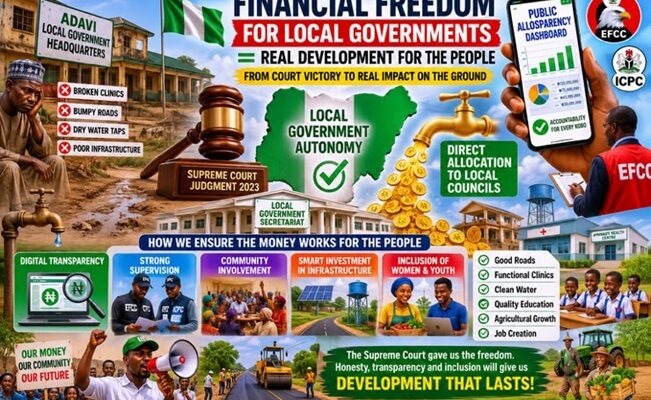
Walk into the administrative headquarters of Adavi Local Government, or almost any rural council across Nigeria, and the story is exactly the same. Broken clinics, bumpy dirt roads, and dry water taps are everywhere. This is not because local people do not want to work; it is the result of a decades-long financial chokehold where state governors hijacked council funds through joint accounts.
Back in September 2023, this exact problem was the core of my final-year university thesis. My field data clearly showed that without financial freedom, local councils could never bring real growth to the grassroots.

Less than a year later, Nigeria celebrated a massive victory when the Supreme Court ruled that withholding these local funds was illegal. Yet, the reality on the ground shows that a court victory does not automatically build a single classroom or fix a broken borehole.
Recent reports show that many state governors are still finding sneaky loopholes to control local allocations. As the federal government pushes harder to send money directly to local council accounts, we face a big question: how do we ensure this money actually develops our villages instead of just enriching local politicians?
To stop this new money from feeding local corruption, we must move past trusting politicians and set up tight, automatic checks. If local chairmen get direct millions without heavy supervision, we will only succeed in moving corruption from the state capitals down to our local secretariats.
A smart public policy approach must enforce total digital transparency. The government should display every single kobo sent to a local council on a simple, public online dashboard that any citizen can check on their phone. At the same time, anti-corruption agencies like the EFCC and ICPC need to station permanent officers at council headquarters to double-check contracts before money leaves the bank. Most importantly, local communities and youth groups must be legally included in project supervision. A contract for a village water project should only get its final payment after the villagers themselves sign off that a working tap is actually on the ground.
Plugging the financial leaks is only the first step; the next move is spending the money on projects that actually last. For a long time, local politics in Nigeria has been about cheap handouts like distributing motorcycles, sewing machines, or small cash to buy loyalty during elections.
This needs to stop.
Real public policy means investing in foundational projects that help the local economy grow over time. Local councils must focus on grading and paving farm roads so villagers can easily get their harvests to the market. They need to build solar-powered storage centers to stop food from spoiling, and they must properly equip village clinics. To make sure the money goes where it hurts most, councils must hold mandatory town hall meetings. Instead of politicians sitting in offices guessing what the people need, the villagers themselves should vote on the most urgent project for their community.
Finally, rural growth will fail if local governments keep ignoring the two groups hit hardest by poverty: women and youth. Local budgets must deliberately set aside a specific percentage of money for projects that directly empower them. This means creating easy micro-credit loans for market women, improving maternal health centers, and building local skill hubs. These hubs should train young people in modern farming techniques and basic digital skills so they can create their own jobs.
Inclusion is not a favor; it is common sense, because a community cannot grow when more than half of its population is left out of the economy. The Supreme Court gave local governments their financial freedom, but only strict honesty, solid infrastructure, and carrying everyone along will turn our 774 local governments into the real engines of Nigeria’s progress.
– Muhammed Sherifdeen Omeiza is a Nigerian researcher and writer whose work explores the intersection of humanitarian action, human rights, gender equality and global governance. With a keen interest in public policy, democracy, and political economy, he examines how local experiences and global decisions shape humanitarian outcomes in times of crisis. His writings draw from African and international contexts, reflecting a commitment to justice, accountability, and people-centered governance in global affairs.
Email: sherifdeenmuhammed001@gmail.com