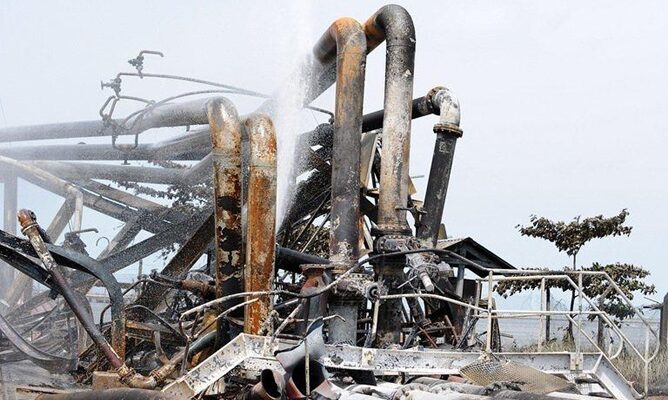

For years, the beating heart of Nigeria’s economy was sustained by a vast, subterranean network of steel arteries that leaked wealth into the dark. Between 2019 and 2023, the nation was not merely contending with isolated incidents of petty oil theft; it was witnessing an industrial-scale economic war waged against its primary subsoil assets. Across the dense mangrove swamps, winding creeks, and shallow offshore stretches of the Niger Delta, an intricate web of organized crime syndicates, artisanal illegal refining cartels, and deliberate sabotage laid active siege to upstream wellheads, flow stations, and trunk lines. What flowed through these compromised logistics routes was no longer just crude petroleum; it was the very fiscal stability of the Nigerian state, hemorrhaging billions of dollars in broad daylight while foreign direct investment fled an operational terrain increasingly defined by lawlessness.
To fully grasp the magnitude of the 2019–2023 systemic collapse, one must examine the staggering metrics of the financial and volumetric loss. In 2021 alone, NNPC shed approximately $7.2 billion in lost crude oil, with daily bleed rates peaking between 102,900 and 200,000 barrels per day (bpd), representing a localized, daily drain of roughly $4 million directly out of the national balance sheet. By 2022, as deliberate sabotage and sophisticated hot-tapping reached an unmitigated high, NNPC’s financial losses ballooned to an unprecedented $22.4 billion (over N29.8 trillion). Nigeria’s primary evacuation arteries were rendered functionally non-operational. The Trans-Niger Pipeline (TNP), a critical 180,000-bpd asset operated by the Shell Petroleum Development Company (SPDC), was found riddled with between 150 and nearly 300 illegal hot-tap connection points, forcing the strategic line into prolonged shutdowns and leaving it running virtually dry for extended stretches.
Downstream and refined product distribution networks fared no better as the destruction moved southwestward. The Atlas Cove–Ibadan pipeline corridor, long considered the logistical backbone for domestic fuel supply across western and southern depots—including the vital Warri-to-Benin and Sapele supply lines was severely compromised by repeated structural ruptures, illegal siphoning operations, and catastrophic, fatal explosions. Urban-adjacent petroleum product distribution lines at Abule-Egba and Isheri Olofin in Lagos State were punctured repeatedly by vandals tapping directly into high-pressure lines, triggering devastating fires, crippling regional fuel logistics, and forcing NNPC to shut down major domestic supply routes. According to data highlighted by the Nigeria Extraction Industries Transparency Initiative (NEITI), millions of barrels were compromised within a broader 13.5-million-barrel joint window spanning 2022–2023/2024, valued at over $3.3 billion. By August 2025, retrospective industry disclosures revealed that during the absolute depth of the 2022 crisis, as little as 30 percent of the crude oil injected into certain major trunk lines actually reached the export terminals.

The destruction of Nigeria’s oil economy was not confined to midstream trunk lines; it penetrated deep into the upstream production sector. Upstream wellheads, gathering manifolds, and flow stations across Rivers, Bayelsa, and Delta States were systematically grounded. Numerous wellheads were clamped, physically tapped, or entirely bypassed by well-funded criminal networks operating with sophisticated technical equipment. Entire field operations were shuttered because producing companies had no secure way to evacuate their fluid output without losing the majority of it along the way. The commercial consequences were cascading and severe: collapsing government revenues, depleted foreign exchange reserves, massive capital expenditure spent on endless emergency repairs, profound operational uncertainty, and a near-total destruction of investor confidence. By late 2022, Nigeria; historically Africa’s premier energy powerhouse saw its production plummet to an agonizing low of roughly 960,000 bpd, failing dramatically to meet its allocated OPEC quota and casting a deep shadow over the country’s sovereign credit ratings.
The turning point in this economic crisis emerged through a radical, structural shift in asset-protection strategy. Recognizing that conventional static guarding and reactive repairs were completely ineffective against deeply entrenched syndicate operations, the leadership under Engr. Bashir Bayo Ojulari spearheaded an overhaul toward a fully integrated energy-security architecture. Officially articulated in early 2026, this dynamic framework abandoned isolated patrols in favor of an integrated model fusing executive and legislative policy coordination, actionable signals intelligence, real-time aerial and maritime surveillance, targeted military deployments, regulatory oversight, and community-based surveillance mechanisms.
Crucially, this evolving arrangement integrated private security contractors; an initiative originally engaged in 2021 and scaled up significantly during the recovery phase. Rather than replacing state authority, these private operators brought granular local terrain knowledge, immediate threat identification, and swift reporting along remote right-of-ways. State security agencies, including the armed forces and police, retained exclusive constitutional authority over tactical interdiction, deep-network financial investigations, and formal criminal prosecutions. By bridging the commercial management of energy infrastructure with the enforcement power of the state, the model disrupted the criminal networks financing the illicit trade.
However, security interdiction alone could not boost export figures if physical production facilities and logistics hubs remained damaged or offline. The strategy therefore paired pipeline security with aggressive operational restoration. Engineering teams worked continuously to repair damaged trunk lines, clamp punctured wellheads, remove physical evacuation bottlenecks, and restore system integrity from flow stations all the way to offshore export terminals. By June 2026, the Nigerian Upstream Petroleum Regulatory Commission (NUPRC) confirmed that crude production had reached its highest level since April 2020, supported directly by operational stability and reliable pipeline infrastructure.
When NNPC Limited’s financial disclosures revealed an aggregate annual expenditure reflecting N11 trillion allocated toward energy infrastructure security and asset safeguarding, public debate immediately flared over the sheer magnitude of the cost. Yet, evaluating this price tag requires weighing it against the catastrophic fiscal losses of the preceding years. The tangible return on this security investment is clearly reflected in the national operational metrics. From the collapse of 960,000 bpd in 2022, crude oil production surged to 1.71 million bpd in 2025, hitting a peak production level of 1.678 million bpd within that same year representing an increase of approximately 750,000 barrels per day, or a 78 percent recovery.
This dramatic operational rebound directly restored Nigeria’s international standing within the global market. After years of severe underperformance, Nigeria met its OPEC production quota in August with an average crude output of 1,500,190 bpd (excluding condensates) and a combined crude and condensate volume of 1,677,777 bpd. This marked the fourth consecutive month that the nation successfully sustained output at or above its 1.5 million bpd OPEC crude quota. Furthermore, securing gas gatherers and condensate routes enabled average domestic and export gas production to expand from 7,354 million standard cubic feet per day (MMscfd) in April 2025 up to 7,729 MMscfd by April 2026.
The recovery trajectory recorded between 2022 and 2026 offers an enduring lesson for global energy logistics: oil pipeline security in a complex swamp and maritime environment is not a simple policing task. It is a multi-dimensional discipline requiring intelligence fusion, community cooperation, public-private coordination, and continuous engineering maintenance. While actual fiscal gains will always fluctuate with global crude prices, operational costs, and contractual terms, the stabilization of Nigeria’s production baseline proves that the huge investment in securing critical energy infrastructure was not an unvouched expense; it was the necessary rescue fee to rebuild the foundation of the nation’s economy.
Arguing that the multi-trillion-naira investment in protecting Nigeria’s critical pipeline and energy infrastructure was “unjustified” overlooks the scale of the crisis that defined the petroleum sector between 2019 and 2023. The Trans-Niger Pipeline was reportedly riddled with hundreds of illegal tap points, while criminal networks siphoned crude and disrupted evacuation.
The economic case for security spending must be tested against outcomes, not cost in isolation. Production recovered from a reported low of 960,000 barrels per day in 2022 to an average of 1.71 million bpd in 2025, while Nigeria met its 1.5 million-bpd OPEC crude quota for four consecutive months by August 2026. Gas production also rose from 7,354 million standard cubic feet per day in April 2025 to 7,729 MMscfd in April 2026. These figures do not prove that security spending alone caused the recovery, but they show why reliable infrastructure protection matters to production and export performance.
Criticism of public spending is essential to accountability. Yet judging energy-security expenditure without considering theft, sabotage, lost production and repair costs presents an incomplete economic picture. Protecting the country’s revenue-generating assets was not a luxury; it was a necessary part of restoring operational stability and safeguarding the foundation of the Nigerian economy.
– ONOGWU Muhammed, B.Tech (Chemical/Petroleum Tech.), LLB, BL, MIAD, ANIPR