
By Muhammed Sherifdeen Omeiz a
For many African families, education is still seen as the safest investment they can make in their children’s future. Parents sacrifice to send their children to university because they believe a degree will provide access to a better job and a better life.
But that promise is becoming harder to keep.

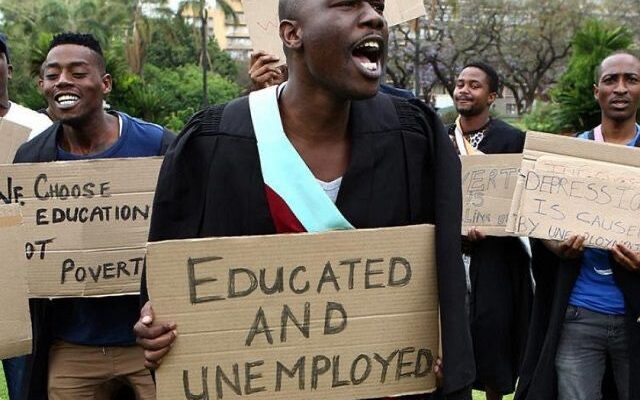
Across Africa, more young people are gaining university qualifications, yet many still struggle to find decent employment. This creates a difficult question: what happens when education expands faster than the economy’s ability to create opportunities for educated people?
The problem is not that Africans are getting too much education.
The problem is that education and the labour market are often moving in different directions.
A university may produce thousands of graduates every year, but the economy may not be creating enough jobs that require their skills.
This creates a mismatch.
A graduate may spend four years studying economics, political science, engineering or another discipline and still find that employers are looking for experience, technical skills or opportunities that the education system did not provide.
Africa’s youth population makes this problem more urgent. The continent is entering a period of rapid growth in its working-age population, with hundreds of millions of young people already entering or preparing to enter the labour market.
Every year, more young people enter the labour market.
If the economy does not create enough productive jobs, the pressure will continue to grow.
This is why education policy cannot be separated from economic policy.
Governments need to ask what kinds of industries they want to develop and what skills those industries will require.
If a country wants to industrialise, it needs technicians, engineers, manufacturers and skilled workers.
If it wants to expand its digital economy, it needs people with relevant technical and digital skills.
If it wants to modernise agriculture, it needs agricultural scientists, processors, entrepreneurs and people who understand modern value chains.
Education should therefore be connected to the economic future a country is trying to build.
But universities should not be blamed for everything.
Governments also need to create economies where graduates can actually find opportunities.
A country cannot solve graduate unemployment simply by changing university courses while ignoring weak industries, poor infrastructure, limited private investment and difficult access to finance.
There is also a need to rethink what success means.
Not every graduate will work for government or a large company.
Entrepreneurship can create opportunities, but telling every unemployed graduate to “become an entrepreneur” is not a substitute for a functioning economy.
Young people need access to capital, markets, electricity, internet and business support if entrepreneurship is going to become a realistic option.
Technical and vocational education should also receive more attention.
A skilled technician, electrician, builder or machine operator can be just as important to economic development as a university graduate.
Africa does not have an education problem alone.
It has an education-to-employment problem.
The solution is therefore not simply to build more universities or produce more graduates.
It is to build stronger connections between education, industry and economic policy.
A degree should open a door.
But the government and the economy still have to build the door.
Until Africa creates enough productive opportunities for its educated population, education will continue to raise expectations faster than many economies can meet them.
– Muhammed Sherifdeen Omeiza is a Nigerian researcher and writer whose work explores the intersection of humanitarian action, human rights, gender equality and global governance. With a keen interest in public policy, democracy, and political economy, he examines how local experiences and global decisions shape humanitarian outcomes in times of crisis. His writings draw from African and international contexts, reflecting a commitment to justice, accountability, and people-centered governance in global affairs.
Email: sherifdeenmuhammed001@gmail.com