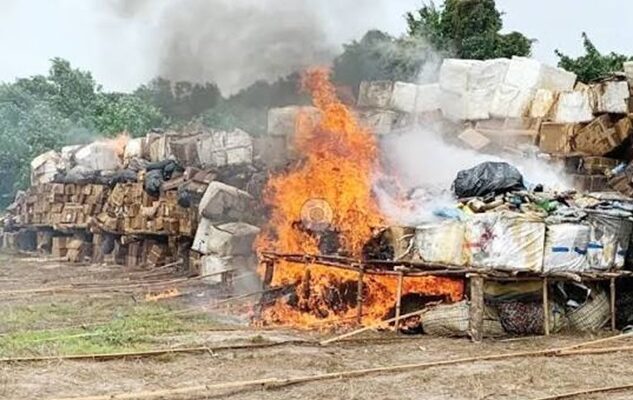

Nigeria cannot burn its way out of poverty. Yet, across the country, cannabis farms are raided, crops are torched, livelihoods are erased, and millions in potential agricultural value vanish in smoke. The spectacle may look like enforcement, but policy should be judged by outcomes. When a nation is drowning in unemployment, deprivation, and fiscal strain, destroying an economically valuable crop without confronting the larger economic calculus is difficult to defend as sound public policy.
What has prohibition achieved? It has not extinguished demand. It has not eliminated cultivation. It has not dismantled the underground market. Instead, cannabis has remained embedded in an illicit economy where growers, traffickers, and criminal networks capture the value while the state captures little beyond enforcement costs. A policy that perpetually chases supply without interrogating the market it creates risks becoming a self-perpetuating machinery of futility.
Legalisation, however, should not mean laissez-faire. It should mean regulation. Nigeria could establish a tightly controlled framework for licensing, cultivation, processing, research, taxation, product standards, age restrictions, traceability, and medical use. Such a regime would not surrender public health to commerce; it would bring an existing clandestine economy under accountable institutions. Regulation would create rules where prohibition has often created shadows.

The economic argument is too substantial to dismiss. Cannabis and industrial hemp possess potential applications in medicine, research, textiles, fibre, manufacturing, and other industries. With rigorous science, agricultural extension, private investment, and regulatory oversight, Nigeria could convert part of an illicit agricultural economy into a taxable and research-driven value chain. Farmers could become licensed producers. Researchers could study therapeutic applications. Manufacturers could develop legitimate products. Government could capture revenue instead of merely financing raids.
Public health must remain the hard boundary. Any reform should be evidence-led and designed to prevent youth access, impaired driving, dependency, unsafe products, and uncontrolled commercialisation. Criminal trafficking should remain subject to serious sanctions. But intelligent regulation is not surrender. It is governance. The state should distinguish between predatory criminal enterprise and controlled agricultural production rather than treating every economic participant as an indistinguishable enemy.
What Nigeria needs is not more smoke rising from ruined farms, but clearer thinking rising above an obsolete policy reflex. You cannot police your way out of an economic problem that requires policy reform. You cannot destroy prosperity into existence. And you cannot burn your way out of poverty. If cannabis has economic, medical, and industrial potential, Nigeria should investigate it with science, regulate it with discipline, and tax it with purpose. The objective of public policy should not be to create impressive fires. It should be to build a more prosperous country after the smoke clears.
– Inah Boniface Ocholi writes from Ayah – Igalamela/Odolu LGA, Kogi state.
08152094428 (SMS Only)