
By Musa Bakare
No tragedy cuts deeper than that of a people who surrender before the battle begins.
No oppression is more painful than the one a people inflict upon themselves.
History records nations conquered by superior forces, but it reserves its deepest pity for those who abandoned their own cause before anyone defeated them.

This is the painful paradox confronting the Okun Yoruba people of Kogi West Senatorial District today as the 2027 Kogi State governorship election approaches.
Since the creation of Kogi State in 1991, the governorship has remained beyond the reach of Kogi West. More than three decades have passed. Generations have come and gone, yet the aspiration of producing an elected governor remains unrealised.
Kogi East Senatorial District has produced three executive governors and governed for over sixteen years. Kogi Central has produced two governors and will have completed twelve years by January 2028.
One would expect that such prolonged political exclusion would unite every son and daughter of Okun behind the common cause of producing the next executive governor of Kogi State in January 2028.
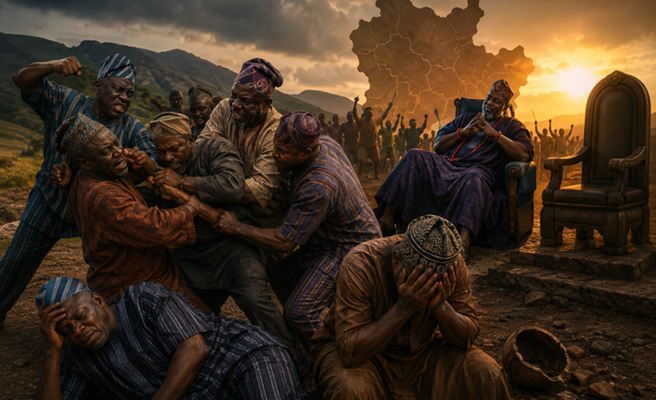
Instead, we are witnessing a painful, morally troubling, and politically self-destructive spectacle.
Some of our own have become the loudest voices declaring that Okun is not yet ready to produce the next governor.
At the expiration of former Governor Ibrahim Idris’s eight-year tenure in 2012, some Okun sons were at the forefront of the agitation that another Igala man should succeed him. The rest today is history.
At the expiration of former Governor Yahaya Bello’s tenure in 2018, another self-inflicted, defeatist spectacle surfaced. Once again, the rest is history.
What greater political tragedy could there be than what the world is seeing in us again in 2026, ahead of 2027?
How can a people seek justice while arguing against their own entitlement to it? How can a nation demand equity when its own children preach surrender? How can history rescue those who have already condemned themselves?
Politics rewards courage, not timidity.
Power is never donated to those who publicly proclaim themselves unworthy. Power gravitates toward those who organise, negotiate, mobilise, and insist. Every great political victory was once dismissed as impossible until determined men and women resolved that enough was enough.
Today, the greatest obstacle confronting the Okun people may not be external opposition. It may well be self-defeatism.
Once a people begin to argue against their own destiny, outsiders merely repeat what they have already confessed.
That is why the present narrative is so sorrowfully heartbreaking.
How can the rest of the world sympathise with a people whose own sons and daughters move from one platform to another, from television stations to radio programmes, from one traditional ruler to another, explaining why their land should continue in subservience to others?
How can anyone champion your cause when you have become the chief prosecutor against yourself?
The Nigerian street captures this bluntly: “Your mumu never do?”
As harsh as the expression sounds, it demands honest reflection.
After more than three decades without producing a governor, should the sons and daughters of Okun still be volunteering reasons why their turn should once again be postponed?
Every delayed destiny should inspire greater determination, not deeper resignation. Every setback should strengthen conviction, not weaken it.
Providence opens doors for those who keep knocking, not for those who abandon the gate before it opens.
No serious people enter a political contest by first announcing defeat. Negotiations begin from a position of confidence, not self-denial. Respect is earned by those who value themselves enough to defend their collective interest.
A people who refuse to believe in themselves cannot reasonably expect others to believe in them.
This is not merely about the 2027 election or the governorship that becomes vacant in January 2028. It is about whether the Okun nation still possesses the collective courage to shape its own political destiny.
Our forebears did not preserve our identity so that their descendants would become permanent spectators in determining the leadership of Kogi State. They endured hardship and sacrifice so future generations would stand with dignity, not surrender voluntarily.
The time has come for sincere introspection. History is watching. Future generations are watching.
Our children will one day ask what we did when history knocked at our door. Did we rise together to demand fairness, equity, and inclusion? Or did we become the generation that argued most passionately against its own inheritance?
May history never remember the Okun people as a nation denied justice by others, but as one that denied itself the courage to pursue it.
– Musa Asiru Bakare, a Founding Member of APC and Political Analyst, writes from Lokoja, Kogi State.