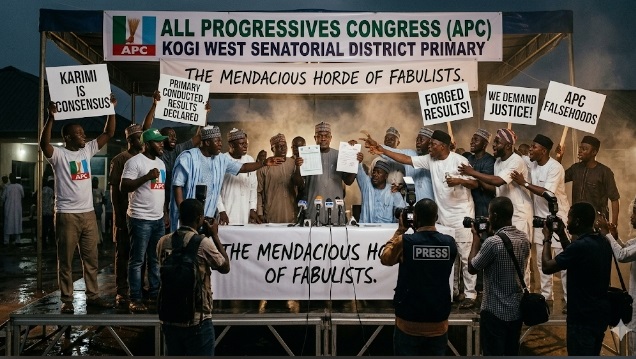

A popular refrain about politics is that it lacks morality. But as the ongoing fallout from the Kogi West Senatorial District primary shows, there are times when one expects at least a modicum of honor among thieves. Instead, what the All Progressives Congress (APC) has put on display in Kogi State is a bizarre, mind-boggling piece of political theater—one driven by a mendacious horde of fabulists who seem entirely comfortable rewriting reality in real-time.
The core issue here is not merely the shameless attempt to tell the public a different story about an event whose facts are already well known. Rather, it is the systemic collapse of integrity among leaders who have chosen to lie through their teeth simply to massage the egos of their political bosses.
The groundwork for this crisis was laid months before the primary actually took place. The incumbent, Senator Sunday Karimi, was the target of a sustained media campaign. This orchestrated friction culminated in a series of highly publicized “vote of no confidence” declarations issued by various mushroom groups—organizations that seemed to exist purely on paper for the sake of political optics.

Yet, just days before the scheduled primary, the narrative shifted overnight. A high-level stakeholders’ meeting was convened, yielding a clear directive: Senator Sunday Karimi would be the consensus candidate of the party.
What followed looked, on the surface, like a masterclass in party discipline:
All other aspirants who had purchased expensive nomination and expression of interest forms addressed the press.
They explicitly stated they were stepping down out of deference to President Bola Ahmed Tinubu and the overarching need for party unity.
The primary election went ahead across the wards of Kogi West. Results were declared, collation was completed, and Senator Karimi was officially pronounced the winner.
He was widely congratulated, notably by the very stalwarts who had just withdrawn from the contest. For a brief moment, the process appeared concluded.
The peace was short-lived. Within days, rumors began circulating that a fresh, obviously doctored result sheet had been manufactured and submitted to the APC National Secretariat.
To give this sudden fraud legs, the machinery of the state party swung into action. Meetings were hastily called. Certain party officers in Kogi State began issuing frantic press statements completely contradicting their own earlier public positions on the primary election.
This sudden about-face highlights a deeper cultural rot within the local political ecosystem. Supposed elders and youth leaders—individuals who by all accounts ought to be mentors and role models—have instead busied themselves proclaiming blatant falsehoods without a hint of shame.
The unfolding situation raises a painful question for observers of Kogi politics: How did the offspring of virtuous, diligent, and courageous men and women become such political weaklings?
Even the traditional elites—the princes and princesses of the region—have effectively devolved into jesters in the court of a system they serve loyally, while their own people reap no tangible benefits.
Those within this political class who loudly perform godliness are proving, through their actions to be counterproductive agents of destabilization. The bitter irony is that the reward for this absolute, subservient loyalty is rarely respect or power; it is merely crumbs brushed off the system’s table.
The troubling reality of Kogi West is that it remains saddled with a lying leadership whose unbridled ambition and greed will continue to act as the bane of progress and development for the entire district.
If the APC National Secretariat accepts this revisionist theater, it signals that outcomes in Kogi West are determined not by votes, consensus, or rules, but by whoever possesses the audacity to invent the most convenient lie. For the people of Kogi West, the cost of this fiction is a predictable gridlock on actual governance and development.
– Ponle Adeniyi
ponleadeniyi457@gmail.com