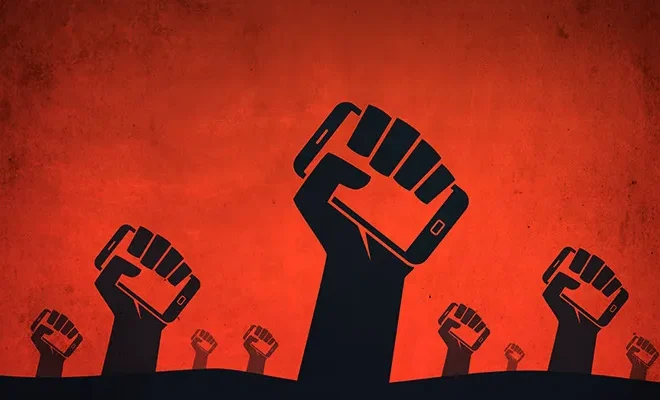

Power no longer announces itself only from marble halls or guarded podiums. It now flickers in the restless glow of mobile screens, carried in the hands of ordinary citizens who have discovered that a voice, once isolated, can become a movement when amplified by millions. What was once dismissed as noise has matured into a force that unsettles governments, compels institutions, and redefines the grammar of protest in the twenty first century.
Digital activism has altered the architecture of dissent. It is no longer bound by geography, class, or access to traditional media. A single post can travel faster than policy, and a hashtag can assemble what decades of silence could not. As Manuel Castells observed, “Networks of outrage and hope are the new social movements.” This is not merely a poetic observation. It is a structural shift. Power is being redistributed from institutions that control information to communities that generate it.
Yet this new power is neither pure nor stable. It behaves like fire. It illuminates, but it can also consume. Digital platforms reward speed over reflection, emotion over nuance, and visibility over verification. In this environment, truth competes with virality. As Zeynep Tufekci warns, “The internet can amplify movements, but it does not necessarily deepen them.” The danger, therefore, is not in the rise of digital activism, but in mistaking momentum for transformation.

In many parts of the world, including Nigeria, the implications are immediate and profound. Young people who once felt excluded from formal political processes are now shaping national conversations in real time. The digital space has become both parliament and protest ground, courtroom and campaign platform. It collapses distance between leaders and citizens, exposing contradictions that would otherwise remain hidden. As Malcolm Gladwell argued, “The revolution will not be tweeted,” yet the evidence suggests something more complex. While tweets alone may not complete revolutions, they are increasingly the spark that ignites them.
Still, there is an unresolved tension at the heart of this transformation. Digital activism thrives on visibility, but lasting change demands structure. A movement that trends today can disappear tomorrow if it lacks organisation, leadership, and strategy. The challenge is therefore not simply to speak, but to sustain. Not merely to trend, but to translate visibility into policy, outrage into institution, and moments into movements.
What emerges, then, is a new political reality. Power is no longer a fixed possession. It is fluid, negotiated daily in the contested space between authority and attention. Digital activism has not replaced traditional politics, but it has irrevocably altered its conditions. It is the wind that cannot be seen yet bends the trees, the quiet current beneath the surface that reshapes the direction of the tide.
The question is no longer whether digital activism matters. It does. The more urgent question is whether societies are prepared for the kind of power it creates.
– Inah Boniface Ocholi writes from Ayah – Igalamela/Odolu LGA, Kogi state.
08152094428 (SMS Only)