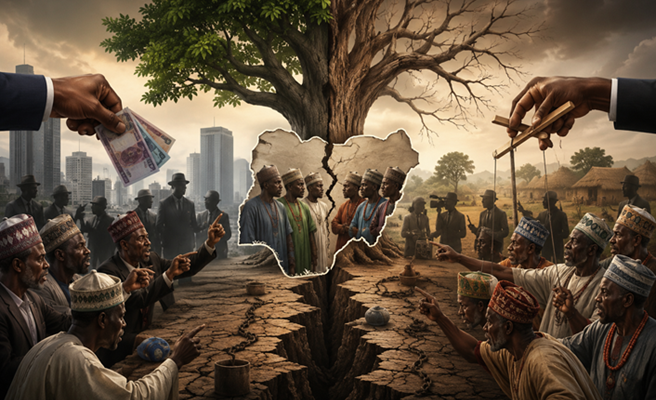

Tribal politics here means politics where people mainly vote, campaign, and make decisions based on ethnic/tribal identity , Hausa, Igbo, Yoruba, and 250+ other groups , instead of only on policy or competence.
It didn’t start in one day. It’s a mix of history, structure, and survival strategy.
HISTORICAL CAUSES

Colonial “Divide and Rule
The British governed Nigeria through “indirect rule”.
They used traditional rulers and grouped people by region/ethnicity. Census, education, and resources were also allocated by region.
This made people see the government as “our region vs their region
Regional Political Parties 1950s-1960s
NPC , mainly Northern/Hausa- Fulani base
NCNC , mainly Eastern/Igbo base
AG , mainly Western/Yoruba base
From the start, parties were built around ethnic leaders. So politics became about “which of us will lead.
Military Coups & Civil War 1966-1970
Coups were interpreted along ethnic lines. The civil war further deepened mistrust.
After that, “protecting our own” became a political strategy.
STRUCTURAL / INSTITUTIONAL CAUSES
Federal System and Federal Character
Nigeria’s 36 states were largely drawn along ethnic lines. Federal Character in the constitution says appointments/resources should reflect diversity.
Competition for Scarce Resources
Oil revenue goes to the center, then shared to states/LGAs. Jobs, contracts, schools, roads all come from the government.
When the “national cake” feels small, people rally with their group to get a bigger share.
Weak Political Ideology
Most parties don’t have clear ideological differences like “left vs right”.
So the easiest way to mobilize millions fast is language, culture, religion, and tribe.
. SOCIAL & ECONOMIC CAUSES
Identity & Security
In times of uncertainty, people trust “their own” more.
Ethnicity becomes a shortcut for trust: he speaks my language, he will not cheat us
Elite Manipulation
Politicians use ethnic/religious sentiment during campaigns to get votes. Slogans like “It’s our turn” or “They are marginalizing us” are powerful mobilizes.
Media & Social Media Echo Chambers
Online, people follow pages and influencers from their own group. Rumors spread faster when framed as “attack on our people
Migration & Urban Competition
When different groups compete for land, jobs, and market space in cities, ethnic associations become welfare and political networks.
EFFECTS OF TRIBAL POLITICS
Positive
Can promote inclusion, representation, and cultural pride. Federal Character has helped minority groups get access.
Negative
Merit is sometimes ignored and poor governance
National policies get delayed because of “zoning” fights
Increases suspicion, stereotypes, and occasional conflict
Makes accountability hard: “Don’t criticize our son”
WHAT REDUCES TRIBAL POLITICS?
Countries that moved past it usually did 3 things
Strong Institutions
Police, courts, INEC work fairly regardless of tribe
Issue-based Politics
Parties campaign on jobs, health, power, not just identity
Economic Opportunity
When people can succeed outside government contracts, ethnic bargaining reduces
National Orientation , Education, Civic education that emphasizes “Nigerian first” alongside ethnic pride.
Tribal politics in Nigeria arose from colonial structure , competition for resources , and weak institutions.
It’s not because Nigerians “like” division. It’s often a survival and representation strategy.
As governance gets more transparent and the economy creates more non-government jobs, we’re already seeing more young voters in 2023 and 2026 elections ask:
What’s your plan? instead of only Where are you from?
– Benjamin Ibrahim writes from Lokoja, Kogi state.
+2348069596250