
By Yusuf Nuhu
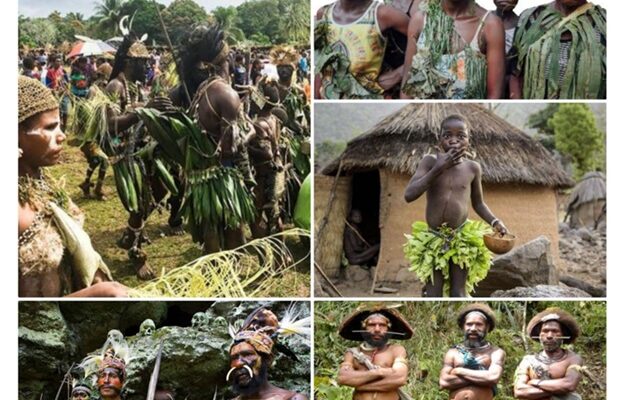
Across the world, some indigenous communities continue to preserve ancient cultural practices, including the use of leaves, bark, grass, and other natural materials as clothing. These traditions have beene passed down through generations and remain an important part of their identity, especially in remote regions where modern influences are limited.
Among the notable groups are the Koma people of Nigeria and Cameroon, the Korowai and Kombai tribes of Indonesia’s West Papua region, as well as the Baka and Efe peoples of Central Africa. While some members of these communities have adopted modern clothing, traditional attire made from natural materials is still used during cultural ceremonies and in isolated settlements.

The Koma people, who live in the mountainous areas along the Nigeria-Cameroon border, are among the most famous African groups known for wearing leaves and simple loincloths. They speak the Koma language, which belongs to the Niger-Congo language family. Their major occupations include farming, hunting, and gathering forest products. The Koma people are widely recognized for preserving their unique cultural heritage despite increasing modernization.
In Indonesia, the Korowai tribe remains one of the world’s most fascinating indigenous groups. They are known for their leaf- and bark-based clothing and their remarkable tree houses built high above the rainforest floor. The Korowai people depend largely on hunting, fishing, sago harvesting, and small-scale farming for survival. Their neighbors, the Kombai tribe, share similar traditions and rely mainly on hunting, gathering, and subsistence farming.
Central Africa is home to the Baka and Efe peoples, who have long maintained forest-based lifestyles. The Baka, found in Cameroon, Gabon, the Republic of Congo, and the Central African Republic, speak the Baka language and depend on hunting, gathering, and other forest resources. Similarly, the Efe people of the Democratic Republic of Congo are renowned rainforest hunter-gatherers whose livelihoods are closely tied to the natural environment.
These communities offer a rare glimpse into ancient ways of life that have survived into the modern era. Their traditions, languages, and cultural practices continue to attract the interest of researchers, tourists, and cultural historians around the world, highlighting the importance of preserving indigenous heritage for future generations.
– Yusuf Nuhu writes from Okene, Kogi state.