
By Muhammed Sherifdeen Omeiza
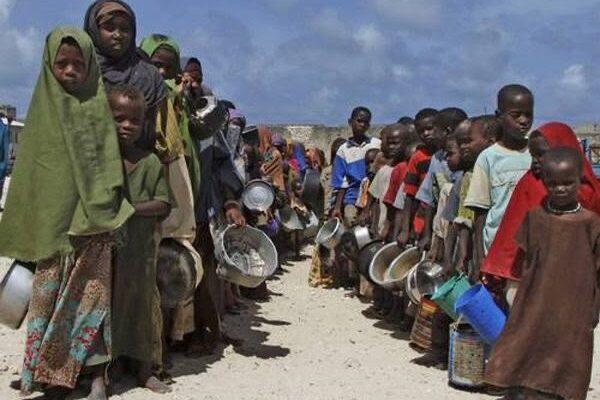
Somalia is facing another serious hunger crisis, but what makes the situation worrying is not only the number of people going hungry. It is the fact that drought, conflict, displacement and falling humanitarian support are happening at the same time. According to the Somali government and United Nations agencies, nearly 6.5 million people were facing high levels of hunger in early 2026, including about 2 million people experiencing emergency levels of hunger. More than 1.8 million children were also expected to suffer from acute malnutrition during 2026.
The crisis did not appear overnight. Somalia has experienced repeated droughts in recent years, and these have had a serious effect on communities that depend heavily on farming and livestock. When rain fails, farmers lose crops and pastoral families lose animals. For a family that depends on livestock for food and income, the death of animals means losing both what they eat and what they sell to survive.

But drought alone does not explain Somalia’s situation. Conflict has made the problem worse. Insecurity affects where people can live, where they can farm, where they can take their animals and where humanitarian organisations can provide assistance. Many families have therefore been forced to leave their homes in search of food and water. Once they become displaced, they often have very little left to depend on.
This is where the crisis becomes more difficult. A family that loses its animals because of drought may already be struggling. If conflict then forces that family to leave its home, it loses even more. If food prices rise and humanitarian assistance is reduced at the same time, the family’s ability to recover becomes even weaker.
The most worrying part is that humanitarian funding is also falling. The World Food Programme warned earlier this year that it needed 95 million dollars to continue supporting the most food insecure people in Somalia between March and August 2026. By May, the 2026 Somalia Humanitarian Needs and Response Plan was only 15.2 percent funded, while the United Nations reported that almost 90 percent of people in need were receiving little or no humanitarian support.
This creates a difficult situation. The number of people who need help is increasing, but the money available to provide that help is decreasing. Recent reporting from Médecins Sans Frontières also shows how serious the funding problem has become. The organisation reported that funding available for nutrition programmes in Somalia had fallen by more than 80 percent, while the number of malnutrition cases it treated increased sharply.
For me, the bigger question is not only how much food Somalia needs today. It is why the country continues to face the same type of crisis again and again.
Humanitarian assistance is necessary. When people are facing severe hunger, they cannot wait for long term development programmes to produce results. Food, water, medicine and treatment are needed immediately. But emergency assistance alone cannot solve a problem that keeps returning.
Somalia needs stronger systems that can help communities survive the next drought instead of waiting until the crisis becomes severe before responding. This means better access to water, stronger agricultural systems, support for livestock keepers, better early warning systems and investment in the communities that are most exposed to drought.
Peace is also important. It is difficult to build food security when conflict continues to destroy livelihoods and force people from their homes. A farmer cannot build a stable agricultural business when insecurity prevents access to farmland. A livestock keeper cannot protect his livelihood when water and grazing areas become difficult to reach.
There is also a lesson here for the rest of Africa. Somalia should not be seen only as a country with a humanitarian problem. Its situation shows how climate problems, conflict and weak economic systems can combine to create a much larger crisis.
Africa is already dealing with rising pressure on food systems. Droughts, floods, conflict and high food prices are affecting communities in different parts of the continent. The lesson from Somalia is that countries cannot wait until people are already hungry before thinking about food security.
Food security is not simply about having food available during an emergency. It is about building systems that allow people to produce food, earn an income and survive shocks without losing everything they have.
This is why the international community still has an important role to play in Somalia. The decline in humanitarian funding cannot be ignored when millions of people are facing hunger. But African countries also need to think beyond emergency assistance. The goal should be to reduce the number of people who need emergency assistance in the first place.
Somalia’s crisis is therefore not just a story about drought. It is a story about what happens when drought meets conflict, displacement and a shortage of resources to respond. Nearly 6.5 million people facing high levels of hunger is not just a statistic. Behind that number are families who have lost crops, livestock, homes and sources of income.
The real solution cannot be to wait for the next crisis and then ask the world for more food. Somalia needs support to survive today’s emergency, but it also needs investment that will make tomorrow’s emergency less destructive.
That is the difference between responding to hunger and building food security.
– Muhammed Sherifdeen Omeiza is a Nigerian researcher and writer whose work explores the intersection of humanitarian action, human rights, gender equality and global governance. With a keen interest in public policy, democracy, and political economy, he examines how local experiences and global decisions shape humanitarian outcomes in times of crisis. His writings draw from African and international contexts, reflecting a commitment to justice, accountability, and people-centered governance in global affairs.
Email: sherifdeenmuhammed001@gmail.com