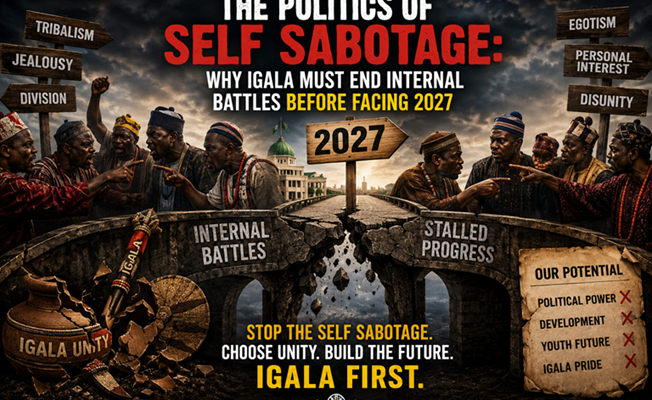

Politics is a bridge, not a battlefield. Yet for too long, Igala politics has resembled a house where its occupants keep widening the cracks in the foundation while expecting the roof to withstand every storm. As conversations around the 2027 elections gather momentum, the greatest threat to the Igala political future may not emerge from rival blocs or competing interests outside Kogi East. It may come from the entrenched culture of internal rivalry, personal vendettas, and fragmented leadership that repeatedly weakens collective bargaining power. A people who continually dig political trenches for one another should not be surprised when they all struggle to cross them.
History offers a consistent lesson. Communities that command enduring political influence are rarely those with the largest populations or the loudest voices. They are those that master strategic cohesion. Political disagreements are inevitable in every democracy, but mature societies distinguish competition from destruction. Unfortunately, political contests within Igala land have too often evolved into campaigns of permanent hostility, where yesterday’s allies become today’s adversaries and today’s victors become tomorrow’s targets. Such cycles consume energy that should be invested in policy, economic advancement, infrastructure, education, and youth development. Politics becomes an endless contest of personalities rather than a disciplined pursuit of public purpose.
The 2027 election should therefore represent more than another struggle for offices. It should become an opportunity for political reconstruction. That reconstruction begins with rebuilding trust among leaders, strengthening institutions instead of personalities, creating platforms for constructive dialogue, and accepting that disagreement need not produce division. No community achieves lasting relevance when every political season leaves deeper fractures than the one before it. Sustainable influence grows from unity of purpose, strategic negotiation, and disciplined leadership rather than emotional triumphalism.

This responsibility extends beyond politicians. Traditional institutions, religious leaders, professionals, youth organisations, women groups, and the wider electorate all possess a stake in reshaping the political culture. Citizens must reject the politics of character assassination, blind loyalty, and perpetual factionalism. They should demand competence, integrity, accountability, and measurable vision from every aspirant, regardless of family ties, financial influence, or political patronage. Democracy flourishes when voters reward ideas instead of insults and performance instead of propaganda.
The road to 2027 will test the political maturity of the Igala people. Elections come and go, but the consequences of political fragmentation can endure for generations. The time has come to fill the trenches instead of deepening them, to replace suspicion with strategic cooperation, and to recognise that no community rises by defeating itself. The future belongs not to those who shout the loudest within their ranks, but to those who possess the wisdom to stand together when history demands collective resolve.
– Inah Boniface Ocholi writes from Ayah – Igalamela/Odolu LGA, Kogi state.
08152094428 (SMS Only)