
Nigerian politicians belong to a distinct political class. While a few exceptional public servants use their offices to uplift their communities, the vast majority operate as a self-serving elite driven primarily by the privileges, patronage, and perks of power.
They exist in an unwritten brotherhood—a fraternity that remains intact until personal ambitions clash and access to power is threatened.
Over the past few months, the political landscape across the country has resembled a battleground. As election cycles approach, the jostling for party tickets and elective offices reaches a fever pitch. Allegations of betrayal fly in every direction, and the high-stakes drama surrounding party primaries and candidate selections leaves voters in perpetual uncertainty.

Yet, the most tragic aspect of this cycle is not the conduct of the political elite, but the blind loyalty of their supporters.
When political heavyweights clash, their followers routinely join the fray as eager foot soldiers. Too many loyalists refuse to learn from history, falling into the same trap election after election:
While politicians clash over tactical interests, followers internalize these rivalries emotionally, turning neighbors and friends with divergent views into sworn enemies.
When politicians inevitably patch up their differences behind closed doors, their partisan followers are left stranded—emotionally spent and politically abandoned.
Loyalists mistake an elite fight for personal survival for a genuine struggle for community development.
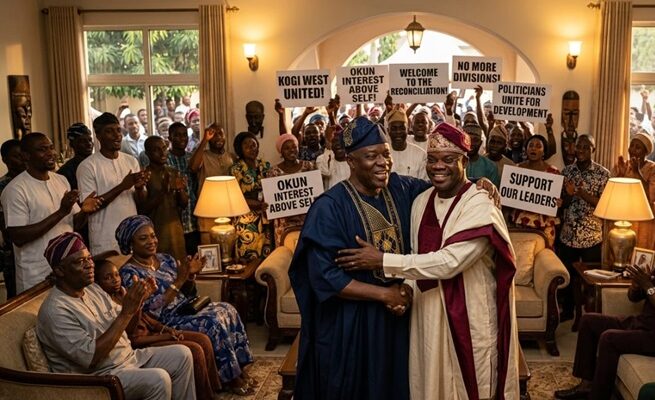
The political drama in Kogi West Senatorial District offers a textbook case of this phenomenon. Here, the line between political enmity and sudden friendship is razor-thin, blurred, and constantly redrawn to suit the needs of the moment.
Recently, the district has witnessed a flurry of high-profile visits. Politicians are making public pilgrimages to the residences of those they vilified only months ago. While peaceful coexistence is always welcome, framing these convenient reconciliations as sacrifices made “in the strategic interest of Okunland” is plain hogwash.
A second term in the National Assembly is a prize like no other. Reviving a fading political career is an existential priority for the politician—and neither has anything to do with the welfare of the people.
The reality behind these courteous visits and public displays of warmth is far simpler:
- These meetings are about calculated survival, acknowledging past overreach, and seeking forgiveness to secure new political lifelines.
- For seasoned politicians facing irrelevance, aligning with former adversaries is a necessary price to stay at the table.
3.In legislative politics, retaining a seat or securing a party nomination outweighs any past personal insult.
The people of Kogi West—and indeed Nigeria at large—know better than to accept these sudden reconciliations at face value. Genuine reconciliation that yields better governance is always welcome; political theatrics meant to secure personal advancement should be called what they are.
Until the electorate stops fighting the battles of a political class that reconciles the moment interests align, the public will remain spectators in a game played entirely for elite gain. Real progress will only begin when followers evaluate leaders by tangible achievements rather than temporary political alliances.
– Ponle Adeniyi
Email: ponleadeniyi457@gmail.com