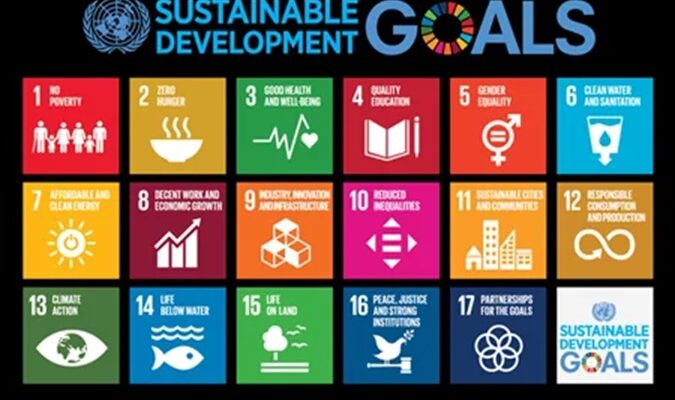

SDGs – Sustainable Development Goals. Think of them as the world’s to-do list to make life better for everyone by 2030.
The UN set 17 goals in 2015, and 193 countries signed up. They’re basically saying: “If we all chip in, here’s how we fix the biggest headaches humanity faces.”
The quick demystify
Forget the jargon. Each goal is just answering a simple question: “What would a decent world look like?”

The SDGs aren’t just for politicians in New York. They’re about stuff you already complain about:
For example
That PHCN bill + no light → Goals 7 + 9
Clean energy + better infrastructure .
Japa wave because jobs are scarce
→ Goals 8 + 10: Decent work + reduced inequality
. Fuel subsidy wahala and food prices → Goals 1, 2, 12: No poverty, zero hunger, responsible
consumption
ASUU strike every semester → Goal 4: Quality education
You’re already living the SDGs. When you tutor your neighbor’s kid, that’s Goal 4.
When you call out a bribe, that’s Goal 16.
When you reuse your takeaway containers, that’s Goal 12.
The big idea: They’re all connected
You can’t fix hunger without addressing poverty.
You can’t have good health without clean water.
You can’t have peace if climate change wipes out farms and people start fighting over land.
So the SDGs are like dominoes.
Push one in the right direction and others start falling too.
Push one the wrong way, and the rest get messy.
What can you actually do?
You don’t need to start an NGO tomorrow. Start micro:
- Learn: Pick 1 goal that fires you up. If it’s joblessness, that’s Goal 8.
- Act small: Buy from local businesses, mentor someone, waste less food.
- Speak up: Hold leaders accountable. If your LGA chairman promised boreholes = Goal 6. Ask for receipts.
- Vote with your wallet: Support brands that pay fair wages and don’t pollute. That’s Goals 8, 12, 13.
SDGs are just a fancy name for “let’s not leave anyone behind while we sort out the planet.” They’re not UN homework.
They’re a checklist for the kind of world we say we want during elections, Twitter rants, and 2am “Nigeria will be great again”
MDGs wrap-up & transition, 2015 • The Millennium Development Goals ran 2000–2015.
Nigeria’s end-point review found mixed results and said the country met less than 25% of the MDG targets.
- The SDGs were adopted by the UN in Sept 2015 as the MDGs’ successor.
Nigeria immediately domesticated the 2030 Agenda and began implementation in 2015. • Nigeria developed a Country Transition Strategy from MDGs to SDGs in 2015 to guide the shift.
The roadmap is structured around 7 themes: Institutional Framework;
Policy & Legal Framework;
Partnerships; Data, Monitoring & Reporting; Human Resources;
Communications; Financing.
Key roles Nigeria created for SDGs
Federal Government / OSSAP-SDGs
- Office of the Senior Special Assistant to the President on SDGs (OSSAP-SDGs) was reconstituted in Jan 2016 as the main implementing actor.
- -fold mandate: Strategic direction/planning/coordination; Representation/advocacy/partnerships; Resource mobilization/management; Monitoring, evaluation, documentation & reporting.
- Tasked to mainstream SDGs into MDAs’ sectoral policies and plans at national/sub-national levels.
State & Local Governments - SDGs implementation structure runs across federal, state, and local levels.
- Local Government is called “pivotal” because it can monitor millions of grassroots activities. LG Chairmen should have mandate to coordinate SDGs locally.
Civil Society Organizations (CSOs) - Roles: create awareness, mobilize private sector, monitor projects, empower marginalized groups, strengthen anti-corruption, advocate for state budgets to align with SDGs.
- Seen as critical partners because they represent underrepresented communities and fill service-delivery gaps.
Private Sector, Media, VOPEs, Citizens - Multi-stakeholder partnerships with private sector, media, and Voluntary Organizations for Professionals
- Citizens have a pivotal role in action and monitoring as primary beneficiaries.
2015→2026 • Nigeria did its first Voluntary National Review in 2017, but started SDG implementation late.
- Mid-term reviews 2019–2022 show progress has been “slow and poor,” hindered by corruption, poor health/education budgets, poverty, youth unemployment.
- As of 2026, Nigeria is in Phase 2 “Scale Up” and moving into Phase 3 “Leave No Nigerian Behind” from 2026–2030.
In conclusion implementation limitations
Insurgency in Nigeria is like a leak in the boat you’re using to achieve the SDGs.
You’re still rowing toward 2030, but you’re also bailing water the whole time.
The Boko Haram insurgency,
banditry, and other conflicts in the North East and parts of North West/Central Nigeria don’t just cause violence. They directly block or reverse progress on almost every SDG.
The 3 big ways insurgency
undermines all SDGS
Money gets redirected
Nigeria spends ∼15% of its budget on defense/security. Every naira used to fight insurgents or rebuild burnt villages is a naira not used for primary healthcare, school feeding, or rural electrification. Goal 16 bleeds Goal 1-15 dry.
Progress gets reversed
Borno State had 73% literacy in 2008. By 2022 it was under 30%. You can build 100 schools, but if 50 get burned down and teachers flee, you’re at -50 net. Insurgency creates “development in reverse.”
Trust collapses
SDGs need communities, government, and business working together = Goal 17. But when people don’t trust the army, the local chairman, or even their neighbor from another ethnicity, joint projects die. Insurgency fractures the partnerships needed to deliver everything else.
But it’s not all one-way: SDGs can also reduce insurgency
This is the flip side.
Insurgency thrives where SDGs are failing:
- Poverty + joblessness = Boko Haram recruitment pool → Goal 1 + 8
- Out-of-school youth = easy radicalization → Goal 4
- Climate-driven desertification = herder-farmer fights → Goals 13 + 15
- Perceived injustice/corruption = people lose faith in state → Goal 16
So fixing SDGs isn’t just “nice to have” while fighting insurgents. It’s actually part of the counter-insurgency strategy.
A 25-year-old in Maiduguri with a decent job, working school, and hope is way harder to recruit than one with nothing to lose.
Budget pressure: Defense gets huge allocations while health/education ministries fight for scraps.
IDP presence: Durumi, Wassa, and other IDP camps here are Goal 1, 2, 3,
Policy focus: “Stabilization” programs in the Northeast are basically SDG projects with armored vehicles. The govt knows you can’t shoot your way to peace — you need schools + jobs too.
The hard truth: Nigeria won’t hit most SDGs by 2030 if the North remains unstable.
The World Bank estimated insurgency has cost Nigeria 2.6% of GDP annually. That’s hospitals, roads, and power plants that never got built.
But the reverse is also true: Investing in SDGs 4, 8, 10, and 16 in the North is literally national security policy.
– Benjamin Ibrahim writes from Lokoja, Kogi state.
+2348069596250