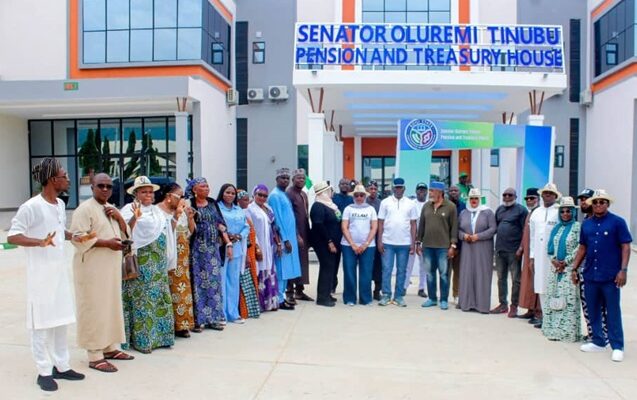

A pro-government advocacy group, Relax Tinubu Is Fixing Nigeria (RTIFN), has concluded a three-day tour of Kogi State as part of a nationwide campaign to publicize what it describes as the on-the-ground impact of President Bola Tinubu’s economic reforms.
The tour, led by RTIFN Deputy Director-General and Nollywood actor Zack Orji, took a delegation of the group’s officials to several state institutions and infrastructure projects in Lokoja and Kogi East, where members spoke with government officials, students, and residents. The delegation included the group’s Director of Town Hall and Special Duties, Farida Deborah Ibrahim, along with representatives from its media, youth, humanitarian, and women’s leadership arms.
Orji said the purpose of the visit was to give Nigerians what he called independent, firsthand evidence of how increased federal revenue allocations are being spent at the state level.

“We are here to showcase how the increased allocation to the state is affecting the lives of the citizens,” Orji said, adding that the group wanted to verify how resources “are being translated into development.”
The delegation toured a number of high-profile sites in Lokoja, including: the newly commissioned Senator Oluremi Tinubu Pension and Treasury House, the newly built Audit House. the International Market, Lokoja International Airport and sections of the Abuja–Lokoja concrete highway


At the Pension and Treasury House, Kogi State Auditor-General for Local Government Mark Okala told the delegation the facility was built to modernize the offices of the State Pension Commission and the Accountant-General, improving service to pensioners and public servants. Okala credited the state’s ability to fund the project to what he called an improved fiscal environment resulting from federal reforms that have increased monthly allocations to states.
The group similarly toured the new Audit House, now the permanent base for the offices of the Auditor-General for the state and local governments, which officials said was intended to strengthen oversight of government spending.
RTIFN, in its own account of the tour, attributed the rise in states’ monthly allocations from the Federation Account Allocation Committee (FAAC) to the federal government’s removal of the fuel subsidy and changes to the exchange rate regime — both of which have been central, and at times controversial, planks of the Tinubu administration’s economic policy since 2023, with critics pointing to the resulting rise in living costs alongside the government’s contention that the changes freed up revenue for states.
The delegation also visited two tertiary institutions — the Confluence University of Science and Technology (CUSTECH), Osara, and Kogi State University, Kabba — to meet students who have received support through the Nigerian Education Loan Fund (NELFUND).
NELFUND was established under the Student Loans (Access to Higher Education) Act, which Tinubu signed in 2024, and offers interest-free loans to students in public tertiary institutions to cover tuition and living costs. According to the fund, thousands of students nationwide have received disbursements since the program began.
One beneficiary, Emmanuel Augustine, a nursing science student at CUSTECH, told the delegation the program had removed a financial barrier that keeps some students out of school. “The NELFUND loan initiative has brought hope to universities across Nigeria,” he said, describing it as giving students “confidence to pursue academic goals without finances becoming a barrier.”
RTIFN commended Kogi State Governor Ahmed Usman Ododo for what it called complementary state-level investment alongside the federal government’s Renewed Hope Agenda, pointing to spending on public finance infrastructure, transportation, education, and institutional development.
The organization said the Kogi visit is part of an ongoing nationwide project-verification tour and reaffirmed its stated aim of providing Nigerians with what it calls factual, ground-level information about government policy through direct engagement with communities and beneficiaries.