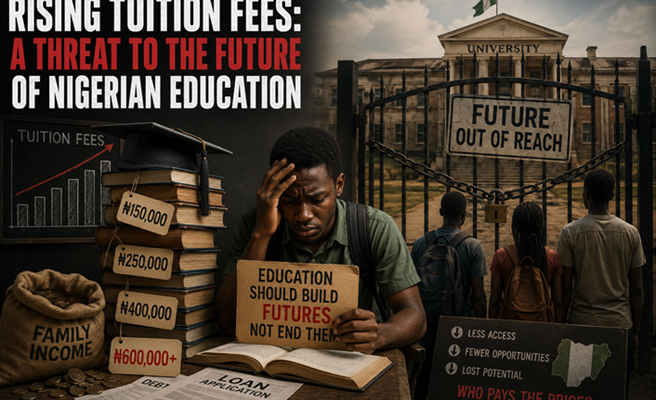

Education remains the bedrock of national development. Unfortunately, the continuous increase in tuition fees across Nigeria is gradually denying many young Nigerians access to higher education.
Ironically, many of those who support or approve these fee increases were themselves beneficiaries of free or highly subsidized education. They rose through an educational system built on the belief that education should be accessible to all, regardless of financial status.
During the administration of Chief Obafemi Awolowo and the UPN era, free education and free healthcare were cardinal policies that transformed countless lives. Likewise, under President Olusegun Obasanjo, the Universal Basic Education (UBE) programme strengthened access to free basic education, ensuring that millions of Nigerian children could attend school.

Today, the situation is different. Parents are struggling to survive, while many students are forced to suspend or completely abandon their education because they cannot afford the ever-rising cost of schooling.
Under the administration of President Bola Ahmed Tinubu, GCFR, Nigerians have experienced the removal of fuel subsidy, a significant increase in the cost of Premium Motor Spirit (PMS), changes to the Value Added Tax (VAT) system, rising electricity tariffs for many consumers, increases in transportation costs, higher telecommunications and data subscription costs, and rising tuition fees in many tertiary institutions. The costs associated with examinations such as WAEC, NECO, and other educational charges have also increased over time, placing additional pressure on parents and students. Combined with persistent inflation, the prices of food, housing, healthcare, and other essential goods and services have continued to rise.
Although the national minimum wage has been increased to ₦70,000, this amount is still inadequate for many Nigerian workers. With the current cost of living, it is difficult for an average family to afford food, rent, transportation, healthcare, and quality education for their children.
Another major concern is the poor maintenance of educational infrastructure. Many public schools and tertiary institutions continue to suffer from dilapidated classrooms, inadequate laboratories, overcrowded lecture halls, obsolete equipment, and insufficient learning facilities. Increasing tuition without making corresponding investments in infrastructure and the quality of education places an unfair burden on students and their families.
Education should never become the exclusive preserve of the rich. Governments at all levels should prioritize increased investment in education, rehabilitate existing infrastructure, expand scholarship and student-support programmes, and make higher education more affordable through meaningful subsidies.
A nation that makes education unaffordable risks denying itself the skilled workforce, innovation, and responsible leadership needed for sustainable development. Investing in education is not an expense—it is an investment in Nigeria’s future.
– Comrade Abduljelil Adabara El-Okene writes from Kogi State.