
By Muhammed Sherifdeeen Omeiza
Nigeria has always been a country where religion plays an important role in society. Millions of Nigerians are Muslims and Christians, and religious institutions have a strong influence on communities. This influence can be used to promote peace, but it can also become dangerous when religion is mixed with political competition, misinformation and violence.
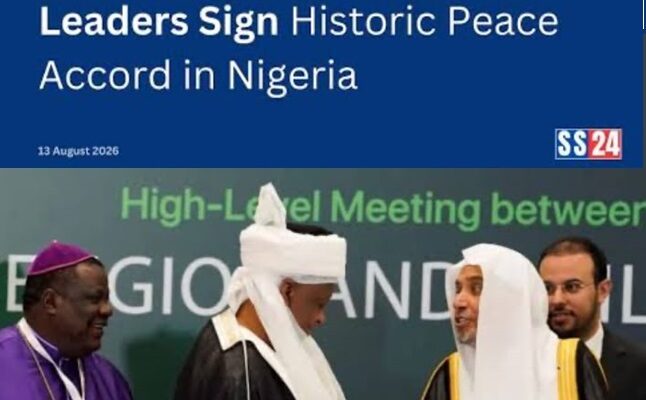
This is why the recent attempt by Muslim and Christian leaders to promote religious harmony deserves attention. More than 50 Muslim and Christian leaders signed a peace accord in Abuja on August 13, 2026, launching an interfaith body aimed at promoting religious harmony and reducing extremism and hate speech.

The agreement is important, but it also raises a bigger question.
Can dialogue between religious leaders actually reduce the divisions that have affected Nigeria for years?
The answer depends on what happens after the meetings and statements.
Nigeria’s religious differences are often discussed as if Muslims and Christians are naturally divided. This is not an accurate picture of everyday Nigerian life. People from both religions work together, trade together, attend the same schools and live in the same communities.
The problem becomes more serious when political actors use religious identity to gain support.
During elections, political competition can sometimes become a competition over who represents a particular religious group. Social media can make the situation worse by allowing false information, inflammatory messages and unverified claims to spread quickly.
This can create fear between communities.
The upcoming 2027 presidential election makes the issue even more important. Political parties and candidates will need to compete for votes in a country where religion remains an important part of political identity. The recent peace initiative therefore comes at an important time.
But religious leaders cannot solve the problem alone.
Political parties have a responsibility to avoid using religion as a tool for division. Government also needs to respond fairly when violence occurs, regardless of the identity of the victims or perpetrators.
This is important because people lose trust when they believe that government protects some communities more than others.
There is also a role for the media and social media users. False information about attacks, religious groups or political candidates can spread quickly and create anger before the truth is even established.
Nigeria therefore needs stronger systems for identifying and responding to misinformation, especially during elections and periods of tension.
Education is another important part of the solution.
Young Nigerians should learn not only about their own religious beliefs but also about the rights and beliefs of people from other communities. This does not require anyone to abandon their religion. It simply means understanding that religious difference does not have to become political hostility.
Most importantly, religious leaders need to speak against violence consistently, not only when it affects their own communities.
The recent peace accord is a positive step, but an agreement signed in Abuja will not automatically change what happens in villages, schools, markets and online communities.
The real test will be whether religious leaders continue speaking together when political tensions rise, whether political parties refuse to exploit religious differences and whether government responds fairly when communities are threatened.
Nigeria does not need everyone to believe the same thing.
It needs people to understand that they can believe different things and still belong to the same country.
Religious diversity is not Nigeria’s biggest problem.
The real danger begins when political competition turns that diversity into division.
Dialogue cannot solve every problem, but sustained dialogue, fair governance and responsible political leadership can make it much harder for religious differences to become a source of conflict.
– Muhammed Sherifdeen Omeiza is a Nigerian researcher and writer whose work explores the intersection of humanitarian action, human rights, gender equality and global governance. With a keen interest in public policy, democracy, and political economy, he examines how local experiences and global decisions shape humanitarian outcomes in times of crisis. His writings draw from African and international contexts, reflecting a commitment to justice, accountability, and people-centered governance in global affairs.
Email: sherifdeenmuhammed001@gmail.com