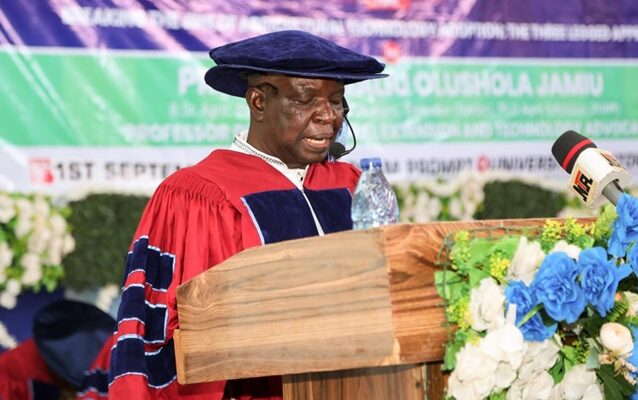

A professor of Agricultural Extension and Technology Advocacy has called on the Federal Government to establish a National Agricultural Development and Technology Transformation Commission (NADTTC) and adopt a “Three-Legged” model linking government, agro-industry and smallholder farmers, warning that Nigeria’s food insecurity persists not for lack of research, but for lack of adoption.
Professor Olushola Jamiu Saliu made the call while delivering the 26th Inaugural Lecture of Prince Abubakar Audu University (PAAU), Anyigba, titled “Breaking the Jinx of Agricultural Technology Adoption: The Three-Legged Approach,” on Tuesday at the University’s main auditorium.
Prof. Saliu explained that his proposed model rests on three mutually reinforcing pillars — government, which provides policy, funding and infrastructure; public/private agro-processing industries, which guarantee markets, cut post-harvest losses through storage and processing, and add value to raw produce; and organised smallholder farmer networks, which strengthen bargaining power, ease access to credit and shared machinery, and aggregate produce for large buyers.

“The three pillars synergise for food security,” he said, arguing that governments absorb policy risk, processors guarantee sales, and farmer groups share operational risk — removing barriers no single actor can overcome alone.
To institutionalise the model, he proposed expanding the existing National Agricultural Development Fund (NADF) into the NADTTC, empowering it to deliver infrastructure, drive privatisation through Public-Private Partnerships, and ensure accountable service delivery. He cited Okomu Oil Palm Company, Presco Oil and Psaltry International as existing examples of agro-processors running outgrower schemes with thousands of smallholder farmers, and noted that Nigeria attracted twenty agro-industrial investors from countries including China, Brazil, Singapore, Saudi Arabia, Germany, the United States, Norway and Switzerland between 2023 and 2026.
Specifically for Kogi State, Prof. Saliu recommended a public-private cashew processing factory in Anyigba, an oil palm processing plant spanning the Ajaokuta/Itobe axis and Alujuafara in Gbede, a cassava flour and ethanol industry in Ayetoro-Gbede, and a mega rice processing plant along the Omi River and River Niger in Kotonkarfe — each anchored by thousands of small-scale farmers as outgrowers.
The lecture drew on years of adoption research to illustrate the scale of the problem the model is meant to solve. Despite Nigeria’s 17 commodity-based research institutes, three international research centres, over 66 faculties of agriculture and the Agricultural Extension Research Liaison Services, uptake of proven technologies remains weak. Improved oil palm variety Tenera was sustained by only 29 percent of farmers, while just 0.7 percent of maize farmers tested their soil before applying fertiliser — a stark contrast, he said, to India, where fertiliser firms and state governments run free soil-testing programmes. Newcastle disease vaccination among poultry farmers stood at just 11.21 percent, and agroforestry adoption in Kogi and Benue states declined between 2008 and 2013 amid limited land, weak market access and an ageing farmer base without successors.
Prof. Saliu urged Nigerian universities to establish a dedicated Agricultural Extension and Technology Advancement Studies Department in every Faculty of Agriculture, describing extension as the pivotal link between research and the farmer’s field. He also called for the decentralisation and partial privatisation of agricultural services through Public-Private Partnership, cautioning that technology costs must not be left solely to private extension providers and agro-industrialists at the expense of smallholder farmers who drive much of the nation’s GDP.
Chairman of the Inaugural Lecture Committee, Professor S.S. Arogba, congratulated Prof. Saliu on the milestone and commended his contributions to the field. PAAU Vice-Chancellor, Professor Salisu Ogbo Usman, described the lecture — the ninth delivered since he assumed office in February 2026 — as evidence of a deepening research culture at the university, noting that many agricultural innovations “do not sufficiently translate into actual practices on farms” because, in his words, technology does not adopt itself.
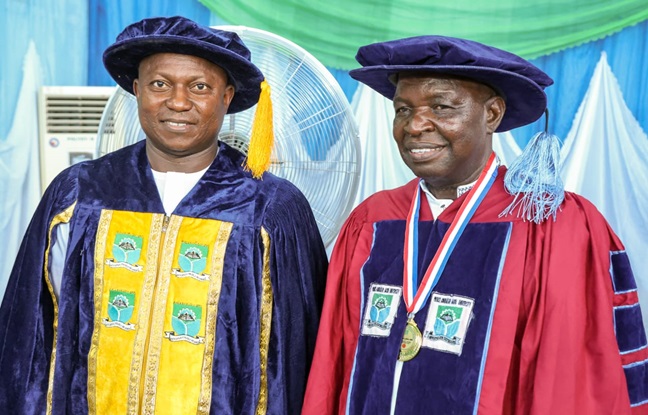
The event, which climaxed with the presentation of an inaugural lecture certificate, plaque and medal to Prof. Saliu, was attended by members of the University Governing Council, Management and Senate, academic and non-teaching staff, students, scholars from other institutions, and traditional and religious leaders.