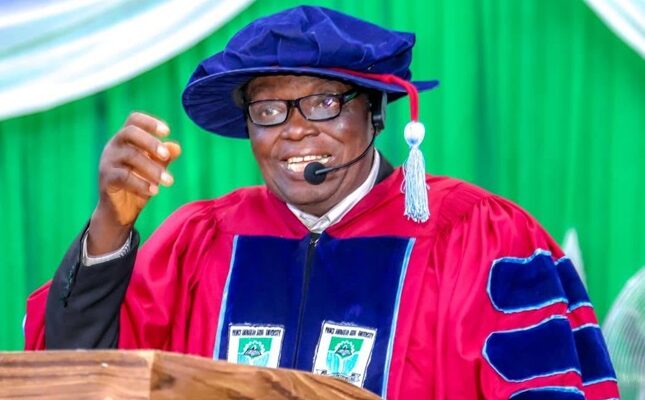

In a scathing critique of the systemic neglect confronting the nation’s educational sector, Professor of Science Education and Dean of the Faculty of Education at Prince Abubakar Audu University (PAAU), Anyigba, Professor Lawrence Achimugu, has warned that unrewarded teacher effort and severe underfunding are crippling the effective delivery of science education across Nigeria.
Delivering the institution’s 30th Inaugural Lecture on Tuesday, October 20, 2026, titled “Monkey De Work, Baboon De Chop: The Dark Shadow over Innovative Teaching Methods in Science Education,” the veteran scholar decried the stark imbalance where educators bear the heavy burden of adopting complex, modern teaching strategies while enduring poor remuneration, dilapidated infrastructure, and non-existent institutional support.
Professor Achimugu explained that the popular Pidgin metaphor “Monkey De Work, Baboon De Chop” vividly captures the plight of Nigerian science teachers who are expected to drive 21st-century learning innovations without commensurate rewards or basic tools. He stressed that when teachers perceive their immense labor as undervalued, their morale plummets, leaving revolutionary teaching concepts as mere theoretical ideas rather than active classroom experiences.

Highlighting the fundamental role of science education in fostering critical thinking, national development, and problem-solving skills, the Inaugural Lecturer stressed that effective teaching must move beyond traditional lecture methods to expose students to scientific investigation, hands-on experimentation, and real-world applications. He listed emerging, learner-centred approaches such as Inquiry-Based Learning, Problem-Based Learning, STEM, STEAM, digital laboratories, artificial intelligence-supported instruction, and flipped classrooms as crucial for preparing Nigerian youths for global competitiveness.
However, the don noted that the practical adoption of these modern frameworks in Nigeria faces formidable obstacles. Key among these are chronic underfunding, decaying laboratory facilities, erratic electricity supply, poor internet connectivity, overcrowded classrooms, weak policy implementation, and lack of continuous professional development for teachers. He observed that many science teachers remain largely unaware of advanced instructional methods, while others are forced back into traditional rote learning due to a lack of functional equipment and digital infrastructure, especially in rural schools.
Drawing from his distinguished 42-year teaching career spanning primary, secondary, and tertiary levels, Prof. Achimugu called on governments at all levels to immediately declare a state of emergency on teachers’ welfare and remuneration. To restore dignity to the profession and motivate educators, he advocated the urgent implementation of a dedicated “Living Salary Scale” alongside a comprehensive welfare package comprising annual leave allowances, furniture allowances, disturbance allowances for transfers, car refurbishment loans, and housing facilities. He further called for the reintroduction of special science allowances and recommended the compulsory acquisition of a Postgraduate Diploma in Education (PGDE) as a minimum teaching qualification for university lecturers to enhance pedagogical competence.
On macro-level funding, the Inaugural Lecturer urged the Federal Government to align national allocation with United Nations recommendations by committing 26 per cent of the national budget and 15 per cent of the Gross Domestic Product (GDP) to the education sector, underpinned by strict transparency, equity, and political will.
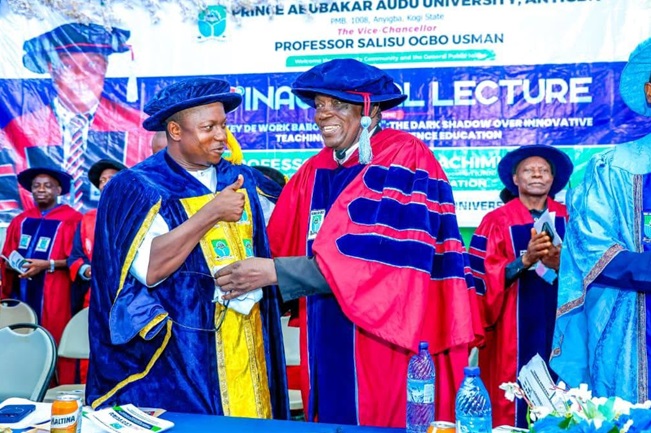
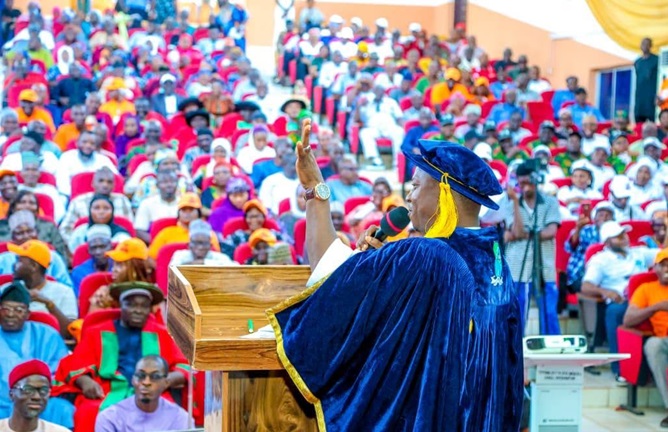
In his remarks, the Vice-Chancellor of PAAU, Professor Salisu Ogbo Usman, commended Prof. Achimugu for his exceptional contributions to scholarship, mentorship, and educational leadership over four decades.
Describing the lecture as timely and insightful, the Vice-Chancellor reiterated that science education remains the bedrock of any nation seeking to solve societal challenges in healthcare, agriculture, engineering, and technology.
He praised the Inaugural Lecture Committee, chaired by Prof. S. S. Arogba, for organizing a successful event that brought together scholars, university management, students, and distinguished guests to reflect on vital solutions for national growth.