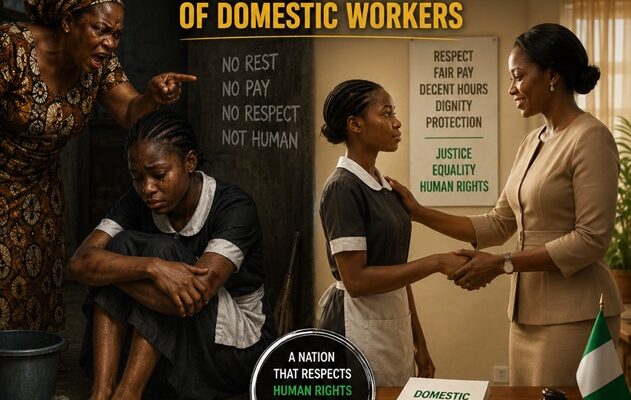

Justice is measured not by how a nation treats its most powerful citizens but by how it protects those with the least power. In Nigeria, domestic workers occupy one of the most vulnerable positions in society. They cook meals, clean homes, care for children, and support households, yet many remain invisible to the law until they are accused of wrongdoing. Reports of physical abuse, unpaid wages, arbitrary detention, forced confessions, and public humiliation reveal a disturbing pattern: the home, a place meant to provide safety, too often becomes a theatre of exploitation. A society that tolerates such injustice cannot credibly claim to uphold the rule of law.
The imbalance of power between employers and domestic staff has created a dangerous culture of impunity. A missing item, an unfounded suspicion, or a family dispute can swiftly become a criminal allegation, frequently without credible evidence or due process. In some instances, workers are assaulted, locked up, or handed over to law enforcement before any meaningful investigation is conducted. Equally troubling, genuine cases of theft or misconduct by domestic workers can provoke public outrage that eclipses the fundamental requirement of justice: every allegation must be established through evidence rather than assumption. Neither wealth nor poverty should determine credibility before the law.
This failure extends beyond individual households. Weak enforcement of labour protections, inadequate employment documentation, and limited access to legal representation leave many domestic workers defenceless. Informal employment arrangements often deny them written contracts, fair wages, reasonable working hours, or mechanisms for resolving disputes. Such conditions encourage exploitation while eroding public confidence in the justice system. A nation governed by law cannot permit employment relationships to operate outside legal accountability simply because they occur behind the walls of private residences.

Reform is both urgent and achievable. Domestic workers deserve enforceable employment contracts, timely payment of wages, humane working conditions, and effective legal protection against abuse. Employers deserve lawful mechanisms to address theft, fraud, or misconduct without resorting to violence or arbitrary punishment. Law enforcement agencies must investigate complaints impartially, rejecting mob justice, coercion, and prejudice. Legislators should strengthen labour protections for domestic workers, while civil society, faith communities, and the media must continue exposing abuse and promoting respect for human dignity. Justice cannot flourish where accountability is selective.
Nigeria’s aspiration to build a just society will remain incomplete if justice ends at the front gate of private homes. Domestic workers are not servants without rights; they are citizens entitled to the full protection of the Constitution and the law. Their dignity is neither negotiable nor conditional upon their occupation. A nation that safeguards the weakest strengthens the rights of everyone. Justice, if it is to deserve its name, must begin where power is most easily abused: at home.
– Inah Boniface Ocholi writes from Ayah – Igalamela/Odolu LGA, Kogi state.
08152094428 (SMS Only)