
By Arowolo Solomon Alaba
Some politicians campaign for an election. Others use an election to build for the next one.
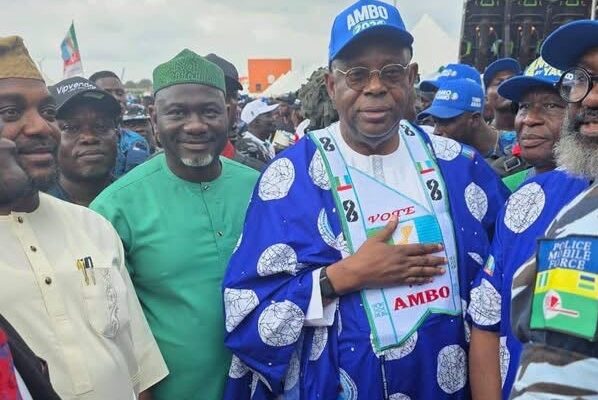
That distinction may explain why James Abiodun Faleke’s two-week presence in Osun deserves more than a passing glance. With the August 15 governorship election approaching, Faleke has moved into the state, not merely to add another political voice to the campaign for the APC candidate, Alhaji Bola Oyebamiji, but to engage the people and structures that determine whether political influence eventually becomes electoral strength.

His meetings with party stakeholders, political elders, traditional rulers, religious leaders, campaign officials and Asiwaju supporters may look like ordinary campaign activities. Taken together, however, they reveal something more deliberate: an attempt to reconnect the different strands of a political family and turn them into a functioning coalition.
But Faleke’s engagement has gone beyond the traditional APC political establishment. He has met student leaders, artisans, market women, members of the Igbo community, the Arewa community, former political office holders and ordinary citizens who simply wanted their concerns heard. He has also engaged candidates of the party preparing for the 2027 elections, from the State House of Assembly level upwards, urging them to mobilise and begin thinking beyond their individual contests.
That breadth is important.
A politician preparing for an election would normally concentrate on party officials, delegates, influential stakeholders and organised supporters. Faleke appears to have deliberately widened the circle. By sitting with artisans and market women, engaging student leaders and community groups, reaching out to ethnic communities and listening to citizens without obvious political leverage, he has attempted to understand the election from the perspective of people who experience politics differently from those who operate within formal party structures.
That matters because Osun is not just another electoral battleground. It is one of the states where the politics of the South-West, the fortunes of the APC and the political standing of President Bola Ahmed Tinubu intersect.
The numbers from 2023 tell an interesting story. Atiku Abubakar secured 354,366 votes in Osun, while Tinubu polled 343,945—a difference of 10,421 votes. It was a defeat, but not a political collapse. If anything, the result showed that the APC had a considerable base in the state but had not succeeded in bringing all its political assets into one effective electoral machine.
The question ahead is whether that gap can be closed, and whether the lessons of 2023 can be converted into a stronger structure before 2027.
This is where Faleke’s method becomes interesting.
He is not approaching Osun as a place where one simply arrives, rallies supporters and leaves after the votes are counted. His engagements suggest a different understanding of political work: that before votes can be mobilised, relationships must be managed; before structures can function, people must believe in them; and before a coalition can win, its different interests must first find a reason to work together.
His consultation with Alhaji Kamis Tunde Badmus, the Asiwaju Musulumi of Yorubaland, his visit to the Oluwo of Iwo, Oba Abdulrasheed Adewale Akanbi, and his meetings with Chief Bisi Akande and former Governor Adegboyega Oyetola are significant against this background.
These are not simply names on a campaign itinerary. They represent different layers of political influence, history and community networks.
There is a certain logic to Faleke’s movement through these circles. The party elder provides institutional memory; the former governor provides political experience; the traditional ruler provides community influence; the religious leader connects with another important constituency; the campaign structure provides machinery; and the grassroots supporters provide the numbers.
The engagement with former Ekiti State Governor Ayo Fayose adds another interesting dimension. Fayose’s political experience and understanding of South-West politics make him a significant political actor beyond the immediate boundaries of Osun. Faleke’s decision to engage him suggests that his approach is not necessarily about speaking only with those who already belong to the same political camp.
In politics, sometimes the most useful conversations are those held across political boundaries.
The same logic appears in his engagement with the leadership of the Accord Party. The reported endorsement of Oyebamiji by a factional chairman of the party demonstrates the potential value of reaching beyond the conventional APC political family.
Whether such endorsements eventually translate into votes is a separate question. But politically, they illustrate an important principle: elections are often won by expanding coalitions, not merely by energising existing supporters.
Faleke has also taken the campaign to the streets.
His walk for Oyebamiji through Osogbo was more than a photo opportunity. In an election where visibility, turnout and last-minute persuasion can matter, taking the campaign directly to the streets sends a different message from holding meetings inside conference rooms. It places the campaign physically among the people and allows supporters to see political leaders participating in the mobilisation rather than simply directing it.
Faleke has also made time for people who may not ordinarily command political attention.
His meetings with ordinary citizens who wanted government or political leaders to listen to them may appear small when compared with meetings involving traditional rulers or senior politicians. But those encounters matter because elections are ultimately about people whose names do not appear on party registers of influence.
The voter who feels ignored may not attend a stakeholder meeting. The artisan may not have access to a political office holder. The market woman may not sit at a strategy table. The student leader may not control a traditional political structure.
But each belongs to a constituency.
And constituencies become votes.
Faleke has also engaged the party’s candidates for the 2027 elections, from the State House of Assembly level upwards, urging them to debate, mobilise and begin working together ahead of the next electoral cycle.
This is perhaps one of the clearest signs that his Osun assignment has a horizon beyond August 15.
By engaging candidates who will contest elections in 2027, Faleke is effectively encouraging them to see themselves as components of a larger electoral ecosystem. Their individual ambitions may be different, but their political survival and success may ultimately depend on the strength of the same structure.
That is the difference between campaigning for an election and building for the next one.
Faleke has spent enough time around the Tinubu political ecosystem to understand that political movements are rarely sustained by one institution alone. His experience with the Tinubu Support Group before the 2023 presidential election exposed him to the value of networks operating beyond the formal boundaries of the APC.
Support groups, volunteers, professionals, community organisers and independent political actors can become powerful extensions of a campaign when they are properly coordinated.
His current call on Asiwaju supporters and support groups in Osun to join the mobilisation therefore carries a wider significance. It suggests an attempt to draw the broader Tinubu political family into the APC’s immediate electoral project while preserving the larger objective of building a stronger political network.
There is also something revealing about Faleke’s decision to be physically present in Osun at this stage of the campaign.
Politics rewards visibility, but serious political organisation demands proximity.
There is a difference between sending people into the field and going into the field with them; between receiving reports and sitting across the table from stakeholders; between asking supporters to mobilise and sharing the political burden with them.
Faleke’s presence sends a simple message: this assignment matters.
In politics, such signals can carry considerable weight, particularly when party members are being asked to put aside individual interests and work towards a collective objective.
Yet the real test will not be the photographs, meetings or rallies.
It will be what those engagements produce.
Can old relationships be strengthened?
Can competing interests be managed?
Can support groups, party structures and grassroots actors operate with greater coordination?
Can the APC translate its political presence into votes?
These are the questions that will determine whether the current mobilisation becomes a temporary campaign exercise or the beginning of something more durable.
There is another development that makes the final days of the campaign particularly interesting.
An NGO reportedly backed by funding and support linked to the European Union had released a report more than two weeks before the election which suggested a difficult outlook for the APC. Yet, three days before the election, the same organisation reportedly described the contest as much closer, with the APC increasingly in contention.
That change in assessment is noteworthy, particularly because it has come after a period of intense mobilisation across the state.
It would, however, be too simplistic to attribute every movement in public opinion to one individual or one campaign. Elections are complex. Voters respond to candidates, local interests, party structures, campaign messaging, economic realities and a host of other factors.
But the shift does raise an important political question: can sustained, intensive grassroots mobilisation alter the trajectory of an election that previously appeared to be leaning in another direction?
Osun may provide an answer tomorrow.
If Oyebamiji emerges victorious, the final two weeks will inevitably come under scrutiny. Analysts will examine the candidate’s appeal, the party’s organisation, local political structures, stakeholder engagement and the impact of the final stretch of mobilisation.
Faleke’s role will undoubtedly form part of that conversation.
Indeed, if the APC wins, Faleke could emerge as one of the most significant figures in the party’s final-week mobilisation—perhaps even the MVP of the election from the perspective of campaign organisation.
Not because one individual wins an election alone.
Elections are never won by one man.
But Faleke’s contribution appears unusually broad.
He has engaged political elders, party structures, traditional institutions, religious constituencies, ethnic communities, students, artisans, market women, former political office holders, opposition figures, candidates and ordinary citizens.
That is a remarkably wide political canvas.
For Tinubu, the stakes are bigger than the Osun governorship election.
The 2023 presidential result showed that the President was within striking distance of victory in the state. A margin of 10,421 votes is small enough to invite a serious political rethink.
But closing that gap will not happen through election-week enthusiasm.
It requires months and years of relationship-building, stronger grassroots organisation, better communication and the ability to keep different political interests within the same tent.
The political machinery required for 2027 cannot be assembled in 2027.
It has to be built now.
This may ultimately be the greater significance of Faleke’s Osun assignment.
The immediate objective is straightforward: help the APC secure victory for Oyebamiji.
The longer-term objective is more strategic: strengthen the political network around Tinubu in a state where the President came close to winning but did not.
Between those two objectives lies the real work of political organisation.
Faleke’s style has often been less about making noise and more about making connections.
In a political environment where loyalty is sometimes measured by public declarations, there is another form of loyalty that is quieter: showing up, keeping relationships alive, bringing people together and remaining useful when the political temperature changes.
That kind of political capital does not always make headlines, but it often becomes valuable when elections arrive.
Osun, therefore, presents Faleke with an interesting political laboratory.
Can a fragmented political base be consolidated?
Can different generations of political actors find common ground?
Can formal APC structures work effectively with the wider Asiwaju support network?
Can political actors across party lines be persuaded to support a common objective?
Can grassroots mobilisation convert political conversations into votes?
And can the lessons of 2023 be converted into a more formidable electoral strategy for 2027?
The answers will not be found in one rally.
They will be found in the structure that remains after the rally is over.
That is why the August 15 election is important, but it is not the whole story.
The immediate winner will be determined by the ballot.
The longer-term political value will be determined by what the APC builds afterwards.
There is, however, another dimension that should not be overlooked.
Faleke’s political relevance has increasingly rested on his ability to operate at the intersection of political leadership and political organisation. He is not necessarily the loudest figure in the room, nor does he always seek to dominate the political conversation. His strength appears to lie in understanding how political networks work: who needs to be consulted, who needs to be brought closer, where grievances exist, and how seemingly separate interests can be connected to a common purpose.
That skill becomes particularly important in a state like Osun, where political loyalty cannot simply be assumed. Elections are shaped not only by party labels but by personalities, local structures, longstanding relationships and the ability of political actors to translate influence into actual mobilisation.
A candidate may have the party structure behind him, but the strength of that structure depends largely on whether the people who control its different layers are genuinely working together.
Faleke’s Osun intervention therefore deserves to be viewed as more than a short-term assignment. It offers him an opportunity to test a model of political organisation in which institutional party structures, grassroots actors, traditional institutions, support groups and influential individuals are not treated as competing centres of power but as complementary parts of one political ecosystem.
If that model works in Osun, its implications could extend beyond August 15.
There is also a lesson here for the wider APC.
Political parties often become strongest when they learn from defeat rather than merely explain it.
The 2023 presidential election in Osun offered the APC a warning: having a substantial support base is not the same thing as having an efficiently coordinated electoral structure.
The difference between 343,945 votes and 354,366 votes was not an insurmountable political gulf. It was a reminder that elections can be decided by the effectiveness with which political organisations convert relationships, goodwill and support into votes.
That is why the real measure of Faleke’s intervention may emerge after the election.
If the relationships cultivated during these two weeks continue beyond the campaign, if support groups remain connected, if party stakeholders remain engaged and if grassroots structures become more coordinated, then Osun may have produced something more important than an election result.
It may have produced a template.
And templates are valuable in politics because they can be replicated.
The road to 2027 will require more than presidential popularity or party machinery. It will require political actors who can build bridges between Abuja and the grassroots, between formal party structures and informal support networks, and between established political figures and emerging actors.
Those who can perform that role effectively will become increasingly important as the political contest approaches.
In that sense, Faleke’s Osun assignment may also be a test of his own political proposition: that influence is most valuable when it can be organised, relationships are most useful when they can be sustained, and political loyalty matters most when it can produce collective action.
That may be the quiet story unfolding in Osun.
The streets, meetings and consultations are the visible part.
The less visible part is the rebuilding of political relationships and the search for a structure strong enough to carry those relationships into 2027.
The politics of 2027 is already underway.
It is being built not only at campaign rallies, but in rooms where political elders are consulted, in communities where supporters are mobilised, in conversations where old differences are negotiated and in networks where loyalty is converted into organisation.
Osun is therefore more than an election.
It is a rehearsal for a bigger political battle.
And Faleke, true to the role he has increasingly carved out for himself, appears to understand that the best way to prepare for tomorrow’s contest is to start building today.
– Arowolo Solomon Alaba is a veteran journalist and PhD student whose research focuses on governance, political communication and democratic institutions.