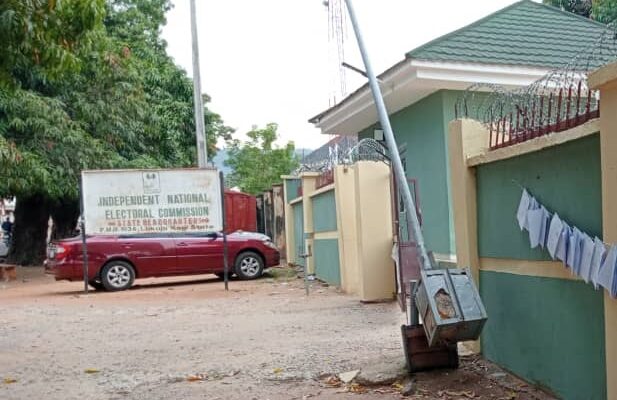

– Congress for Better Kogi State demands immediate review of the disputed constituencies and full disclosure of the legal authority behind their creation
The Congress for Better Kogi State is giving the Independent National Electoral Commission (INEC) fourteen days to review and reverse what we consider the unlawful creation of three new State House of Assembly constituencies in Kogi East, or be prepared to defend the action in court.
We are making this demand because there is a fundamental difference between restoring a constituency that previously existed and creating a constituency that never existed in the first place. That distinction is not a matter of political interpretation. It is a matter of law, history, and constitutional procedure.

INEC has presented the recent exercise in Kogi as a restoration of previously suppressed constituencies. If that is the position of the Commission, then the Commission must be able to demonstrate, with verifiable records, that every constituency described as restored actually existed before it was suppressed.
Where is the historical record of these three constituencies? Where are the original constituency boundaries? Where are the previous electoral maps, constituency codes, election records, and other official INEC records establishing their prior existence? And, most importantly, what specific judicial order or constitutional process authorised their restoration or creation? These are straightforward questions. They deserve straightforward answers.
The Congress for Better Kogi State is particularly concerned about the emergence of three additional State Assembly constituencies in Kogi East. The issue before the public is not whether the people of Kogi East deserve adequate political representation. They do. The issue is whether the number of constituencies can be increased through an administrative decision that cannot be clearly traced to a constitutionally valid process or a verifiable judicial order.
Restoration presupposes prior existence; you cannot restore what never existed.
If these three constituencies were genuinely suppressed constituencies, INEC should publish the historical records establishing that fact. If their creation was ordered by a competent court, the Commission should identify the case, publish the judgment or enrolled order, and clearly state the specific relief granted by the court.
Public statements, media reports and references to court cases are not substitutes for the actual judgment.
We therefore call on the Chairman of the Independent National Electoral Commission, Prof. Joash Amupitan, SAN, to personally cause an immediate administrative and legal review of the matter.
As a lawyer and as the head of an institution entrusted with the integrity of Nigeria’s electoral system, the INEC Chairman has a responsibility to ensure that every constituency delineation undertaken by the Commission can withstand constitutional, statutory and judicial scrutiny.
The Constitution of the Federal Republic of Nigeria provides the framework for the establishment and delineation of State constituencies. Sections 91, 112, 113, 114 and 115 impose clear constitutional considerations concerning the composition of State Houses of Assembly, constituency delineation, population equality, periodic review and the legal effect of boundary alterations.
These provisions cannot be treated as optional administrative guidelines, nor can the restoration of constituencies become a mechanism for introducing entirely new constituencies without a demonstrable historical or constitutional foundation.
We are aware that there have been judicial proceedings concerning suppressed constituencies in Kogi State and that various public reports have referred to court judgments in connection with the restoration exercise.
That is precisely why INEC must put the matter beyond doubt.
Let the Commission produce the actual judicial authority upon which each disputed constituency rests; let the public see the case number, parties, date of judgment, court, judge and operative orders; let INEC show the historical records proving that the three disputed constituencies existed before their alleged suppression; let the Commission also explain the constitutional and administrative process through which the present boundaries were determined.
If the records establish that these constituencies genuinely existed and were lawfully ordered to be restored, there should be no difficulty in demonstrating it.
But if the records do not establish their prior existence, or if the judicial authority being relied upon does not authorise what INEC has done, then the Commission must have the courage to correct the decision.
This is not an attack on Kogi East; it is not an attack on the Igala people; it is not an argument against equitable political representation.
The people of Kogi East, like every other part of Kogi State, are entitled to fair and lawful representation. But no part of the state should receive representation through a process that cannot be justified by the Constitution and the law.
We cannot build a credible electoral system by allowing administrative convenience to replace constitutional procedure.
The danger goes beyond Kogi East. If an electoral constituency can simply be created and described as “restored” without clear historical evidence, judicial authority, and compliance with the constitutional framework, then the integrity of constituency delineation across Nigeria is placed at risk; that is why this matter must not be dismissed as a local political disagreement.
The Congress for Better Kogi State therefore demands that INEC, within fourteen (14) days of this publication:
1. Conduct and publish a formal review of the three disputed Kogi East State Assembly constituencies.
2. Produce the verifiable historical INEC records establishing the prior existence of each constituency claimed to have been restored.
3. Publish the specific judgment, enrolled order or other valid legal instrument upon which the restoration or creation of each disputed constituency is based.
4. Clearly identify the boundaries, constituent wards and areas covered by each constituency and explain the legal and administrative basis for those boundaries.
5. Where the Commission cannot establish that any of the three constituencies previously existed or cannot demonstrate a valid legal authority for their creation or restoration, reverse the decision immediately.
Our position is simple: restore what was lawfully suppressed; do not create what never existed without the legal and constitutional framework
We also call on the INEC emphatically to conduct a full forensic investigation on the purported court judgment that has been used to allegedly mislead the INCE to commuting this fundamental institutional error.
We are giving INEC fourteen days because this matter affects the integrity of electoral representation and cannot be allowed to drift indefinitely.
At the expiration of the fourteen-day period, if the Commission fails to provide a satisfactory explanation and fails to reverse any constituency whose creation cannot be justified in law, the Congress for Better Kogi State will commence appropriate legal proceedings against the decision.
Our lawyers are prepared to seek all appropriate reliefs available under the law, including declaratory and injunctive reliefs and any other orders necessary to compel compliance with the Constitution and protect the integrity of constituency delineation in Kogi State.
We would prefer that this matter be resolved administratively and transparently. We would rather see INEC review the records, correct any errors, and move forward with an electoral process that enjoys public confidence.
But where constitutional questions are raised, and legitimate demands for verification are ignored, litigation becomes the responsible next step.
The integrity of our electoral system is bigger than any individual, political party, ethnic group or constituency.
Kogi belongs to all of us; its electoral boundaries must therefore be created, restored and altered according to the Constitution, the law and verifiable facts and not political convenience.
INEC has fourteen days to do the right thing.
After fourteen days, we will take the next lawful step.
– Nayo Jude Babtunde-Uyi
Convener
Congress for Better Kogi State
Abuja, Nigeria