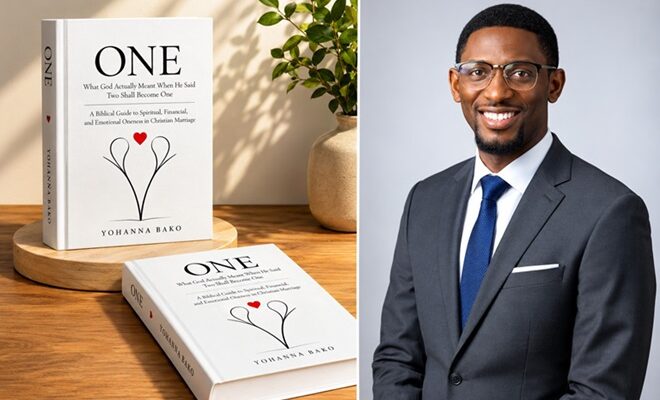

Before the first page is turned, Dr. Yohanna Bako asks a question that hangs over every Christian marriage, whether thriving, surviving, or quietly fading into routine. “Are we actually one?” It is a disarming question because it refuses the comfort of appearances. A marriage may be stable without being whole. It may endure without becoming what God intended. That single question becomes the pulse of ONE: What God Actually Meant When He Said Two Shall Become One, a book that is less interested in repairing marriages than in redefining how Christians understand them.
This is not another Christian marriage manual. It does not open with communication tips or the familiar catalogue of conflict resolution, intimacy, and budgeting. Bako begins much further upstream. He returns to Genesis. He insists that every conversation about marriage begins with origin. Who designed it? By whose definition does it exist? Until those questions are settled, every practical solution remains cosmetic.
There is courage in this approach. In an age of self-help formulas and therapeutic shortcuts, Bako chooses theology over technique. He argues patiently, chapter after chapter, that marriage is not primarily about happiness, compatibility, or even companionship. It is about covenant. It is about oneness. Everything else flows from that centre.

The finest quality of ONE is neither its theology nor its practical advice. It is its voice.
Bako writes with uncommon restraint. He trusts silence. He trusts cadence. He allows an idea to breathe before pressing his conclusion. The opening pages read like literary nonfiction. The prose carries echoes of Eugene Peterson, Tim Keller, and C.S. Lewis, yet it never feels derivative. His sentences move with quiet confidence. They persuade rather than perform.
The preface alone demonstrates this gift. He recounts eight years of marriage, migration, financial struggle, the painful decision to send a young son back to Nigeria while he and his wife rebuilt their lives abroad. These moments never descend into emotional exhibitionism. Personal experience is offered as evidence of wrestling, not proof of authority. “My marriage is one data point. The Word of God is the standard,” he writes. It is perhaps the most important sentence in the entire book because it establishes both his humility and his ambition. ONE_PB
The structure reflects similar discipline. Twelve chapters unfold almost architecturally. Foundations come before applications. Spirit before finances. Identity before parenting. Each section feels deliberately placed, reinforcing the author’s conviction that healthy marriages are built, not improvised.
Yet books deserve more than admiration. They deserve interrogation.
ONE occasionally mistakes certainty for completeness.
Bako writes from a firmly conservative evangelical position. Readers know exactly where he stands on biblical authority, gender, covenant, and the meaning of marriage. There is integrity in that clarity. There is also risk. Alternative theological interpretations rarely receive sustained engagement. Counterarguments appear only briefly before the author returns to his preferred reading. The result is a book that persuades believers already standing near its theological neighbourhood more easily than those approaching from elsewhere.
Its engagement with the realities of contemporary marriage is similarly uneven.
For a work so attentive to Scripture, it gives comparatively little attention to the insights of psychology, sociology, trauma studies, or modern counselling. Marriage is treated almost exclusively as a theological institution. That choice gives the book coherence. It also narrows its conversation. Human relationships often collapse under burdens that demand both biblical wisdom and psychological understanding. ONE strongly offers the former. It is less interested in the latter.
There are moments, too, when repetition weakens momentum. Because oneness governs every chapter, certain arguments return in slightly altered forms. The writing remains elegant, yet the rhythm occasionally circles ground already won. A leaner manuscript might have sharpened its impact.
Still, these criticisms emerge precisely because the book invites serious reading. Lightweight books rarely deserve careful criticism.
Perhaps the book’s greatest achievement lies in its refusal to romanticise marriage.
Many Christian books speak of marriage as though love naturally deepens with time. Bako argues the opposite. Distance grows quietly. Drift rarely announces itself. Two people sitting at the same dinner table may already be living separate lives. His fictional prologue captures this with painful accuracy. There is no shouting. No betrayal. Only two faithful people who have gradually stopped reaching for each other. It is one of the finest pieces of writing in the book because it recognises that many marriages die by inches rather than explosions.
That insight feels especially relevant in Nigeria.
Public conversations about marriage have become increasingly polarised. Social media celebrates extravagant weddings while quietly ignoring ordinary marriages. Church conferences promise effortless harmony. Online cynicism dismisses marriage altogether. Between these competing narratives stands ONE, refusing both fantasy and despair. It argues that lasting marriages depend neither on chemistry nor performance but on disciplined faithfulness shaped by Scripture.
Whether readers agree with every theological conclusion almost becomes a secondary question.
The deeper achievement of ONE is that it restores seriousness to marriage. It asks Christians to think before they celebrate. To study before they imitate. To build before they decorate.
Books rarely change institutions.
They change conversations.
Yohanna Bako has written one that deserves to enter Nigeria’s conversation about marriage. It is thoughtful without being academic. Personal without becoming sentimental. Convictional without descending into polemic. It is not a flawless book. At times it is longer than necessary, more certain than curious, and more theological than interdisciplinary.
Yet it remains one of the most intellectually substantial books on Christian marriage written by a Nigerian author in recent years.