
Democracy was supposed to dismantle the politics of masters and servants, yet Nigeria increasingly resembles a republic struggling to escape its feudal past. Political mafian patrons distribute opportunities, loyalists compete for access, and ordinary citizens depend on the goodwill of powerful individuals. The ballot remains, but citizenship is losing its meaning.
The resemblance is rooted in political patronage. Under medieval feudalism, lords controlled land, resources and protection, while serfs depended on their authority for survival. Nigeria is not a feudal society in the legal sense, but its patron-client relationships increasingly reproduce similar inequalities. Political access becomes a privilege rather than a right.
Political godfatherism has become one of the most visible expressions of this arrangement. Wealthy sponsors finance ambitions, influence party nominations and expect loyalty from beneficiaries who eventually occupy public offices. Political authority then risks becoming an extension of private investment, with elected representatives answering to their sponsors before the electorate.

Nigerian political scientist Isaac Olawale Albert examined this phenomenon in his 2005 study, Explaining Godfatherism in Nigerian Politics. He identified how political godfathers build loyal networks, manipulate political participation and restrict democratic competition. Two decades later, subsequent scholarship continues to examine the persistence of these patronage relationships across Nigeria’s political landscape.
The electoral process reveals another dimension of this democratic contradiction. When poverty becomes widespread, financial inducements can exploit citizens’ immediate desperation. A voter who should freely evaluate candidates and policies may instead face pressure to exchange a constitutional right for temporary relief. The ballot becomes a transaction rather than an instrument of accountability.
In their 2022 Chatham House study, Leena Koni Hoffmann and Raj Navanit Patel examined vote-selling and democratic dissatisfaction in Nigeria. They explained how economic hardship can trap citizens in self-defeating relationships with political patrons. This creates a dangerous cycle: poverty weakens political independence, while clientelism undermines demands for better governance.
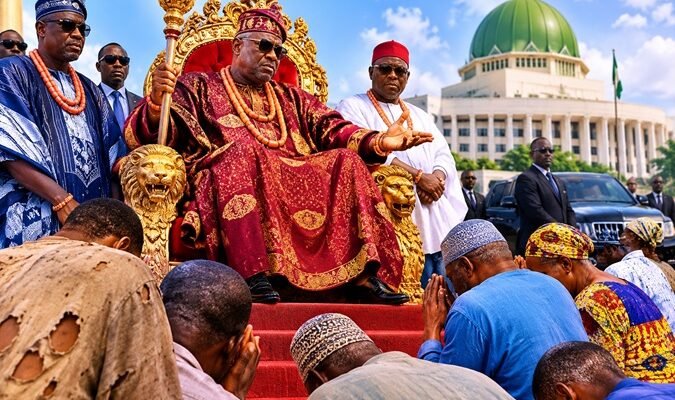
The problem also deserves attention at the grassroots, where political influence, customary authority and control over community resources sometimes intersect. Traditional institutions have legitimate cultural and historical responsibilities, but those responsibilities must operate within constitutional boundaries. No citizen should require personal submission to a powerful individual to secure lawful rights or opportunities.
Lord Acton offered a warning that remains relevant to every political system: “Power tends to corrupt, and absolute power corrupts absolutely.” His observation exposes the danger of concentrating political influence in a few hands. When loyalty replaces accountability and personal connections determine access, democracy begins to resemble an estate managed by private landlords.
Nigeria must therefore confront the difference between electing leaders and surrendering citizenship. Political parties must strengthen internal democracy, electoral institutions must confront vote buying, public officials must account for public resources, and traditional authorities must respect the law. Public appointments and opportunities should serve the public interest, not private political networks.
A republic cannot function as a private estate, and an elected official is not a feudal lord. Nigerians did not embrace democracy to exchange colonial masters for political godfathers or military rulers for civilian patrons. The ultimate test of democracy is not how many people kneel before those in power, but how freely citizens can stand before them as equals.
– Inah Boniface Ocholi writes from Ayah – Igalamela/Odolu LGA, Kogi state.
08152094428 (SMS Only)