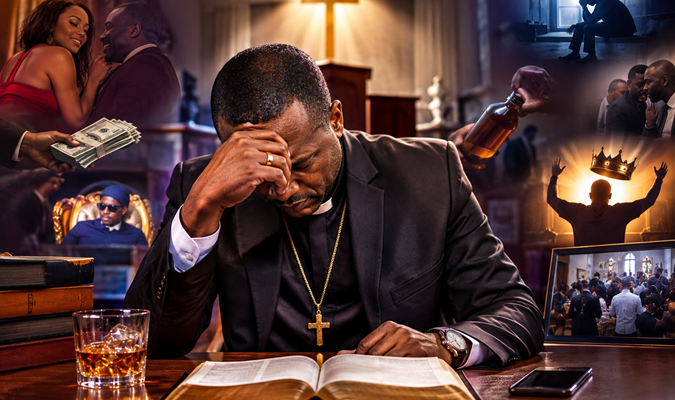

Pastoral longevity demands more than anointing. It demands discernment. A pastor can love God sincerely, preach faithfully, and still permit habits, relationships, exhaustion, ambition, or unhealthy environments to become termites beneath the structure of his calling.
The pulpit may remain polished while the foundation quietly cracks. The congregation may still applaud while the pastor’s private life weakens. This is why pastoral vigilance must begin before crisis, before scandal, before headlines, and before the damage becomes too expensive to repair.
The first responsibility is spiritual. A pastor must never become so busy working for God that he stops walking with God. Sermon preparation cannot replace communion. Public prayer cannot compensate for private prayerlessness. Ecclesiastical activity cannot substitute for intimacy with Christ.

Jesus said, “Without me ye can do nothing.” The statement is not theological decoration. It is a ministerial survival principle. The pulpit is not the source. The secret place is. When the private altar becomes cold, public activity may continue for a season, but the roots have already begun to dry.
Closely related is the danger of losing love while retaining ministry language. A pastor can preach grace while harbouring resentment, defend truth while destroying people, and speak about Christ while quietly competing with other servants of Christ.
Paul’s instruction is brutally simple: “Let all your things be done with charity.” Ministry without love becomes religious machinery. Competition can turn fellow ministers into enemies. Jealousy can disguise itself as discernment. Gossip can masquerade as concern. A pastor should never build his relevance by demolishing another minister’s reputation.
The Body of Christ is larger than one pulpit, denomination, parish, fellowship, or personality. Different assignments do not require hostility. Different theological convictions do not justify contempt. Christ is not divided, and His servants should be careful not to manufacture divisions that the cross did not create.
Another serious danger is becoming uncorrectable. The most vulnerable pastor is not necessarily the inexperienced one. It may be the influential one whom nobody can question.
When every disagreement becomes rebellion, every critic becomes an enemy, and every correction becomes persecution, leadership has become insulated from reality. Proverbs teaches that wisdom belongs to those who receive counsel. A pastor needs people courageous enough to say, “You are wrong,” before a mistake becomes a catastrophe.
Accountability is not an insult to authority. It is a guardrail beside it.
A pastor must also understand the danger of toxic ministry environments and toxic Christians. Not every person who says “Jesus” is emotionally healthy. Religious vocabulary does not sanctify manipulation. Church membership does not baptise gossip, intimidation, jealousy, sabotage, character assassination, or spiritual control.
There is a difference between correction and humiliation, disagreement and hostility, accountability and manipulation, persecution and dysfunction. A pastor should not become so frightened of being accused of lacking love that he permits destructive people to govern his emotional life, family, decisions, or ministry.
Love does not require unlimited access. Forgiveness does not automatically restore trust. Grace does not eliminate boundaries.
A pastor can pray for someone without permitting that person unrestricted access to his private life. He can forgive without returning to the same destructive pattern. He can remain humble without becoming available for manipulation. Sometimes a boundary is simply wisdom with a backbone.
The danger of toxic environments is especially insidious because prolonged exposure can alter the pastor himself. A minister repeatedly betrayed may become suspicious. A minister continually attacked may become defensive. A minister surrounded by manipulation may eventually begin manipulating others.
The poison does not always remain outside the vessel.
That is why pastors must examine not only the people around them, but the atmosphere those relationships are creating within them.
Family neglect is another silent destroyer. A pastor may become a hero to hundreds while becoming a stranger to his own household. He attends everybody’s emergency but misses his child’s important moments. He counsels marriages while his own spouse quietly experiences loneliness.
That is not sustainable ministry.
First Timothy places household management within the qualifications for spiritual leadership. The home is not an inconvenient annex to ministry. It is part of the assignment. A pastor should not build a magnificent public house of worship while allowing the domestic house to collapse behind him.
Your congregation may call you pastor. Your children call you father. Your spouse calls you husband or wife.
Do not allow the public title to consume the private identity.
Then comes sexual and emotional compromise, one of the most devastating dangers because it often begins without appearing dangerous. A private message becomes a regular conversation. A counselling relationship becomes emotional dependence. Familiarity becomes secrecy. Secrecy becomes intimacy. Intimacy eventually demands a price.
Anointing does not abolish temptation.
Wisdom establishes distance from it.
Paul said, “Flee sexual immorality.” He did not say negotiate with it. He did not say demonstrate how strong your anointing is by standing beside it. Sometimes holiness looks less like confrontation and more like departure.
Pastors must establish clear boundaries around counselling, private communication, emotional dependency, travel, accommodation, finances, and personal relationships. A ministry can take decades to build and moments to damage.
Financial integrity deserves equal vigilance. Money tests character differently from preaching. A pastor can survive theological criticism and still destroy his credibility through financial opacity.
Church money is not personal money. Offerings are not discretionary income. Congregational generosity requires stewardship, documentation, accountability, transparency, and appropriate oversight.
The temptation to mix personal and institutional resources can begin innocently. That is precisely why it is dangerous. What starts as convenience can become entitlement. Entitlement can become secrecy. Secrecy can become scandal.
Luke 16:10 teaches that faithfulness in little things matters. A minister should never become materially prosperous at the expense of moral credibility.
Another quiet enemy is materialism. Wealth itself is not sin. Excellence is not sin. A good house is not sin. A respectable vehicle is not sin. The danger begins when possessions become louder than presence.
A pastor can spend years building an impressive ministry while the secret place becomes neglected. The pursuit of comfort can gradually displace the pursuit of God. The desire for applause can become indistinguishable from the desire for influence.
No vehicle can purchase divine wisdom.
No designer garment can manufacture anointing.
No building can replace God’s presence.
Jesus asked what it profits a person to gain the whole world and lose the soul. The question remains relevant wherever ministry becomes more concerned with appearance than communion.
The appetite for applause can be equally corrosive. Praise is pleasant, but it becomes dangerous when it becomes necessary.
Titles can become intoxicating. Invitations can become addictive. Honorariums can become expected. Social media approval can become a hidden master.
Eventually, the pastor begins asking a dangerous question: “What will people think?”
He stops preaching difficult truths because they may offend influential members. He avoids necessary correction because attendance may fall. He protects his image more fiercely than his character.
That is how a pulpit becomes a mirror.
Jesus did not call pastors to become celebrities. He called them to become faithful.
Wrong associations can accelerate nearly every other danger. Not everyone who enters your circle belongs in your confidence. Not every friend deserves access to your secrets. Not every adviser deserves access to your decisions.
Some relationships strengthen conviction. Others slowly anesthetise it.
The Bible warns that evil company corrupts good habits. A pastor must therefore distinguish between loving people and granting them influence. You can love everyone without allowing everyone to shape your theology, finances, emotions, family, or decisions.
Never exchange your calling for a shortcut offered by a charming companion.
Neglecting the body is another form of poor stewardship. Some pastors have mistaken exhaustion for sacrifice. They sleep little, eat poorly, ignore symptoms, postpone medical care, and continue working as though the body were an inexhaustible machine.
It is not.
Your body is the vehicle through which your earthly assignment is carried. Rest is not weakness. Appropriate medical care is not unbelief. Treatment does not insult faith.
Even fasting requires wisdom. Prolonged fasting, especially without water, can impose serious physiological stress. Breaking an extended fast should be approached cautiously, with appropriate hydration and gradual reintroduction of food. Spiritual discipline should never become physical recklessness.
Prayer does not abolish biology.
Faith does not cancel wisdom.
Spiritual lethargy often accompanies physical and emotional exhaustion. The pastor becomes busy everywhere except within. He can counsel everyone while neglecting his own soul. He can prepare sermons without allowing Scripture to examine him.
The most dangerous ministry schedule is one that leaves no room for the Minister.
The pastor must remain a sheep before he becomes a shepherd.
Refusing rest can therefore become another hidden threat. God did not create human beings as perpetual motion machines. Even Jesus withdrew from crowds. Even Elijah required sleep and nourishment before receiving further instruction.
A pastor who never rests may eventually become irritable, emotionally brittle, intellectually exhausted, spiritually dry, and physically vulnerable.
The kingdom will survive your Sabbath.
The church will survive your absence for a few hours.
Rest is not abandoning the assignment. Sometimes rest is preserving the vessel that carries it.
Finally, a pastor must guard against forgetting that he is human. Ministers need friends, mentors, trusted counsellors, accountability, healthy recreation, family intimacy, and spaces where they do not have to perform spiritual strength.
The pastor does not cease being human when he enters the pulpit.
He still becomes tired. He still needs encouragement. He can still make mistakes. He can still require correction. He can still need help.
That admission does not diminish his calling. It protects it.
The greatest pastoral tragedy is not merely falling publicly. It is spending years constructing a ministry while quietly destroying the person God called to carry it.
Therefore, examine the foundation before the walls crack.
Examine the heart before resentment hardens. Examine the marriage before distance becomes estrangement. Examine the finances before suspicion becomes scandal.
Examine the relationships before familiarity becomes compromise. Examine the body before exhaustion becomes collapse.
Examine the secret place before spiritual dryness becomes normal. Examine the environment before toxicity becomes culture.
And examine the soul before applause convinces you that the platform is more important than the Presence.
Paul’s counsel to Timothy remains one of the most sobering instructions ever given to a minister:
«“Take heed unto thyself, and unto the doctrine; continue in them.”
1 Timothy 4:16»
The order matters.
Take heed unto yourself.
Before the sermon, the self. Before the platform, the character. Before the congregation, the soul. Before expansion, integrity. Before influence, intimacy with God.
The ultimate measure of ministry is not how loudly people celebrated you while you were alive. It is whether you remained faithful to God, truthful to yourself, responsible toward your family, accountable to others, and spiritually alive until the end.
The goal is not merely to start well. It is not merely to preach well. It is not merely to build well. It is to finish well.
And sometimes finishing well requires the courage to recognise what is quietly corroding the foundation before anyone else notices the cracks.
Guard the vessel. Guard the altar. Guard the family. Guard the body. Guard the boundaries. Guard the integrity. Guard the calling.
Then keep walking with God.
For the pastor who finishes well, the greatest testimony may not be the size of the ministry he built, but the integrity with which he carried it.
– Inah Boniface Ocholi writes from Ayah – Igalamela/Odolu LGA, Kogi state.
08152094428 (SMS Only)