
By Muhammed Sherifdeen Omeiza
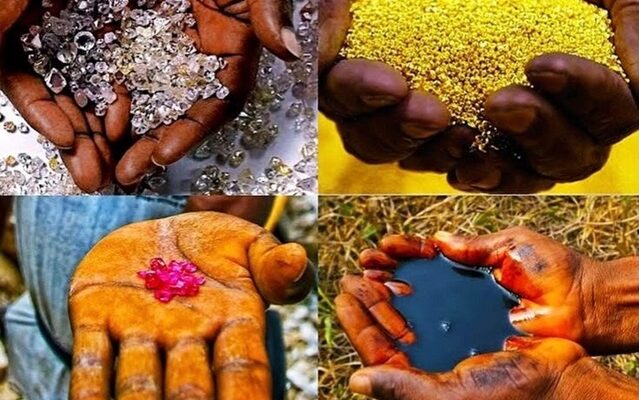
Africa is often described as a continent rich in natural resources but poor in development. This statement has been repeated so many times that it is beginning to sound like a normal description of Africa. But there is a serious question we need to ask: if Africa has so many resources that the rest of the world needs, why are these resources still not creating enough jobs, industries and better living conditions for Africans?
Africa holds about 30% of the world’s critical mineral reserves. These include cobalt, copper, lithium, graphite and other minerals that are becoming increasingly important for electric vehicles, batteries, renewable energy and modern technology. Yet the continent still captures only a small part of the value created from these resources. Much of the mining takes place in Africa, but processing and manufacturing often happen elsewhere.

The Democratic Republic of Congo is a good example. The country is responsible for more than 70% of global cobalt production, a mineral that is important in many rechargeable batteries. Yet producing the mineral is not the same as controlling the industry around it. The real economic value increases when the mineral is processed and transformed into products that can be sold at much higher prices.
The same issue can be seen in Zambia. The country is one of Africa’s major copper producers, but for decades much of its copper has left the country with limited processing and manufacturing taking place locally. This means that Zambia can earn money from copper exports without capturing the full economic benefits that could come from developing industries around copper.
Zimbabwe provides another important example. The country has significant lithium deposits and has taken steps to restrict the export of unprocessed lithium in an attempt to encourage local processing. The policy reflects an important idea: African countries should not simply allow their resources to leave the continent without creating industries around them.
But there is a problem.
Stopping the export of raw minerals does not automatically create factories.
A country cannot develop a battery industry simply by telling mining companies not to export lithium. It needs reliable electricity, good roads, skilled workers, technology, finance, stable policies and access to markets. Without these, investors may simply move their activities somewhere else.
This is where African governments need to think beyond natural resources. The real objective should not only be to extract minerals but to build industries around them.
Morocco is already showing what this can look like. The country has been attracting investment into battery and electric vehicle supply chains, including projects designed to increase local industrial production. One recently announced battery project is expected to create more than 600 direct jobs in its first phase.
Africa needs more examples like this.
The growing global demand for critical minerals gives African countries a rare opportunity. The United States, China, Europe and other major economies are all looking for reliable supplies of minerals needed for the energy transition and modern technology. This gives African governments more bargaining power than they may have had in the past.
But bargaining power is only useful when it is properly used.
African governments should negotiate investment agreements that go beyond mining rights. Companies investing in African minerals should be encouraged, and where appropriate required, to support local processing, skills development, technology transfer and infrastructure. Governments should also ensure that communities where mining takes place benefit from the resources around them.
Nigeria also needs to pay attention to this conversation. Although Nigeria is better known for oil, the country has significant deposits of minerals such as lithium, tin, gold and other solid minerals. If Nigeria simply repeats the old pattern of exporting raw resources, it may miss another opportunity to build industries and create jobs.
The answer is not to stop foreign companies from investing. Africa needs investment. The answer is to negotiate better and create policies that make local value addition possible.
This also requires regional cooperation. Not every African country can build every part of a mineral supply chain alone. One country may have the mineral, another may have processing capacity, while another may provide access to ports and markets. The African Continental Free Trade Area can therefore play an important role in creating regional value chains instead of forcing every country to develop everything independently.
The biggest mistake would be to believe that possessing natural resources is the same as possessing economic power. It is not.
Economic power comes from what a country can do with its resources.
Africa has spent decades exporting raw materials and importing finished products. The result is that jobs, technology and much of the value created from African resources are often found outside Africa.
The current demand for critical minerals gives the continent another chance to change this pattern. But this opportunity will not last forever.
African governments must therefore move from asking, “How much can we earn from exporting this mineral?” to asking, “What industries can we build around this mineral?”
That is where the real value of Africa’s natural resources lies.
– Muhammed Sherifdeen Omeiza is a Nigerian researcher and writer whose work explores the intersection of humanitarian action, human rights, gender equality and global governance. With a keen interest in public policy, democracy, and political economy, he examines how local experiences and global decisions shape humanitarian outcomes in times of crisis. His writings draw from African and international contexts, reflecting a commitment to justice, accountability, and people-centered governance in global affairs.
Email: sherifdeenmuhammed001@gmail.com