
By Muhammed Sherifdeen Omeiza
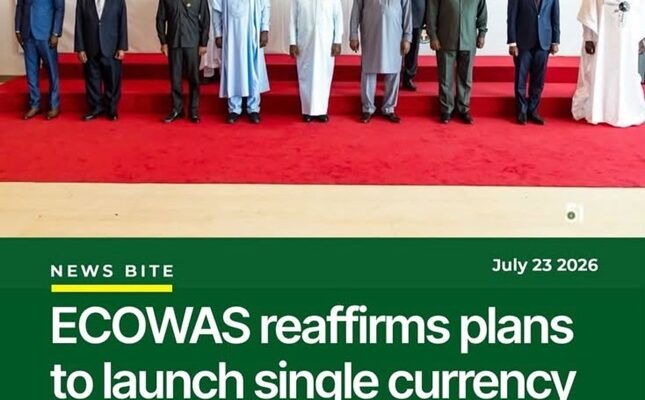
For many years, West African countries have discussed the idea of having one currency. The proposed ECO is expected to create a common monetary system for countries within ECOWAS, reduce the difficulties of exchanging different currencies and make it easier for businesses and individuals to trade across borders. The idea sounds attractive, especially at a time when African countries are trying to increase trade among themselves. But having one currency is not only about printing new notes and replacing the naira, cedi or dalasi. It means that countries will have to give up an important part of their monetary independence and allow a regional institution to make major decisions about interest rates, inflation and monetary policy.
This is where the debate becomes important. A common currency can bring real benefits, but it can also create serious problems if the economies using it are not ready.

The European Union provides the most important example. The euro has made trade and movement of money easier among countries that use it. A business in France can trade with Germany without worrying about changing currencies. People travelling across many European countries can use the same currency. It has also strengthened economic integration and made Europe more connected financially.
But the euro has also shown that a common currency does not automatically make different economies equal. Countries such as Germany, France, Greece and Italy have different levels of productivity, debt, industrial strength and economic structure. When they use the same currency, they cannot simply devalue their national currency when their economy is struggling. They also cannot set their own interest rates to respond to a domestic economic problem.
The Eurozone debt crisis made this problem very clear. Greece faced a severe debt crisis and had limited options because it could not use its own currency or independently control monetary policy. The crisis showed that monetary union requires more than a common central bank. It also requires strong fiscal rules, economic coordination and mechanisms that can support countries when they face serious economic shocks.
West Africa is not Europe, but there are lessons to learn.
The economies within ECOWAS are very different. Nigeria has one of the largest economies in Africa and depends heavily on oil. Côte d’Ivoire has a strong agricultural and manufacturing base. Ghana has its own economic structure, while countries such as The Gambia and Sierra Leone operate on a much smaller scale. Their inflation rates, debt levels, foreign reserves, exports and economic priorities are not the same.
This raises an important question. If these countries use one currency, what happens when one country experiences an economic crisis that does not affect the others?
Take Nigeria as an example. If the price of crude oil falls sharply, Nigeria may experience a major reduction in foreign exchange earnings. Another ECOWAS country that does not depend on oil may not face the same problem. Yet both countries would be operating under the same regional monetary policy. The interest rate that is appropriate for one may not be appropriate for the other.
This does not mean the ECO is a bad idea. In fact, it could become one of the most important steps towards deeper economic integration in West Africa. A common currency could reduce transaction costs, encourage regional trade and make it easier for businesses to operate across borders. It could also reduce some of the uncertainty created by constantly changing exchange rates.
But West Africa should not rush into it simply because Europe has the euro.
The first priority should be economic convergence. Countries should have relatively stable inflation, sustainable debt, strong foreign reserves and responsible fiscal policies before joining a common monetary system. The ECO should also have strong institutions that are independent enough to make decisions based on economic conditions rather than political pressure.
There must also be a system for helping countries when they face serious economic shocks. If one country suffers a major crisis, there should be a regional mechanism capable of providing support without creating permanent dependence on stronger economies.
This is particularly important for Nigeria. Because of the size of its economy, Nigeria will naturally have significant influence in any West African monetary system. But the ECO should not become a Nigerian currency under another name. Decisions must reflect the interests of all participating countries, regardless of their economic size.
There is also a wider issue of monetary independence. Africa has had a long debate about how much control it should have over its own monetary affairs. This debate has sometimes included ideas such as the proposed African gold-backed currency associated with Muammar Gaddafi. However, many popular claims about the idea, including claims that it directly caused his downfall, are not supported by strong evidence. What remains relevant is the broader question behind the debate: how can African countries gain greater control over their economies while still benefiting from regional and global cooperation?
The answer should not be isolation. Monetary independence should not mean refusing to cooperate with the rest of the world. The real goal should be to build institutions that allow African countries to make economic decisions based on their own development needs.
For the ECO to succeed, ECOWAS should therefore take a gradual approach. Countries that meet the required economic conditions could enter first, while others are given time to prepare. The region should strengthen trade, regional payment systems and economic cooperation before and alongside monetary integration. There should also be clear rules on government borrowing, inflation and fiscal discipline.
Most importantly, citizens need to understand what the ECO will mean for them. Governments should not sell the currency only as a symbol of African unity. They should explain how it will affect salaries, savings, prices, businesses, imports and exports.
A common currency can bring West Africa closer together, but it can also expose weaknesses that national currencies currently hide. The experience of the euro has shown both sides of this reality.
The question, therefore, should not be whether West Africa wants one currency. The bigger question is whether West Africa has built the economic and political institutions needed to make one currency work.
If the answer is yes, the ECO could become an important tool for regional integration. If the answer is no, introducing it too quickly could create problems that will be much harder to solve later.
West Africa does not need a currency simply because Europe has one. It needs a currency that works for its own people, economies and future.
– Muhammed Sherifdeen Omeiza is a Nigerian researcher and writer whose work explores the intersection of humanitarian action, human rights, gender equality and global governance. With a keen interest in public policy, democracy, and political economy, he examines how local experiences and global decisions shape humanitarian outcomes in times of crisis. His writings draw from African and international contexts, reflecting a commitment to justice, accountability, and people-centered governance in global affairs.
Email: sherifdeenmuhammed001@gmail.com