
By Idris Rufai
In Nigeria’s higher institutions, one begins to wonder whether project defence is designed to assess students’ academic competence or to introduce them to a new course titled Advanced Suffering and Unnecessary Patience.
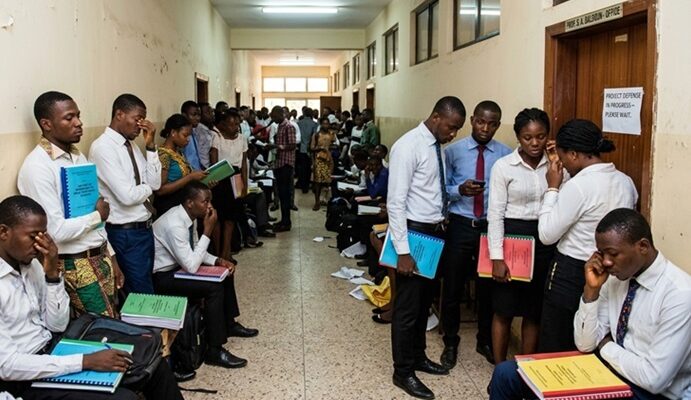
Imagine a student who has spent years attending lectures, writing examinations, completing assignments and struggling to survive the economic realities of the country. Finally, the long-awaited final-year examination comes to an end. Naturally, one would expect such a student to return home, reunite with family, seek opportunities and begin planning the next chapter of life. Unfortunately, for some students, the end of examinations is not the end of academic stress. It is merely the beginning of another waiting game.

Welcome to the world of project supervision, where a student may defend a proposal successfully and still find himself trapped in an endless cycle of corrections, uncertainty and delays.
One is tempted to ask: What exactly is the importance of project proposal defence if, after the defence, students must still endure unnecessary complications that prolong their stay on campus?
Project proposal defence is an academic exercise intended to evaluate the relevance, feasibility and direction of a student’s research. It should provide clarity, establish expectations and help students proceed confidently with their projects. Yet, when students who have completed this process continue to experience avoidable delays, repeated uncertainties and difficulties in securing approval for their work, the very purpose of the exercise deserves serious reconsideration.
Of course, academic supervision requires patience. Research is not a race, and supervisors have a responsibility to maintain academic standards. Students must also accept corrections, demonstrate commitment and produce quality work. Nobody is suggesting that students should be awarded academic qualifications for work they have not done.
However, there is a significant difference between maintaining academic standards and creating circumstances that make academic progress unnecessarily difficult. There is a difference between correcting a student’s mistakes and keeping that student in a state of perpetual uncertainty.
When does academic supervision become an unnecessary burden, and who is responsible for drawing the line?
Consider the financial implications. In a country where the cost of transportation, accommodation, feeding and other basic necessities continues to challenge ordinary citizens, remaining on campus for weeks after final examinations is not a small inconvenience. For students who depend on their parents, guardians or limited personal resources, every additional day comes with a price.
The landlord is not interested in whether a supervisor has approved a project. The food seller does not offer free meals because a student is waiting for corrections. Transport operators will not reduce their fares because someone is still struggling to obtain project clearance.
Unfortunately, academic calendars do not pay students’ bills, and supervisors’ offices are not social welfare centres.
Yet, students may find themselves remaining in school lodges long after their examinations, not because they have chosen to enjoy campus life, but because their academic responsibilities have not been concluded.
For some, the consequences go beyond money. Prolonged uncertainty can affect personal wellbeing, disrupt family plans and delay opportunities to seek employment, pursue further studies or begin other meaningful activities.
The irony is that students are often encouraged to become independent, productive and responsible citizens. But how can they confidently take the next step when the completion of their academic journey remains uncertain?
THE STUDENT IS ALWAYS WRONG: A NIGERIAN ACADEMIC TRADITION?
Perhaps the most troubling aspect of this situation is not the delay itself, but the apparent difficulty students face when attempting to question it.
In a society where connections can sometimes speak louder than merit, students may begin to wonder whether justice is available to everyone or reserved for those who know the right people.
Who should a student approach when a supervisor becomes a source of unnecessary delay? Where does one seek redress when repeated attempts to resolve a problem produce no meaningful result? And what happens when the person expected to provide a solution is part of the problem?
These are not questions students should have to answer through guesswork.
Unfortunately, the fear of being labelled disrespectful, troublesome or academically unserious may discourage some students from speaking up. Others may worry that reporting a problem could worsen their situation or affect their final assessment.
And so, silence becomes the safest option.
The student remains quiet, smiles through the frustration and continues to wait. After all, in an environment where the person holding the pen may influence the final outcome, challenging authority can feel like risking everything.
What a wonderful system it would be if students were taught to speak up for justice but punished, formally or informally, for daring to question injustice.
This is the contradiction that demands attention. Institutions should not merely teach students the principles of accountability, fairness and responsible leadership in the classroom; they should demonstrate those principles in their daily administration.
A student who raises a legitimate concern should not automatically be considered disrespectful. Respect for authority must not become an excuse for the absence of accountability.
Equally, lecturers and supervisors deserve protection from false accusations, unreasonable pressure and disrespectful conduct. A fair system must protect both sides, investigate complaints objectively and ensure that neither students nor academic staff abuse their positions.
The goal is not to turn students against their supervisors. It is to build an academic environment where both parties understand their responsibilities and where problems can be resolved without intimidation or unnecessary hostility.
WHERE DO WE CHANNEL THE SITUATION?
Drawing from my experience in the academic environment, I believe the question of project supervision deserves more attention than it currently receives. Students need accessible channels through which they can report persistent delays, unclear instructions and other difficulties affecting their academic progress.
However, such channels must be more than names written in a student handbook or offices that exist only on paper. They must be accessible, impartial and capable of providing timely solutions.
If a student has completed the required stages of a project and is waiting for feedback, there should be a reasonable mechanism for following up. If a supervisor is unavailable, an alternative arrangement should exist. If disagreements arise over a research topic or corrections, the department should have a clear process for resolving them.
Most importantly, students should not be left guessing about when their projects will be approved or what additional requirements they must satisfy.
Academic institutions should consider establishing clear timelines for project supervision, feedback and approval. Where delays are unavoidable, students should receive explanations and realistic expectations. Where a dispute persists, an independent departmental or faculty committee should be available to review the matter.
These measures would not undermine the authority of supervisors. Rather, they would strengthen institutional accountability and protect the integrity of the academic process.
After all, a system that depends entirely on the goodwill, availability or personal discretion of individuals is vulnerable to inconsistency.
A CALL FOR RECONSIDERATION
The purpose of higher education should extend beyond producing graduates who can write examinations and defend research projects. Institutions are also expected to prepare young people for responsible participation in society.
That responsibility includes respecting their time, protecting their dignity and providing fair procedures for resolving academic disputes.
Project supervision should be a partnership between the supervisor and the student, not an endless contest in which one person holds all the power and the other is expected to endure every difficulty in silence.
Students must be willing to work, accept corrections and meet reasonable deadlines. Supervisors, in turn, should provide constructive guidance, communicate expectations clearly and avoid preventable delays. Departments and institutional authorities must ensure that established procedures work for everyone.
A student’s right to quality education should not depend on personal connections, fear or the ability to endure avoidable hardship.
It is time for our higher institutions to review their project supervision procedures and ask difficult but necessary questions. Are existing timelines clear enough? Are complaints handled fairly? Are students adequately informed about their rights and responsibilities? And are supervisors supported and held accountable under the same transparent standards?
These questions deserve honest answers.
My argument is not that every delay is deliberate or that every supervisor is responsible for students’ difficulties. Research can be demanding, and genuine academic challenges are inevitable. My concern is that where delays are avoidable, communication is poor and accountability is weak, students bear the consequences disproportionately.
We must not allow the pursuit of academic excellence to become an excuse for administrative inefficiency or the unnecessary suffering of students.
A project should test a student’s ability to research, analyse and contribute knowledge, not how long the student can survive uncertainty, financial pressure and the fear of questioning authority.
If project proposal defence is intended to prepare students for successful research, then the process that follows must reflect that purpose. There should be clear expectations, reasonable timelines, effective communication and accessible channels for seeking redress.
The ultimate question is simple: if a student has fulfilled the required academic responsibilities, why should the path to completing that student’s education remain unnecessarily difficult?
Our institutions must rethink their project supervision measures before the waiting game becomes an accepted tradition.
Because when students can no longer distinguish between academic discipline and avoidable suffering, it is not only the students who need to learn a lesson. The system itself must be willing to learn.
– Idris Rufai
Email: idrisrufai744@gmail.com