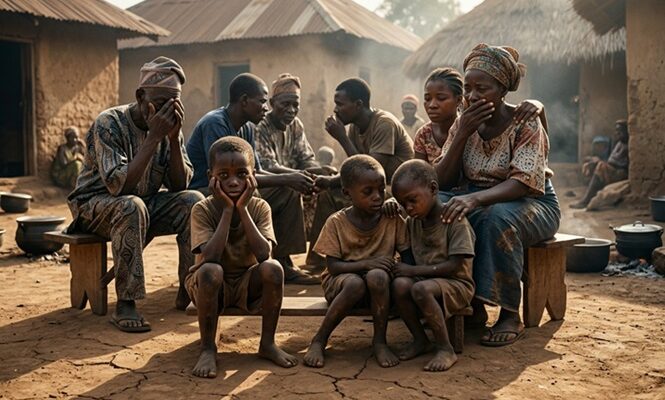

A child cannot eat economic growth. A mother cannot cook a government’s promise, and a father cannot pay for dinner with statistics announcing national progress. Within Nigeria, the struggle to afford food and water has become a painful measure of the distance between economic policy and ordinary life. A nation’s development means little to families who cannot reliably feed themselves.
The scale of the crisis demands attention. The Food and Agriculture Organization’s 2026 assessment estimated that 36.3 million people would face crisis level or worse acute food insecurity during the June to August lean season. This included approximately 2.1 million people in Emergency conditions and 10,300 in the most severe Catastrophe classification. These figures describe a humanitarian emergency, not merely a difficult season for household budgets.
The economic pressure remains substantial. Nigeria’s annual food inflation rate stood at 19.59 per cent in September 2026, according to figures released by the National Bureau of Statistics. Although headline inflation eased to 14.63 per cent, slower inflation does not mean food and water has become affordable; it means prices are rising more slowly overall. For households whose incomes have failed to keep pace with previous price increases, even a modest shopping trip can require painful sacrifices.

To Nigeria’s leaders, the question is not whether economic reforms are necessary. Governments must confront structural weaknesses, improve revenue generation and create conditions for sustainable growth. But reform cannot be judged exclusively by fiscal indicators, investor confidence or aggregate output. Its human value must also be measured by whether workers can afford basic necessities, children receive adequate nutrition and vulnerable households can survive economic shocks without losing their dignity.
The crisis is compounded by insecurity and disrupted agricultural production. Violence in parts of Nigeria has restricted access to farmland, interrupted markets and weakened rural livelihoods. When farmers cannot safely cultivate their fields, the consequences travel beyond their communities: production suffers, supply chains weaken and already vulnerable households face additional pressure. Food security therefore requires more than distributing relief; it requires restoring the conditions under which people can produce, transport and purchase food.
There is also a question of public responsibility. Emergency assistance can prevent immediate suffering, but programmes must be transparent, properly targeted and independently scrutinised. Agricultural investment must deliver measurable improvements rather than disappear into administrative promises. Support for vulnerable families must reach intended beneficiaries. Where public money is allocated to alleviate hardship, citizens deserve to know what was spent, who benefited and what results followed. Compassion without accountability can become an expensive performance.
Nor can the responsibility rest with government alone. Businesses can strengthen local supply chains, communities can support vulnerable households, and civil society can identify failures and demand evidence. Farmers need access to finance, reliable infrastructure, secure land and viable markets. Yet private generosity cannot replace effective public institutions, just as public policy cannot succeed without the participation of producers, traders and communities. The task requires coordinated action rather than competing claims to moral credit.
The final measure of leadership is not how convincingly a nation announces its ambitions, but how faithfully it protects the people who live beneath those ambitions. The millions facing food insecurity are not an inconvenient footnote to Nigeria’s economic story; they are central to its meaning. Every child who goes hungry exposes a question that no official statement can answer away: what is the purpose of national progress if its benefits remain beyond the reach of those who need them most?
– Inah Boniface Ocholi writes from Ayah – Igalamela/Odolu LGA, Kogi state.
08152094428 (SMS Only)