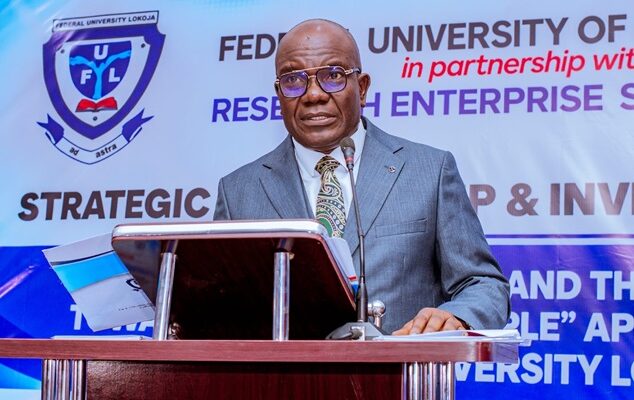

Abuja — Federal University Lokoja (FUL) has launched a five-year Partnership Portfolio (2026–2030) aimed at mobilising investment from government, industry, financial institutions, development partners, alumni and private investors to accelerate the institution’s growth.
The Vice Chancellor, Professor Gbenga Solomon Ibileye, unveiled the portfolio on Thursday at an investment and partnership convening in Abuja themed “University Governance and the Corporate World: Towards an ‘All-of-People’ Approach to Financing Federal University Lokoja.”
Speaking at the event, which drew university officials, Governing Council members, corporate representatives, alumni and development partners, Professor Ibileye called for a shift away from traditional philanthropy towards strategic investment and shared value creation.

He said the pace of FUL’s development would increasingly depend on partnerships and resource mobilisation beyond government funding, noting that unlike older universities that had benefited from decades of public investment, younger institutions like FUL — established in 2011 and now 15 years old — must find innovative pathways to grow.
“We are young, but we are not starting from zero. We have a foundation, we have talent, we have location, we have ideas, we have networks and, most importantly, we have the ambition to build an institution capable of making a lasting contribution to Nigeria’s development,” he said.
The Vice Chancellor stressed that the Partnership Portfolio was designed to complement, not replace, government funding, and he pitched the University directly to investors.
“I am here to invite you to investment, and to speak to you in the language that every serious investor understands, which is the language of returns on investment,” he said, while also urging alumni to support scholarships, research, infrastructure, entrepreneurship and innovation projects. “Do not leave this University the way you met it,” he added.
Call for Governance Reform
The Chairman of the Federal Civil Service Commission (FCSC), Professor Tunji Olaopa, called for a review of the legal and governance frameworks guiding Nigerian universities, arguing that existing establishment laws could constrain institutional flexibility.
He urged the National Assembly, the Federal Ministry of Education and other stakeholders to amend university establishment Acts to grant institutions greater operational and academic autonomy, while insisting that such autonomy be matched with accountability tied to measurable outcomes.
Professor Olaopa also championed the “All-of-People” partnership model and proposed a diversified funding ecosystem involving government matching funds, community-backed endowments, and commercialisation through technology transfer offices and science parks, with proceeds from innovation and research transparently shared among researchers, students, the university and private-sector partners.
A Platform of Possibilities
The Executive Director of Research Enterprise Systems, Professor Fatai Aremu, described a university as more than a collection of buildings, framing investment in FUL as an investment in people and human capital. “We are here today to do things differently,” he said.
The Director of Alumni Relations and Linkages, Professor Abel Joseph, said the initiative was intended to dispel the notion that financing a federal university was government’s responsibility alone, noting that FUL’s rapid growth had created rising needs in infrastructure, research funding and student support. He said the approach forms part of the University’s Vision Plan 2026–2031.
Investment Opportunities on Offer
Professor Ibileye outlined a range of investment opportunities, including student accommodation, staff and faculty housing, conference and hospitality facilities, commercial and mixed-use developments, technology and innovation projects, agriculture and renewable energy.
He noted that student accommodation presents an immediate opportunity, allowing investors to finance, construct and operate facilities, recover their investment during a concession period, and later transfer the assets to the University. He also cited opportunities in banking, retail, food courts and campus-edge developments, pointing to FUL’s location at the confluence of the Niger and Benue rivers, about 200 kilometres from Abuja, as an added advantage for commercial and hospitality investment.
On technology, he highlighted openings in research laboratories, innovation and incubation hubs, cloud computing and technology transfer, referencing the University’s TETFund-approved Centre of Excellence in Artificial Intelligence, Robotics and Cyber Sciences, alongside academic programmes spanning Artificial Intelligence, Cybersecurity, Data Science, Engineering, Law, Pharmacy and Nursing Science, among others.
Professor Ibileye said the University was open to Build, Operate and Transfer (BOT), Public-Private Partnership (PPP), Lease and Joint Venture arrangements, structured around capital requirements, technical capacity and risk allocation, with safeguards including transparent agreements and defined investment recovery mechanisms.
“Our proposition is simple: come with your capital, come with your expertise, come with your technology, come with your vision,” he said. “Federal University Lokoja is ready to partner.”
The event also featured the unveiling of the third edition of FUL Voice, the University’s publication produced by the Directorate of Strategic Communication and Corporate Documentation under Dr Tosin Olagunju.