
By Stephen Adeleye
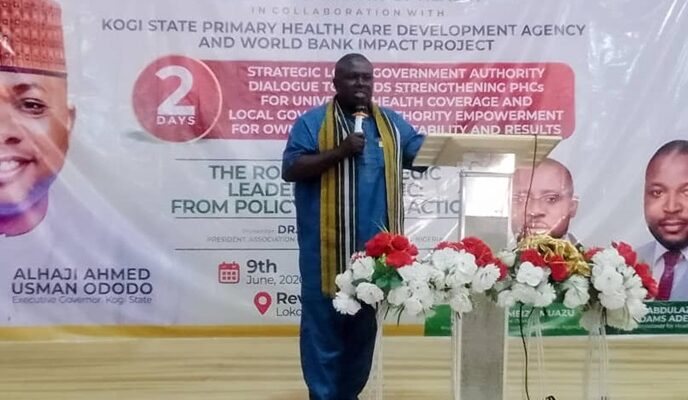
The President of the Association of Public Health Physicians of Nigeria (APHPN), Dr Terfa Kene, has called on local government chairmen in Kogi State to prioritize community involvement and strengthen Ward Development Committees, WDCs, as the key to achieving Universal Health Coverage (UHC).
Dr Kene made the call in his presentation at a 2-Day Local Government Authority Dialogue, themed: “The Role of Strategic Leadership in UHC: from Policy to Local Action”, on Tuesday in Lokoja as the World Bank IMPACT project winds down in Kogi.

He said the project’s end marks “the beginning of the end for donor-driven inputs, but also the beginning of sustainable, homegrown solutions.”
According to him, inputs into the health system have been consolidated and the next phase must focus on investing in the system to deliver expected results.
“Essentially, we are talking about three things: community involvement, strong local government action, and functional Ward Development Committees,” he said.
The public health expert introduced the concept of “hybrid communities,” where residents at home, local fiscal actors, and the diaspora pool resources to fund primary healthcare.
He stressed that financial risk protection through the health insurance system must also be scaled up.
Dr Kene urged LG chairmen to move beyond infrastructure and grasp the philosophy of primary healthcare.
“Many of them see it as just buildings and equipment. Primary healthcare is about prevention, health promotion, and keeping people well, not just treating them when they are sick,” he said.
“My call is simple: local communities must take responsibility. Strengthen Ward Development Committees, mobilize resources within the community, and ensure those in leadership are accountable for every resource given to them,” he said.
Dr Kene, a Consultant Public Health Physician and Epidemiologist, said this approach would position Kogi State to sustain health gains and ensure no one is left behind as donor funding declines.
The Secretary to Kogi State Government, Dr. Folashade Ayoade, representing Gov. Ahmed Ododo, charged LG chairmen to take “absolute ownership” of PHCs, saying UHC is impossible without functional grassroots facilities.
She outlined three pillars: ownership, strict accountability for resources, and focus on results like reduced maternal mortality.
She urged LG leaders to end passive governance and lead action at the grassroots.
Kogi Commissioner for Health, Dr Abdulazeez Adams Adeiza, charged LG chairmen to take full responsibility for PHCs as IMPACT winds down.
He said PHCs remain the statutory duty of LGAs by the 1999 Constitution and National Health Act 2014.
“The state will continue supervision via KSPHCDA and BHCPF, but LGs must fund, equip and monitor facilities to sustain gains and UHC,” he said.
The Executive Director, Kogi State Primary Health Care Development Agency (KSPHCDA), Dr Musa Omeiza Muazu, urged LG chairmen to take full ownership of PHCs to sustain IMPACT gains.
He said immunization coverage widened and maternal mortality dropped, but donor support ends December 2026.
“By law, PHC is their duty. Chairmen must prioritize staff, equipment, maintenance and funding to ensure Universal Health Coverage beyond donor support,” Muazu said.
Also speaking, Lokoja LGA Chairman, Hon. Adamu Abdullahi, who spoke on behalf of other local government chairmen, commended Governor Ahmed Ododo for the tremendous improvement in healthcare delivery, especially at the grassroots across the 21 LGAs.
Abdullahi assured the state government of the full support and commitment of all LG chairmen to take ownership of the project at the local level.
The representative of the traditional institution, HRH Ali Bukar, pledged the full support of traditional rulers to ensure the project continues to achieve its goals and the objectives of delivering Universal Health Coverage for the masses.