
By Muhammed Sherifdeen Omeiza
Imagine surviving a brutal village raid, losing your home, and spending years in a crowded displacement camp, only to look out one morning and see the very person who pulled the trigger walking free, receiving free food, and learning a trade courtesy of the government. This is not a movie plot; it is the everyday reality for millions of people in northern Nigeria.
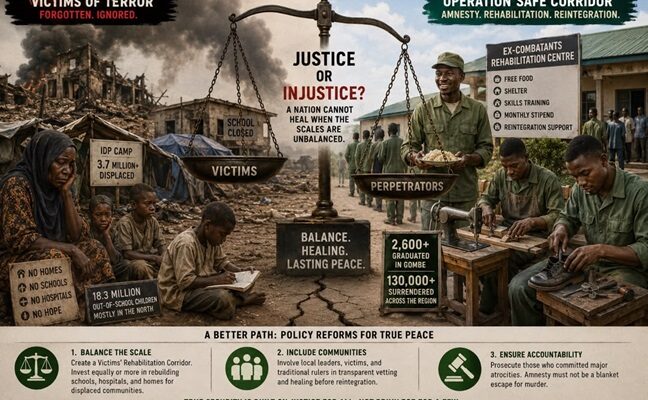
According to official data from the International Organization for Migration and the UN Refugee Agency, more than 3.7 million Nigerians are currently living as internally displaced persons within their own country due to violence and terror. Yet, under a controversial federal initiative called Operation Safe Corridor, thousands of former insurgents are being rehabilitated, fed, and re-educated on the taxpayers’ dime.

This reality has sparked a fierce national debate about justice, forgiveness, and how a country should fix itself after years of war. On one hand, the Nigerian military and defense experts argue that you cannot win a war with guns alone. Operation Safe Corridor was set up as a peaceful back-door exit for low-risk fighters who want to drop their weapons voluntarily.
According to recent public updates released by the National Counter Terrorism Centre, while over 2,600 ex-combatants have successfully graduated from the main facility in Gombe State, the wider push has encouraged over 130,000 insurgents and their family members to surrender across the region. From a purely practical standpoint, every fighter who surrenders is one less gunman on the battlefield, which makes communities safer and saves the lives of Nigerian soldiers.
However, the program feels deeply unfair to the communities that suffered the most. While the federal government pours money into training repentant militants in carpentry, tailoring, and shoe-making, the victims of their violence are left to rot in poverty. The humanitarian crisis is staggering, with a recent report from the United Nations Children’s Fund confirming that Nigeria now has 18.3 million out-of-school children, with the vast majority concentrated in the conflict-ridden North-West and North-East regions.
When an innocent orphan cannot get a basic education due to school closures while a former insurgent gets free vocational training, the moral balance of the nation breaks down. The biggest challenge now is not just getting fighters to surrender, but convincing local families who lost loved ones to live side-by-side with men who once terrorized them, leading to deep social tension and rejection.
When we look at this issue through the lens of public policy, the breakdown becomes obvious. Good public policy must serve the entire public, not just one group. Right now, Operation Safe Corridor operates as a lopsided strategy because it focuses almost entirely on the perpetrator while ignoring the victim.
In policymaking, when you reward bad behavior to stop it, without simultaneously healing those who were harmed, you create a crisis of state legitimacy. The government is essentially telling law-abiding citizens that their suffering matters less than a criminal’s rehabilitation. Because the policy was designed in military boardrooms without consulting the local communities who have to host these men, it has built a wall of distrust that threatens to collapse the entire peace process.
To fix this policy flaw and bring lasting peace, Nigeria must shift from a system that pampers rebels to one that actively restores communities. First, the federal government needs to balance the scale by creating a parallel Victims’ Rehabilitation Corridor where, for every naira spent on retraining a former insurgent, an equal or greater amount is invested in rebuilding schools, hospitals, and homes for the displaced.
Second, the reintegration process must not be forced on the public; local community leaders, victims, and traditional rulers must be part of a transparent vetting and emotional healing process before any rehabilitated fighter is released.
Finally, those who committed major atrocities must face the court system, ensuring that amnesty never becomes a blanket escape card for murder, because true national security cannot be built on a system where those who broke the peace are treated better than those who kept it.
– Muhammed Sherifdeen Omeiza is a Nigerian researcher and writer whose work explores the intersection of humanitarian action, human rights, gender equality and global governance. With a keen interest in public policy, democracy, and political economy, he examines how local experiences and global decisions shape humanitarian outcomes in times of crisis. His writings draw from African and international contexts, reflecting a commitment to justice, accountability, and people-centered governance in global affairs.
Email: sherifdeenmuhammed001@gmail.com