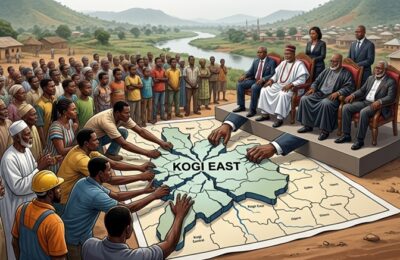

Every election asks who should govern. The election approaching in 2027 poses a more consequential question for the Igala nation: what kind of leadership deserves to govern? The distinction is not semantic. Societies rarely decline because they run out of politicians. They decline when they lower the moral and intellectual standards by which leaders are judged. For a civilisation whose political institutions predate colonial rule and whose monarchy remains one of Nigeria’s enduring traditional authorities, the stakes extend far beyond another electoral contest. The future of Igalaland will depend less on campaign promises than on whether its people insist that public office once again becomes an expression of honour, competence, and stewardship rather than personal ambition.
History offers a demanding benchmark. Long before the emergence of modern democratic institutions, the Igala Kingdom developed an elaborate political order that balanced royal authority with customary restraints, communal obligations, and institutional continuity. The Attah Igala represented more than sovereign authority. The throne symbolised justice, unity, and accountability to the people. Leadership was inseparable from responsibility. Authority carried obligations before it conferred privilege. Those principles enabled the kingdom to survive internal succession disputes, external military pressures, and eventually the disruptive forces of colonial administration. The endurance of the institution was not accidental. It reflected a political philosophy that understood legitimacy as something earned through conduct rather than inherited through office.
That philosophy deserves renewed attention because contemporary politics increasingly rewards the opposite virtues. Electoral competition has become dominated by patronage networks, transactional alliances, and the corrosive influence of money. Political success is too often measured by the size of campaign structures rather than the quality of ideas. Public discourse has become saturated with personalities while substantive conversations about education, security, industrial development, agricultural productivity, youth employment, and institutional reform remain peripheral. Such a political culture produces officeholders who are skilled at winning elections but poorly equipped to govern. Democracy cannot flourish when electoral victory becomes the highest political achievement instead of effective public service.

The consequences are already visible across many parts of Kogi State especially the East. Young professionals continue to leave in search of opportunities elsewhere. Rural communities struggle with inadequate infrastructure. Farmers confront insecurity alongside declining public investment. Economic potential remains constrained despite the region’s strategic importance and abundant human capital. None of these challenges can be solved through emotional appeals to ethnic solidarity alone. Identity may inspire political mobilisation, but it cannot substitute for policy competence. Communities prosper when leaders possess both moral credibility and administrative capacity.
The temptation during every political season is to personalise every debate. Citizens become preoccupied with names while neglecting standards. Yet institutions are ultimately shaped by the expectations of those they serve. A society that rewards loyalty above integrity should not be surprised when corruption flourishes. A society that celebrates wealth without questioning its source gradually weakens its own moral foundations. Likewise, a society that overlooks competence in favour of political convenience eventually pays the price through poor governance, diminished investment, and declining public confidence.
The challenge before Igala political leaders is therefore larger than winning elections. It is restoring public trust. Trust cannot be manufactured through campaign advertising or carefully choreographed endorsements. It is accumulated through transparency, humility, disciplined administration, and consistent respect for the rule of law. These qualities rarely generate dramatic headlines, yet they remain the indispensable architecture of prosperous societies. Around the world, regions that have achieved sustained development did so because institutions became stronger than individuals and public accountability became stronger than personal patronage.
Traditional leadership also carries an important responsibility in this moment. Culture should never be reduced to colourful ceremonies performed during festivals or election campaigns. Its greatest contribution lies in its ethical influence. Traditional institutions retain their relevance when they remind political actors that power is temporary but reputation is permanent. They serve society best when they elevate standards rather than personalities and when they defend the collective interest above factional advantage. In that respect, tradition remains a living constitutional resource capable of strengthening democratic governance rather than competing with it.
As 2027 approaches, the defining issue for Igalaland is neither who speaks the loudest nor who assembles the largest political coalition. The defining issue is whether leadership will once again be measured by character before charisma, competence before connections, and service before self interest. Civilisations are not remembered because they produced ambitious politicians. They are remembered because they produced leaders whose integrity outlived their tenure.
The Igala Kingdom has already written distinguished chapters in Nigeria’s political and cultural history. The responsibility of the present generation is not merely to celebrate that inheritance but to prove itself worthy of it. If the standards that once defined Igala leadership are restored to public life, 2027 may become more than another election cycle. It may mark the beginning of a political renewal grounded not in nostalgia, but in the enduring truth that the legitimacy of leadership rests not on the acquisition of power, but on the faithful exercise of it.
– Inah Boniface Ocholi writes from Ayah – Igalamela/Odolu LGA, Kogi state.
08152094428 (SMS Only)