
By Abdulkarim Abdulmalik
In the often turbulent politics of Israel, parliamentary symbolism can sometimes be as significant as the numbers behind a vote.
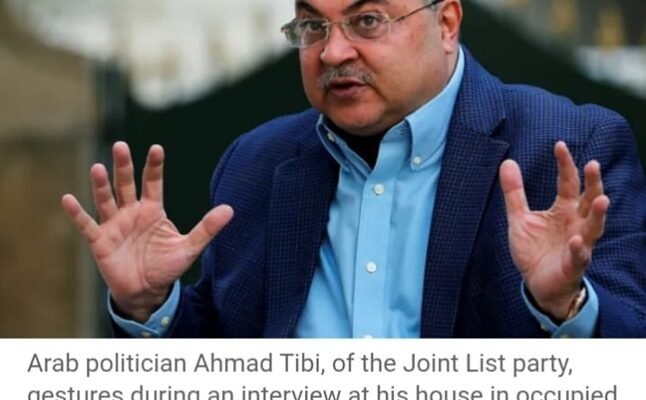
The appointment of Ahmad Tibi as a temporary Deputy Speaker of the Knesset may look, at first glance, like another routine arrangement in a newly constituted parliament. But beneath the procedural language lies a much larger political story: Arab and Palestinian citizens of Israel have emerged from the latest election with greater parliamentary leverage, while the political camp associated with Prime Minister Benjamin Netanyahu is confronting a new reality in which it can no longer easily dictate the direction of the Knesset.

The Knesset Arrangements Committee voted 13–8 to recommend nine temporary deputy speakers, including Tibi, who leads the Ta’al party and chairs the Joint List. The appointment came despite strong objections from members of Netanyahu’s political camp. The appointments are temporary, pending the establishment of the parliament’s permanent leadership structure.
Yet the significance of Tibi’s elevation goes beyond the title.
It represents the growing influence of Arab political parties at a moment when Israel’s political arithmetic has become unusually complicated.
The numbers have changed
The October 27 parliamentary election produced a Knesset in which neither major political grouping secured the 61 seats required for a governing majority.
According to reports, Netanyahu’s bloc emerged with 53 seats, while the bloc led by Gadi Eisenkot won 48. Arab parties, meanwhile, secured a combined 19 seats, giving them potentially decisive importance in the formation of the next government.
That is the real story behind Tibi’s appointment.
For years, Arab parties have been an important but frequently marginalised component of Israeli parliamentary politics. The latest election, however, has transformed their position from being merely represented in the Knesset to potentially becoming kingmakers in a deeply divided parliament.
Tibi himself described his appointment as a significant achievement for the Joint List, which secured 11 seats. He also said that efforts by Netanyahu’s Likud and Itamar Ben-Gvir to prevent his appointment had failed.
For supporters of Palestinian citizens’ political participation, the message is powerful: parliamentary representation is beginning to translate into institutional influence.
Why Netanyahu’s camp is uncomfortable
The reaction from the right reveals just how politically sensitive the development has become.
Members of Netanyahu’s bloc strongly objected to the inclusion of Arab lawmakers in the Knesset leadership. Some right-wing politicians have sought to portray cooperation with Arab parties as unacceptable, particularly because of disagreements over the Arab factions’ positions on Israel’s conflict with Hamas and broader questions of national security.
But the opposing argument is straightforward: if Arab citizens are elected to parliament, their representatives are entitled to participate in parliamentary institutions according to the rules governing the Knesset.
Indeed, Ahmad Tibi is not a newcomer to parliamentary leadership. He has served in the Knesset for many years and has previously held the position of deputy speaker. His return to the post therefore represents not simply an unexpected breakthrough but also a reminder that Arab lawmakers have occupied senior parliamentary positions before.
The immediate political embarrassment for Netanyahu’s camp is that attempts to block the appointment did not succeed.
But the deeper challenge is larger.
A new parliamentary mathematics
The election has created a parliament in which political survival may increasingly depend upon negotiation rather than ideological certainty.
The Arrangements Committee itself illustrates this new reality. The opposition bloc succeeded in taking control of the powerful committee, with Arab parties receiving representation alongside other political factions. The committee has significant temporary authority over parliamentary organisation and the establishment of important committees.
Arab lawmakers are therefore no longer simply watching parliamentary decisions from the margins.
They are becoming part of the machinery through which those decisions are made.
That could have important consequences for legislation, committee appointments, parliamentary debates and, most importantly, coalition negotiations.
The Arab parties may not agree with the Zionist parties on fundamental questions concerning Israel’s identity, security or the Palestinian issue. But parliamentary politics does not always require ideological agreement. It often requires arithmetic.
And arithmetic is currently working in their favour.
A possible turning point
The appointment of Tibi should nevertheless not be exaggerated.
He is a temporary deputy speaker, and the appointment does not mean that Arab parties have suddenly taken control of the Knesset. Nor does it automatically mean that Netanyahu’s political career is finished.
But political symbolism matters.
A Palestinian citizen of Israel occupying a visible position within the leadership structure of the country’s parliament sends a message about the changing character of Israeli political competition.
It also exposes an important contradiction confronting Israeli politics: a democracy cannot easily claim to represent all its citizens while simultaneously treating the elected representatives of a significant portion of those citizens as permanently illegitimate.
The question now is whether Tibi’s appointment becomes merely a temporary parliamentary arrangement or part of a broader transformation in the relationship between Arab political parties and Israel’s governing institutions.
Beyond the Netanyahu question
It would be tempting to describe the development simply as “a slap for Netanyahu.” Politically, there is certainly an element of that.
But the bigger story is not Netanyahu personally.
It is the emergence of a Knesset in which no single political camp can comfortably ignore Arab lawmakers.
The 19 seats held collectively by Arab parties give them leverage that could become crucial in the struggle to form a government. President Isaac Herzog has already tasked Eisenkot with trying to form a government, while negotiations continue in a highly uncertain political environment.
This means that the Palestinian citizens of Israel, through their elected representatives, may find themselves in a position they have long sought: not merely protesting from outside the centres of power, but influencing what happens inside them.
For Israel, that could produce difficult conversations, new alliances and perhaps unexpected compromises.
For Netanyahu, it is another indication that the political landscape he once dominated is changing.
And for Tibi and the Joint List, the moment represents something more profound than a parliamentary chair.
It is a seat at the table.
Whether that seat becomes a platform for meaningful political influence, a bargaining instrument in coalition formation, or simply a temporary symbol of a changing Israel will depend on what happens next.
But one thing is already clear: the latest Knesset election has changed the arithmetic, and Israeli politics will have to reckon with it.
- with agency reports.