
By Prince Friday Ogungbemi
The legislature in all modern democracy is constitutionally saddled with the responsibility of making credible and enforceable laws for peace, order, socio-economic and political development of the state concerned.
A State House of Assembly in Nigeria is the Legislative arm of government at the state level, with responsibilities focused on lawmaking, oversight, and representation.

Operating under Sections 90-94 of the 1999 Constitution (as amended), they ensure peace, order, and good governance within their respective states
The capacity of any society to develop economically is fundamentally dependent on the quality of laws passed by the legislature as an institution of democracy and the competence of the legislators themselves.
The legislature therefore, as the first arm of Government, determines to a very large extent the direction of public policy through its law making powers and other related subsidiary functions.
Particularly the function of oversight guarantees peace and order and above all, transparency and accountability in governance.
The legislature as an institution of elected representatives is the “eye”, the “ear” and the voice of the people. The legislature therefore, is central and core to the concept of representation in a democratic dispensation.
It is important to state here that a democratic government is fundamentally hinged on a tripod with each of the arms vested with constitutionally defined roles.
The concept stipulates a setting in which the legislative arm enact laws for good governance of the society, the executive arm executes laws so made while the judiciary interprets and adjudicates the laws.
The principle of parliamentary sovereignty and supremacy of law, which forms the cardinal basis of the democratic tradition is largely a product of revolution.
The democratic nature of revolutionary movements during the 17th century, put governments under siege and succeeded in making the governing powers responsible for their acts.
The legislative powers of a state House of Assembly in Nigeria are enunciated in the provisions of Section 4 (6, 7, 8) of the 1999 Constitution of the Federal Republic of Nigeria (As Amended) as stated below.
(6) The legislative powers of a State of the Federation shall be vested in the House of Assembly of the State.
(7) The House of Assembly of a State shall have power to make laws for the peace, order and good government of the State or any part thereof with respect to the following matters, that is to say-
(a) any matter not included in the Exclusive Legislative List set out in Part I of the Second Schedule to this Constitution;
[Part I Second Schedule]
(b) any matter included in the Concurrent Legislative List set
out in the first column of Part II of the Second Schedule to this Constitution to the extent prescribed in the second column opposite thereto; and
[Part II Second Schedule]
(c) any other matter with respect to which it is empowered to make laws in accordance with the provisions of this Constitution.
The Constitution equally provides how the House of Assembly is to exercise its powers under the law in Section 100 as quoted below.
- Mode of exercising legislative power of a State:
(1) The power of a House of Assembly to make laws shall be exercised by bills passed by the House of Assembly and, except otherwise provided by this section, assented to by the Governor.
(2) A bill shall not become law unless it has been duly passed and, subject to subsection (1) of this section, assented to in accordance with the provisions of this section.
(3) Where a bill has been passed by the House of Assembly it shall
be presented to the Governor for assent.
(4) Where a bill is presented to the Governor for assent he shall within thirty days thereof signify that he assent or that he withholds assent.
The Constitution equally provides for sanctions for any unauthorized person that intrude into the sitting of House in Section 99. It states as follows:-
- Any person who sits or votes in a House of Assembly of a state knowing or having reasonable grounds for knowing that he is not entitled to do so commits an offence and is liable on conviction to such punishment as shall be prescribed by Law of the House of Assembly.
It is pertinent to note at this juncture, that the Constitution provides in Section 108, Right of Attendance for the Governor to the sitting of the House through a motion moved, properly seconded and question put and vote cast, before he is ushered into the Hallowed Chamber.
- (1) The Governor of a State may attend a meeting of a House of Assembly of the State either to deliver an address on State affairs
or to make such statement on the policy of government as he may consider to be of importance to the State.
(2) A Commissioner of the Government of a State shall attend the House of Assembly of the State if invited to explain to the House of Assembly the conduct of his Ministry, and in particular when the affairs of that Ministry are under discussion.
(3) Nothing in this section shall enable any person who is not a member of House of Assembly to vote in that House or in any of its committees.
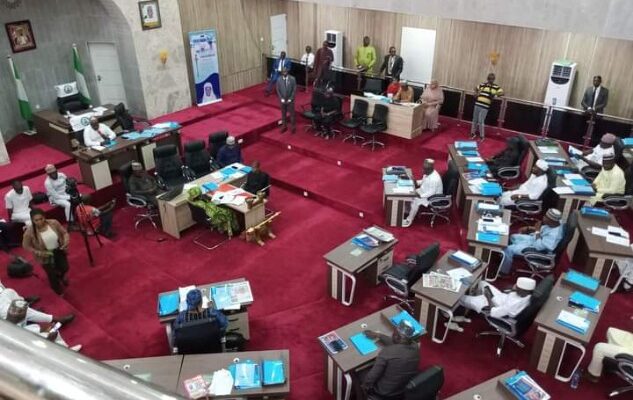
To my esteemed readers from the forgoing, the Hallowed Chamber of a Legislative Assembly is not a ‘Theatre of Arts’ for fun seeker.
A “hallowed chamber” in legislative context is often used to describe parliamentary chambers where law-making occurs, emphasizing the dignity, sanctity, and honour of the venue.
It is referred to as “Hallowed Halls” to describe respected, traditional institutions or spaces with rich history.
The Hallowed Chamber is similarly refered to as a sacred, highly respected, or venerated place, most commonly used to describe legislative halls like a Parliament or Senate, signifying the grave importance of laws made there. It implies a space treated with deep reverence or regarded as sacred.
They call it the hallowed chambers, a place where laws are made for the good governance of the society. A place made sacred by the gravity of the decisions.
Finally, overzealous individuals should note that the House of Assembly is vested with powers to reprimand and admonish an offender over an abuse of the privilege of the House.
The offender may be subjected to a reprimand by the Speaker, in any case that is not sufficiently serious to warrant imprisonment.
While members receive a reprimand standing in their place, non-members are brought to the Bar of the House attended by Sergeant-at-Arm.
It is therefore, instructive that the “Hallowed Chamber” must be kept sacred, government officials and unauthorized persons, holding whatever high positions, should know and be enlightened on their limits.
That they can only be part of proceedings at plenary or Committee of the Whole after due authorization with Right of Attendance fully legislated upon and resolution obtained.
– Prince Friday Ogungbemi, a journalist, writes from Lokoja.