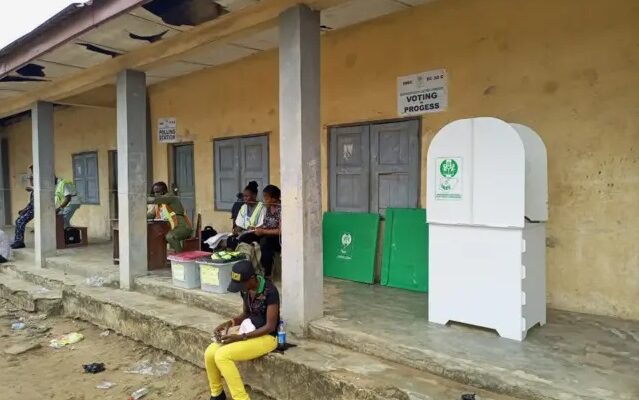

Prefilled election results refers to election result sheets that have figures entered into them before voting has taken place at the polling unit.
What it means in practice
In Nigeria’s electoral system, the official result sheet is usually called Form EC8A at the polling unit level. Officials are supposed to fill it only after votes are counted in the presence of party agents and observers.

A “prefilled” sheet is one where the votes for candidates/parties are already written in before voting, counting, or collation happens.
Examples from reported cases in Nigeria:
Civil society groups reported incidents of prefilled result sheets in parts of Kogi, Ogori/Magongo, and Okehi LGAs during the Nov 2023 off-cycle governorship elections.
In some cases, people were allegedly apprehended with filled result sheets and cash before voting started.
The allegation is that these sheets are later used to replace the genuine results, or that polling units are forced to accept them.
Why it matters
Electoral integrity: It undermines the principle that results should reflect votes actually cast.
Legal violation: Under the Electoral Act 2022, results must be entered at the polling unit after counting and signed by officials and party agents. Prefilling violates this process.
Impact on trust: When prefilled sheets are alleged, it fuels disputes, protests, and claims of disenfranchisement.
INEC’s response: INEC’s standard procedure is to reject results that don’t match the BVAS accreditation numbers and to investigate reports of prefilled sheets.
Don’t confuse with “pre-processing”
“Pre-processing” in some countries like the US means opening and verifying mail ballots before Election Day so results can be released faster. That’s a lawful administrative step.
“Prefilled results” in the Nigerian context refers to falsifying the actual vote counts before voting occurs.
Prefilled election results emanate when result sheets are filled out before voting and counting actually happen. It doesn’t happen by accident – it’s a deliberate act to manipulate the process. Here’s how it typically occurs, based on reported cases and election monitoring reports in Nigeria and similar contexts:
Unauthorized access to result sheets
Election result sheets like INEC’s Form EC8A are supposed to be in tamper-evident packs, distributed to polling units on election day.
If the packs are intercepted, stolen, or diverted at the LGA collation center, Registration Area Center (RAC), or during transport, they can be filled outside the polling unit.
This often happens when materials aren’t properly batched or secured, or when RACs lack logistics as reported by CSOs in Kogi 2023.
Collusion with election officials or security personnel
Ad hoc staff, presiding officers, or security agents may be compromised to hand over blank or partially filled sheets.
Once they have the official sheets with stamps and serial numbers, they can write in figures for candidates before voting.
Creation of fake or “duplicate” sheets
In some cases, fake result sheets are printed to resemble the official ones.
These are used to substitute genuine results during collation, or to force presiding officers to sign under duress/intimidation.
Manipulation at collation centers
Even if polling units conduct voting, prefilled sheets can be introduced at ward, LGA, or state collation centers:
Genuine sheets are replaced or “overwritten” with prefilled ones. Figures are altered during data entry, especially if BVAS/IReV uploads are delayed or skipped.
Why it’s done
The motive is usually to:
Inflate votes for a particular candidate/party before voting occurs.
Compensate for expected low turnout or unpopularity in an area.
Create a paper trail that matches a pre-determined outcome, making it harder to challenge without physical evidence.
How it’s usually detected
BVAS mismatch: Accredited voter numbers from BVAS don’t match the votes recorded on the sheet.
Missing signatures: Party agents and voters present at the PU didn’t witness the process but the sheet is signed.
Timing issues: Sheets are uploaded to IReV with timestamps before voting ended.
Physical evidence: Reports of people caught with filled sheets and cash before polls open.
Legal status in Nigeria
Under the Electoral Act 2022, this is electoral fraud. INEC’s guidelines state that any result not generated from a process witnessed at the polling unit can be rejected during collation. The Act also gives INEC power to review results declared under duress or based on prefilled sheets
Under Nigerian law, announcing a winner based on prefilled results is illegal. The announcement has no legal effect, and the result can be voided. The people involved can face criminal and administrative sanctions.
Here’s how it works under the Electoral Act 2022 and INEC regulations:
What the law says about valid results
Section 60(1) Electoral Act 2022: Voting at a polling unit shall be in accordance with the procedure in the Act and INEC guidelines. Results must be computed and declared at the polling unit.
Section 64(4)-(6): If INEC determines that a result was not generated from votes cast at a polling unit, or was obtained through fraud, it can review and reject that result before a certificate of return is issued.
Section 65: INEC can review a declaration/return within 7 days if it was made under duress, contrary to law, or based on false information.
Prefilled results don’t meet the legal standard because they aren’t derived from votes actually cast and counted at the polling unit.
Legal status of an announcement based on prefilled results
Void ab initio: The declaration is void from the outset. An election tribunal or court can cancel it.
No certificate of return: INEC will not issue a Certificate of Return, or will withdraw it under Section 65 if it finds fraud.
Tribunal/Court reversal: Election petitions are commonly upheld on grounds of “non-compliance with the Electoral Act” and “corrupt practices” where prefilled results are proven.
Criminal liability for those involved
Announcing or using prefilled results falls under “electoral offences”:
Section 123 Electoral Act 2022: Making a false statement of result is an offence. Punishment: fine of ₦500,000 or 12 months imprisonment, or both.
Section 124: Falsification of election results is an offence. Punishment: fine of ₦1,000,000 or 3 years imprisonment, or both.
Section 121: Signing a false result sheet or colluding to do so is an offence.
If security personnel or INEC staff are involved, they also face disciplinary action under the Police Act, Public Service Rules, and INEC Staff Conditions of Service.
How INEC is supposed to implement it
INEC’s process to prevent/undo this:
Collation officers compare Form EC8A with BVAS accreditation data and IReV uploads. Mismatches trigger rejection.
Review mechanism under Section 65: INEC can review a declaration within 7 days if it suspects fraud or duress.
Referral for prosecution: INEC’s Legal Department can refer cases to the police or the ICPC/EFCC for prosecution.
Cancellation/re-run: Where substantial prefilled results are found, INEC may cancel results in affected areas and order a re-run.
Role of the courts
Election tribunals and courts routinely nullify elections where prefilled results are proven.
The burden is on the petitioner to prove that prefilled sheets were used and that they substantially affected the outcome.
Recent examples: Tribunals have voided results in Kogi, Imo, and Bayelsa off-cycle elections where prefilled sheets were substantiated.
In conclusion, if INEC announces a winner based on prefilled results, the legal status of INEC and the announcement changes like this under Nigerian
The announcement itself becomes legally defective
Status: Void/voidable.
Under Section 64(4) and 65 Electoral Act 2022, INEC cannot validate a result that wasn’t generated from actual votes at the polling unit.
If it’s proven that the result was prefilled, the declaration is “contrary to law” and can be reviewed by INEC within 7 days or set aside by an election tribunal/court.
The winner does not legally hold the office, even if sworn in, until the tribunal confirms it.
INEC’s institutional status
INEC does not lose its legal status as the electoral body. It remains the body constitutionally mandated under Section 153, 154, 158 of the 1999 Constitution and Part 1 of the Third Schedule to conduct elections.
But its actions in that specific election become subject to review, nullification, and liability.
INEC can be sued, and the courts can issue orders of mandamus, nullification, or a re-run against it.
Liability for INEC as an institution
Administrative liability: INEC can be ordered to cancel the result, conduct a review, or conduct a rerun. The Supreme Court in Atiku v. INEC 2019 and other cases has upheld that INEC has a duty to ensure only valid votes count.
Civil liability: The Commission can be joined in election petitions and ordered to pay costs if found negligent.
Criminal liability: The Commission as a body corporate isn’t usually prosecuted, but individual INEC officials involved can be prosecuted under Sections 121, 123, 124 Electoral Act 2022 for falsification, false declaration, and corrupt practices.
What happens in practice
Before certificate of return is issued: INEC can withhold it under Section 64(6) once it finds the result was not from votes cast.
Within 7 days of declaration: INEC can review and reverse itself under Section 65 if it discovers the declaration was made on false/pre-filled data.
After 7 days: Only an election tribunal or court can nullify it. INEC becomes a respondent in the petition and must defend its process.
If INEC fails to act: Petitioners can get the court to compel INEC to cancel the result and order a rerun.
Key legal principle
The courts hold that INEC is not above the law. In Buhari v. INEC 2008 and Oyetola v. INEC 2019, the Supreme Court ruled that INEC’s declaration is not final if it violates the Electoral Act. INEC’s status is that of a public body exercising statutory power – so its decisions can be quashed for illegality, procedural impropriety, and irrationality.
– Benjamin Ibrahim writes from Lokoja, Kogi state.
+2348069596250