
For decades, buying petrol in Nigeria has followed a familiar routine: drive into a filling station, wait for an attendant, request the quantity of fuel required, make payment and drive away. But that familiar experience is beginning to change.
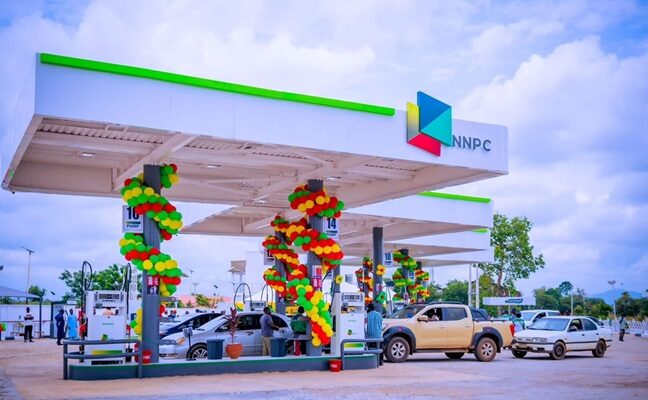
With the commissioning of its first technology-powered self-service smart station along Bill Clinton Drive, Airport Road, Abuja, on Thursday, 10 September 2026, NNPC Limited Retail has taken a significant step towards redefining how Nigerians interact with filling stations and access energy.
The development is more than the introduction of a new type of filling station. It signals a broader shift in the way Nigeria’s principal energy company is thinking about retailing, customer experience, technology and the future of mobility.
The 24-hour facility allows motorists to dispense fuel themselves and complete transactions through automated systems, giving customers greater control over the fuelling process while reducing dependence on conventional attendant-led operations.
For ordinary Nigerians, particularly motorists travelling at night, the significance of this innovation is difficult to overlook.
In a country where relatively few filling stations operate round the clock, motorists who run out of fuel during late-night journeys can be left with few options. Such situations can mean wasted hours, unnecessary inconvenience and, more seriously, exposure to road hazards and security risks while searching for an operational filling station.
The availability of a reliable 24-hour self-service facility offers a practical response to some of these challenges.It means that a motorist can arrive at the station at virtually any hour, select the required quantity of fuel, make payment and continue the journey without having to wait for an attendant to become available. That is convenience, but it is also an important dimension of energy accessibility.

The new NNPC Retail facility brings several technologies together to create a more seamless retail experience.
Automated payment terminals allow customers to complete transactions at the pump using compatible cards and digital payment methods. This reduces the traditional steps involved in purchasing fuel and reflects the wider movement towards cashless and technology-enabled commerce.
The station is also fitted with smart touchscreens and digital displays providing clear, step-by-step instructions. For Nigerians already familiar with automated teller machines and other self-service technologies, the transition to self-service fuelling should be relatively straightforward.
The technology is not merely about speed. It is also designed to improve accuracy, safety and control.
Automated safety shut-off systems, supported by sensors, can stop fuel flow when necessary, including when the nozzle is improperly positioned or the tank reaches capacity. Such features can help minimise product wastage and improve operational efficiency.
The facility also incorporates loyalty-app integration, enabling participating customers to use digital membership identification to access applicable rewards, points or discounts. In a competitive retail environment, such systems can help transform an ordinary fuel purchase into a more connected customer relationship.
Perhaps one of the most important aspects of the Abuja facility is that it does not treat the filling station simply as a place to buy petrol.
Nigeria’s transport and energy landscape is changing. The growing adoption of compressed natural gas, the emergence of electric mobility and the continuing importance of LPG are gradually expanding the country’s definition of what an energy retail outlet should provide.
The NNPC Retail smart station is designed with that changing landscape in mind.
Electric vehicle charging infrastructure is already part of the facility, providing an alternative energy option for electric vehicle users. The station also offers LPG dispensing, lubricant services, an automated car wash and other lifestyle-oriented services, while plans are in place to expand its energy offering to include CNG.
That combination is significant. It points towards a future in which a filling station is no longer simply a petrol forecourt, but a multi-energy and mobility destination capable of serving consumers whose transportation choices are becoming increasingly diverse.
For NNPC Limited, this is an opportunity to remain relevant as the global and domestic energy transition reshapes consumer behaviour. It also reflects an understanding that the future of energy retail will not be defined by a single product.
The broader message from the innovation is clear: NNPC Retail wants to compete not only on the availability of petroleum products, but also on the quality, speed, reliability and convenience of the service surrounding those products. That is an important distinction.
Energy companies around the world are increasingly recognising that consumers do not merely purchase fuel; they also purchase convenience, reliability, accessibility and confidence. The companies capable of delivering these efficiently will be better positioned to retain customers as the energy market evolves.
NNPC Retail’s move therefore represents an investment in both infrastructure and customer expectations.
It also reinforces the position of NNPC Limited as an industrial player whose responsibilities extend beyond crude oil production and petroleum supply into the increasingly sophisticated business of energy distribution and retail.
The Abuja facility provides a visible expression of that ambition.
The real test of the initiative, however, will be its scale. NNPC Retail has indicated plans to establish an additional 50 to 70 self-service stations across Nigeria within six months. If successfully implemented, that expansion could take the concept beyond Abuja and place technology-enabled, 24-hour energy retail within reach of significantly more Nigerians.
Such an expansion would be particularly meaningful in major cities and along busy inter-city routes, where demand for reliable and accessible fuelling services is high. It could also encourage the wider downstream petroleum market to rethink the conventional filling-station model.
Competition, after all, is not always about lowering prices. It can also be about improving the quality of the experience.
By introducing automation, multiple energy options, digital payments, loyalty technology and extended operating hours, NNPC Retail is putting forward a different proposition for what an energy retail outlet can become.
The commissioning of the Abuja self-service smart station is therefore best understood as the beginning of a larger transformation rather than the completion of a single project.
For the motorist, it promises less waiting, greater convenience and access to energy at virtually any hour. For the industry, it demonstrates how technology can improve efficiency and reshape the downstream retail experience. And for NNPC Limited, it is a statement of intent: that Nigeria’s foremost energy company is prepared to innovate, adapt and invest in the infrastructure required to remain at the centre of the country’s changing energy economy.
The Nigerian filling station has existed for generations as a familiar point of call for motorists. With NNPC Retail’s self-service smart station in Abuja, however, the conventional model is beginning to give way to something broader: a technology-driven energy, mobility and lifestyle destination built around the changing needs of the modern consumer.
If the proposed expansion of 50 to 70 additional stations is realised, Thursday’s commissioning in Abuja may eventually be remembered not simply as the opening of another filling station, but as the point at which NNPC Retail began a more deliberate transformation of Nigeria’s energy retail landscape.
And in an industry undergoing rapid change, that could prove to be a defining step for Nigeria’s national energy giant and one of the country’s most important industrial players.
– Onogwu Muhammed, B.Tech., LLB, BL, LLM (In View) MIAD, ANIPR