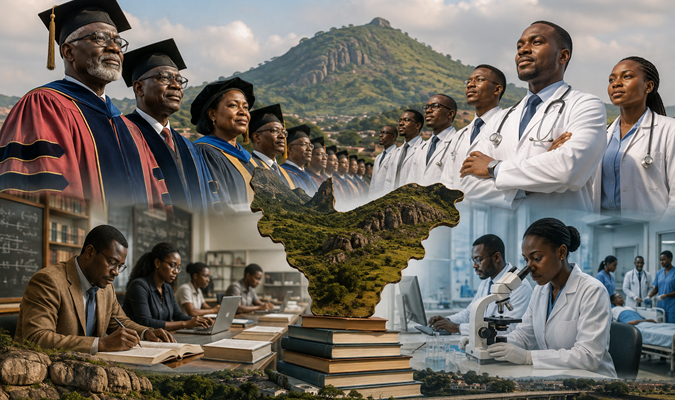

There are mountains that God raises in the landscape, and there are mountains that history raises in the minds of men. Kogi State has both and very inspiring. At the confluence of the Niger and Benue Rivers lies a state that has produced an extraordinary concentration of scholars, professors, doctors, researchers, administrators, writers, scientists, economists, physicians and intellectuals. Yet a painful question confronts us: What happens when a society possesses an extraordinary concentration of knowledge but lacks the institutional imagination to harvest it?
Kogi must begin to see its professors and doctorate holders not merely as people with titles before their names, but as repositories of national memory, scientific knowledge, institutional experience, international networks and problem-solving capacity. The professorate is not an ornament, not at all; A PhD is not merely a certificate, even if we have them in abundance, for in my own immediate family, I can count five or six of them; and retirement is not the death of intellectual usefulness.
If anything, for many scholars, 70 should be the beginning of a new chapter of service-not the end of relevance as presently and sadly seen across our dear state.

In Kogi state, knowledge and its repository remain our strategic comparative national assets, for when rightfully deployed is worth more than any crude oil refinery can compare with. No wonder the Okun/Kabba noted that“Ọ̀gbọ́n ló ń dá ilé dúró”-Wisdom is what keeps a house standing-, While the Igalas also noted that, “Ọ̀nọ̀ k’ágbà, ọ̀nọ̀ k’ọ̀gbọ́n.”-Respect the elder; respect wisdom and the Ebira agreed that “Aha ni agbara”-Knowledge is strength.
“Okun says wisdom sustains the home; Igala honours the wisdom of the elder; Ebira reminds us that knowledge is strength. Therefore, to insult a professor is to insult the very knowledge upon which society hopes to build its future.” What will the Oworos says…. please let me know.
A doctorate holder is a person who has attained the highest level of academic qualification in a particular discipline through advanced study, research and an original contribution to knowledge. A PhD is fundamentally a research degree: the candidate is expected to identify a problem, master the existing literature, undertake rigorous investigation and produce knowledge that adds something genuinely new to the field. A professor is something different and will continue to be so, as far as the search for knowledge is concerned.
Professor is not simply another academic degree,mba!. It is an academic rank earned through rigorous years of teaching, research, publication, supervision, scholarly recognition, academic leadership and contribution to knowledge. This distinction matters and will continue to be so till thy kingdom come.
A person may hold a PhD without being a professor, however, a professor normally holds a doctorate or equivalent terminal qualification, but becoming a professor requires another long and tedious journey.
In the United States, for example, 58,131 research doctorates were awarded in 2024; 98.5 percent were PhDs. These figures demonstrate the enormous scale of the global knowledge economy.
But behind every doctorate is a human story of endurance and an unwavering resilience. For many disciplines, the journey from university entrance to PhD may take eight to twelve years or more: roughly four years for an undergraduate degree, one to two years for a master’s degree and another three to six years, sometimes considerably longer, for doctoral research. Then comes the academic career.
The journey to full professor can easily consume another 15 to 25 years or more after the doctorate, depending on the country, discipline, institution and individual achievement. Thus, the person sitting quietly in retirement at 70 may carry behind that quietness four or five decades of intellectual labour. That is not old knowledge but a national asset. That is accumulated national capital, that remains priceless.
Before Nigeria calls someone “Professor,” that person may have spent decades reading while others slept, conducting experiments when others were celebrating, “owambes”, writing manuscripts that were rejected, rewriting papers, supervising students, attending conferences, defending research, applying for grants, examining theses and travelling across borders in pursuit of knowledge. A professor’s real wealth is therefore not necessarily the salary he or she received.
It is the knowledge accumulated in the mind and makes it powerful but perishable. It is the network of researchers developed over decades and makes it useless if not applied to national development or to better humanity. It is the students taught and some later also becomes a professor
It is the policies influenced, books written, discoveries made, problems solved, and the young people inspired; if you have one in your family, they are our national monuments that must be everlastingly treasured. If the legendary footballer,Pele,can be declared a national monument in Brazil, please permit me to declare our professors, a national monument and be treated as such. For their rare wisdom cannot be purchased in a laboratory or imported by government contract.
The OECD reports that the share of doctorate holders in the working-age population has grown substantially across its member countries, reaching 1.3 percent in 2022. Slovenia and Switzerland were above 3 percent, demonstrating how some countries have built exceptionally dense reservoirs of advanced human capital.
The United States, Germany, Switzerland, Sweden, the United Kingdom, Australia, Israel and other advanced economies have similarly built systems in which universities, research institutes, industry and government continuously draw upon highly educated populations.
The lesson is profound: countries do not become powerful merely because they produce educated people. They become powerful when they build institutions capable of converting education into innovation, policy, industry, health, security, agriculture and human development.
Kogi’s intellectual story is larger than rhetoric, I salute all our Professor in Kogi state and even beyond. The available institutional evidence already reveals a remarkable concentration.
Nigeria’s 2017 education statistics recorded 58 full professors at Kogi State University, Anyigba, while Federal University Lokoja had 15 full professors at that time.
But Federal University Lokoja has grown dramatically and it will continue to be so, for the people are rabidly progressive. The university reported that its number of professors increased from 24 to 68 within a recent three-year period, alongside major growth in faculties, programmes and student enrolment.
Another dataset based on the Nigerian University System Statistical Digest for 2020 recorded 28 professors at Federal University Lokoja and 38 at Prince Abubakar Audu University, illustrating again the rapid expansion and the difficulty of using a single historical number as today’s statewide total. There is therefore an important correction to make to popular claims.
There is no authoritative current census establishing exactly how many professors are indigenes of Kogi State. A 2023 fact-check of the claim that Kogi had the second-highest number of professors by state of origin found that the available NUC list did not identify professors by state of origin and therefore could neither validate nor invalidate the claim. But the absence of a census should not blind us to the phenomenon.
The universities physically located in Kogi alone contain a substantial professoriate. Beyond them are Kogi-born professors serving in universities, research institutions, government, industry and international organizations across Nigeria and the world. That is the mountain. The question is: What are we doing with it?
The comparison with Ekiti is especially revealing. Ekiti has long cultivated a national reputation for educational attainment. At Ekiti State University alone, the Faculty of Education reports more than 110 full-time academic staff, including 50 professors, while the Faculty of Science reports about 131 academic staff, including 39 professors. In 2024, EKSU announced the promotion of 70 academic staff to professor and another 60 to associate professor.
Offa presents a different but equally fascinating intellectual model. Public descriptions of Offa’s educational culture have claimed that the town has more than 100 professors, although this is not an official census and should therefore be treated as a community claim rather than a verified statistical fact.
More importantly, Offa has built institutions around education. Summit University, Offa, for example, has developed postgraduate programmes and maintains professors and PhD-level academics within its academic structure. The comparison gives Kogi an important lesson. Educational culture does not become development merely because a community produces professors.
The decisive question is whether the community creates institutions, networks, foundations, research centres, scholarship systems, think tanks, laboratories, industries and mentoring structures capable of multiplying the value of those professors. Ekiti’s educational culture, Offa’s community investment in education and Kogi’s deep reservoir of scholars should therefore be viewed not as rivalries but as three versions of the same national lesson:
What can professors actually do for a country? Almost everything, if they are willing and determined to do so; an agricultural economist can help redesign food policy, a medical professor can improve healthcare systems, an engineer can design infrastructure, a physicist can contribute to energy and technology, a chemist can advance pharmaceuticals and manufacturing, an economist can advise on fiscal policy, a political scientist can strengthen institutions, a historian can preserve national memory, a linguist can protect indigenous languages, an environmental scientist can help protect forests and water resources, a computer scientist can build digital systems, a professor of education can reform teacher training, a legal scholar can improve legislation and a communication scholar can strengthen public information. Here is why the wealth of a nation is not measured only in crude oil, gold, buildings and foreign reserves.
The most valuable national resource may be the organized intelligence of its people; Kogi has examples and in abundance.
Professor Francis Sulemanu Idachaba, born in Kogi, became one of Nigeria’s eminent agricultural economists, served as Vice-Chancellor of the University of Agriculture, Makurdi and later Kogi State University, published extensively and advised on agricultural development. He also founded scholarship and education foundations. His policy thinking included stronger relationships between government, industry and universities.
Professor Bamidele Ogbe Solomon, another Kogi-born scholar, became a professor of chemical engineering and served two terms as Director-General of the National Biotechnology Development Agency, contributing directly to Nigeria’s biotechnology policy and institutional development.
Professor Seth Sunday Ajayi, who died in January 2026, was a particularly extraordinary example. He became Africa’s first professor of wildlife and fisheries ecology, contributed to the development of Nigeria’s conservation framework and National Parks system, and served with or advised international bodies including UNEP, IUCN, FAO and the World Bank. Nigeria awarded him the Nigerian National Order of Merit.
Professor Olufemi Obafemi, born in Kabba, Kogi State, became an internationally recognized professor, playwright, poet and critic and received Nigeria’s highest intellectual honour, the NNOM, in 2018.
Professor Olugbemiro Jegede is another example of knowledge crossing institutional and national boundaries. He served as foundation Vice-Chancellor of the National Open University of Nigeria, Secretary-General of the Association of African Universities and consultant to organizations including UNESCO, World Bank, UNDP, UNICEF and the African Development Bank.
These are not merely academic biographies. They are blueprints. They show what happens when intellectual capital is connected to institutions.
There is, however, another uncomfortable question. How many young Nigerians have these professors mentored? There is no credible statewide database showing how many people individual Kogi professors have mentored, nor is there a database showing how many they “failed to mentor.” It would therefore be unfair to manufacture numbers. But the absence of measurement exposes another weakness.
Nigeria has measured professors by titles, publications, promotions and retirement dates, but has done far less to measure their multiplier effect. Perhaps every professor should eventually be asked a more important question than “How many papers have you published?”
We should ask: How many minds did you build? A professor who produces ten excellent professors has multiplied his or her intellectual life. A professor who establishes a scholarship fund has multiplied opportunity. A professor who mentors young entrepreneurs has multiplied economic capacity. A professor who trains policymakers has multiplied public impact. The future measure of academic greatness should therefore include intellectual descendants.
There is a dangerous Nigerian habit of equating retirement with disappearance of a professor. The world offers another philosophy. American neurologist Howard Tucker became internationally recognized as the world’s oldest practicing doctor, continuing his professional life into his 100s; by 102 he had been practicing medicine for decades.
The American chemist George K. Schweitzer taught and worked at the University of Tennessee for an extraordinary 76 years and was recognized by Guinness World Records as the longest-serving professor. He remained active until shortly before his death at 99 in 2024.
And Ray Crist, an American chemist who worked on the Manhattan Project, retired from teaching at the extraordinary age of 104. These examples do not mean every professor should work until 100.They mean something more sensible:
A 72-year-old professor may be exhausted, yet, another may be producing some of the best ideas of his life. One may need retirement. Another may need a laboratory, a research assistant and a chair. A rational society distinguishes between the two.
Nigeria has already recognized the special position of professors.PenCom’s guideline for professors provides for retirement at 70 in specified circumstances and recognizes special pension arrangements for eligible professors. But the problem is deeper than the retirement age.
The problem is what happens after retirement. A professor may spend 40 or 45 years acquiring knowledge, building international relationships, supervising students and understanding Nigeria’s problems-then suddenly become institutionally invisible. Yet the knowledge remains. This is an extraordinary waste.
I propose that Nigeria should establish a national policy that effectively declares: “academic life begins again at 70.” Not compulsory employment. Not an endless extension of government payroll.Not a system where everyone automatically remains in office. Rather, a National Emeritus Knowledge Service. At 70, qualifying professors and senior researchers should be offered the opportunity to enter a second academic life based on competence, health, performance and national need. The government would not need to employ all of them full-time.
Instead, it could create a national intellectual marketplace in which ministries, states, universities, industries and international development agencies commission their expertise. That would transform retirement from intellectual extinction into intellectual deployment.
The greatest global lesson is that concentrations of academics become powerful when institutions connect them.UNESCO’s Global Convention on Higher Education emphasizes international academic mobility, recognition of qualifications and cooperation across borders. As of May 2026, 41 states had ratified the convention. UNESCO also reports that China accounted for 21.1 percent of the world’s researchers in 2018, while the United States accounted for another 16.2 percent.
These countries do not simply have researchers. They have research ecosystems. Universities connect with laboratories. Laboratories connect with industry. Industry connects with government. Government connects with policy. Policy connects with investment. Investment connects with innovation. Innovation creates jobs. Jobs create prosperity. That is the chain. Kogi must build its own version.
Why should Kogi’s professors work individually when they could work collectively? The state should establish a Kogi Intellectual Commonwealth, connecting professors and doctorate holders from all relevant institutions. Every member should be mapped by expertise and knowledge
Every retired professor who voluntarily joins the proposed programme should be encouraged to mentor perhaps 10–20 young scholars annually. If 500 professors participated and each mentored 10 young researchers, that would produce 5,000 mentorship relationships every year. Over five years, potentially 25,000. That is how intellectual mountains become intellectual rivers. And those rivers can feed a nation.
Kogi’s academic wealth should also become a diplomatic asset. A Kogi professor working in Canada can connect a Nigerian university to a Canadian research Centre. A professor in Britain can facilitate laboratory partnerships. A professor in America can help attract research funding. A medical professor can connect Nigerian hospitals to global clinical networks. An agricultural scientist can connect Kogi farmers to international research. An environmental scientist can attract international conservation partnerships. The diaspora professor should not be seen as someone who left Nigeria. He or she should be seen as a bridge Nigeria has planted abroad. That is how academic capital becomes international cooperation.
Perhaps the most important sentence in this entire discussion is this: Nigeria cannot afford to waste people whose minds took 40 years to build. We spend billions constructing roads. We spend billions building offices. We spend billions purchasing equipment. But we sometimes allow the human beings who know how to use, maintain and improve those systems to disappear into retirement. That is false economy.
A professor with 40 years of experience is an asset accumulated over decades. The country should therefore stop thinking only about the cost of retaining an elderly scholar. It should ask: What is the cost of losing the knowledge that scholar carries?
Kogi has mountains, not only mountains of stone but also Mountains of minds. Its hills are populated by doctors, professors, engineers, scientists, economists, lawyers, historians, writers, administrators, researchers and other highly trained professionals. But a mountain that never releases water cannot feed a valley. The time has come to make Kogi’s intellectual mountains feed Nigeria. Let our professors return to classrooms-not necessarily as full-time employees, but as mentors.
Let them return to laboratories, to policy rooms, to boardrooms, to communities, to farms, to hospitals, to schools. Let them return to the world. And let Nigeria understand that retirement from office must never mean retirement from knowledge.
Professor Seth Sunday Ajayi showed that a scholar could move from a classroom to national environmental policy and international conservation. Professor Francis Idachaba showed that an agricultural economist could influence national agricultural institutions. Professor Bamidele Solomon showed how academic expertise could enter biotechnology policy. Professor Olugbemiro Jegede showed that Nigerian scholarship could operate simultaneously across Kogi, Nigeria, Africa and the global education system. These men and women are not exceptions to be celebrated only at funerals.
They are models to be institutionalized. The challenge before Kogi is therefore not simply to produce more professors. It is to produce more consequences from the professors it already has. The next generation should not merely inherit their titles. It should inherit their knowledge, their courage, their discipline, their research culture, their international networks, their public-service ethic, their institutions and their dreams. and perhaps the greatest measure of the professorate of Kogi will one day be neither the number of professors nor the number of PhDs.
It will be the number of problems solved because those professors existed. That is the real mountain that is the real hill, that is the real wealth. A society that wastes its wisdom will repeatedly pay for the same mistakes. Kogi must not waste its mountains, for they are many and towering, Nigeria must not waste its professors, for they are our national assets, Humanity must not waste its minds. The time to turn academic excellence into national power is now.
– Madiba Ibrahim Lapinni
09011364063