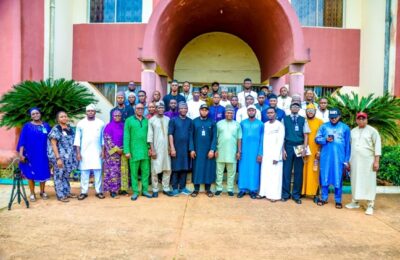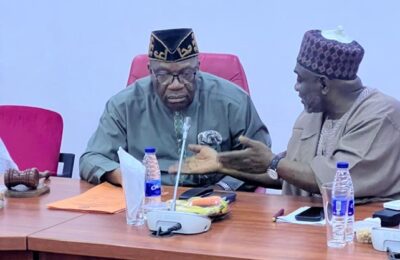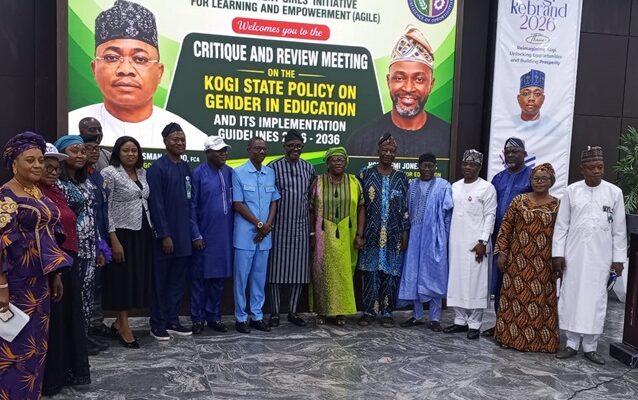

The Kogi State Ministry of Education, in collaboration with the State Adolescent Girls Initiative for Learning and Empowerment (AGILE), on Thursday convened a stakeholders’ meeting in Lokoja to review a draft policy aimed at tackling gender disparities in the state’s education sector.
The meeting, held at the Banquet Hall of the Kogi State Government House, brought together education officials and stakeholders to critique the draft Kogi State Policy on Gender in Education and its Implementation Guidelines, which is designed to cover the period 2026 to 2036.
The event was declared open by Governor Ahmed Usman Ododo, who was represented by the Secretary to the State Government, Mrs. Folashade Ayoade. In his address, the Governor commended the technical committee responsible for drafting the document and urged stakeholders to brainstorm and produce a workable policy that would not only address gender issues but also improve the overall quality of education in the state.

Speaking on the Governor’s behalf, Mrs. Ayoade reiterated his commitment to repositioning the education sector with the goal of ensuring that every child of school-going age is educated. She called on the Ministry of Education to work toward reducing the number of out-of-school children to zero and advised the Ministry to invoke provisions of the Child Rights Act that prohibit children of school-going age from hawking during school hours.
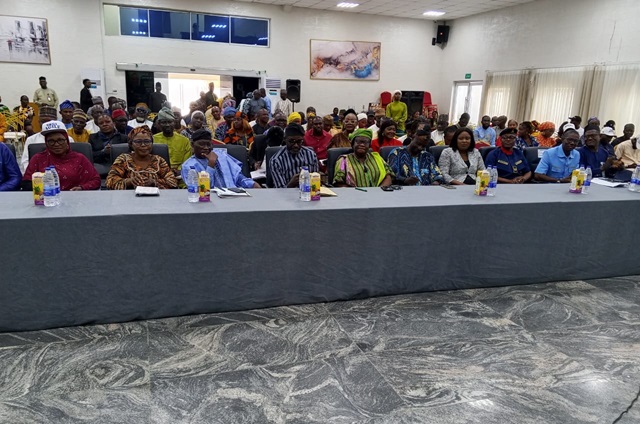
She also appealed to parents and guardians to place greater value on education and to encourage their wards to attend school, describing education as the key that prepares individuals for opportunities in life.
In his remarks, the State Commissioner for Education, Hon. Wemi Jones, said the draft policy, once implemented, would strengthen the state government’s capacity to initiate and oversee the integration of gender concerns across all facets of learners’ educational lives.
He explained that the Ministry of Education, working with the State AGILE programme, developed the policy document in response to global concerns over gender parity in education. According to him, a significant number of girls and boys remain deprived of access to foundational knowledge, essential competencies and life skills needed for safe, productive and meaningful participation in society.
He added that the policy, covering the period 2026 to 2036, is intended to address gender parity, inclusivity and equal opportunity across all segments of society.
The Director of Educational Planning, Research and Statistics, Dr. Animoku Ahman Elizabeth, said the state policy was developed in response to the National Policy on Gender in Education 2021. She explained that its focus is to address concerns around access, retention, performance and completion in education for boys, girls, men and women alike.
Dr. Animoku noted that the Kogi State Policy on Gender in Education (KSPGE) is key to the attainment of Sustainable Development Goals 4 and 5, as well as the elimination of all forms of discrimination in education, thereby ensuring equity, equality, parity and social inclusion.
She said the policy is anchored on the principles and values enshrined in the Nigerian Constitution, existing national policies, and state laws that promote gender mainstreaming across all levels of the education sector, in line with the principles and practices of gender equity and social inclusion.
Stakeholders at the meeting commended the Ministry of Education for developing the draft policy and called for a high-level sensitisation campaign to create public awareness of the policy across the state.