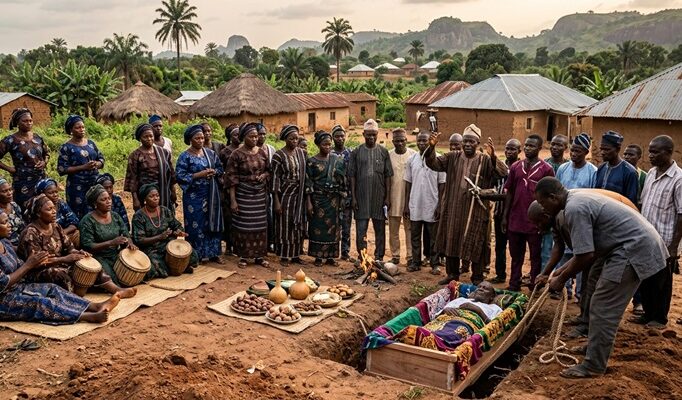

Kogi State is special because it has 3 major traditions in one state – Igala, Ebira, and Okun (Yoruba)
All 3 strongly believe in ancestral home burial, but with different meanings.
IGALA (Ankpa, Idah, Dekina) – The Largest

For Igala, burial at home is LAW.
Belief:
A man must be buried in his Oda (family compound) to join Ibegwu (ancestors). If buried outside, he becomes a wandering spirit
Alekwu will punish the family.
For a late personality (Titled man, Achijobe, Elder):
He must be buried in front of his own house he built in the village, not at the backyard.
Before burial, Attah or district head must be informed. Masquerades Egwu and Egu may appear.
They do “Egwuchu” rite – elders pour hot water and gin on the grave to send him to their ancestors peacefully.
His grave is plastered and becomes family altar. Children will pour libation there during festivals.
Taboo:, Igala will NEVER allow cremation or burial in public cemetery for a true son. They will contribute money to bring body home even from abroad.
EBIRA (Okene, Adavi, Okehi)
Ebira tradition is very firm.
Belief: Ancestral home burial is called Iresu Ebira say “The house that gave birth to you must swallow you.
For a late personality:
Body must enter through town, not sneak in at night. The whole clan lined up to welcome him.
They perform Eche Ori” traditional dirge by women, telling his life story.
If he was a title holder (Ohi, Obobanyi), hunters fire guns, and his cap or staff is placed on the grave.
Burial is inside the family compound, facing Mecca if Muslim, but still in ancestral land.
After burial, they do Ozumi 3-day or 7-day final rites, sharing food to show he was a provider.
Note: Ebira Muslims still bring the body home – Islam allows it as long as the burial is quick.
So they rush to carry body from Lokoja/Jos to Okene same day.
OKUN (Kabba, Yagba, Ijumu) – Yoruba Kogi
Okun is Yoruba tradition.
Belief: ,Burial at home connects you to Ile Ogere origin of lineage. Yoruba says “Eni to ba ku, ile lo n lo” ,He who dies returns home.
For a late personality
They do “Isinku Ile” – home burial is status. Burying outside means you were a stranger or disowned.
If he was a chief (Oba, Baale, Chief), his burial is at night with secrecy, and some rites are done by Ogboni society.
Grave is often inside room or veranda of his first house at home.
After burial, they plant tree or build small house on grave – it becomes memorial place.
WHAT ALL 3 HAVE IN COMMON IN KOGI:
Personality must return:, No matter how big he was in Abuja or Jos, Kogi people say Let our son come home.
Women married out are different:
A daughter married out is buried in husband’s ancestral home, not her father’s.
Refusal brings sanction:
If a family refuses to bring their body home, the traditional council can fine them or refuse to perform final rites for the family.
Modern practice:
Now families do 1 day lying-in-state in Lokoja/Abuja, then carry body at night to village for main burial by 10am next day.and
If you are to bury kogi indigin ask
Where is his ancestral compound – Igala, Ebira or Okun?
Because rite, timing, and who to meet (Attah, Ohi, or Oba) is different.
Deceased assets of family head
This is the most common crisis in Kogi after a father’s death.
In all 3 Kogi cultures – Igala, Ebira, Okun
tradition already has a complete system to stop this.
The crisis starts when children abandon tradition and use city-way.
Here is the Traditional Guide:
WHY CRISIS STARTS – According to Kogi Elders:
Father did not announce successor when alive
Children who lived in the city (Jos, Abuja, Lokoja) think money is seniority
First son or last wife wants to grab asset before traditional sharing
Tradition says: When head is cut off, body will scatter.” So they act quickly to install new head.
THE TRADITIONAL GUIDE – STEP BY STEP
STAGE 1:
MOURNING PERIOD – NO TALK OF PROPERTY (7 to 40 days)
In all Kogi cultures, you CANNOT discuss property while body is still fresh.
Igala:
Until after Ochala (final 7th day rites), nobody talks of farm or house. Whoever talks is cursed.
Ebira: During Ozumi, all children must sleep in their father’s house together.
That togetherness rebuilds respect.
Okun:
Family remains in Ile Ojo they stay indoor together to mourn. Elders watch behavior.
Rule:
Any child grabbing key or land during mourning loses right to asset in traditional council.
STAGE 2:
ELDERS TAKE OVER – FAMILY IS NOT OWNER YET
After burial, family does NOT share. Power goes to Family Elders.
Who are they?
Igala: Amachala(father’s eldest brother) and Gago (father’s sister)
Ebira: Ohiheyi Ete (eldest uncle from father’s side) and eldest woman in clan
Okun: Baale MolebiI yalode of family
They will call the meeting, Ite Ihoye in Igala, Irehva Ete” in Ebira.
At that meeting, they restore respect first:
All children sit according to age – First son to last born. Not according to wealth.
The eldest son is prostrated to elders and recognized as Adah Oboni holder of father’s cap, NOT owner of all property.
Anyone who insulted senior brother or mother during crisis must kneel and apologize before property is mentioned. Without apology, no sharing.
This restores respect before asset.
STAGE 3:
TRADITIONAL SHARING – NOT EQUAL, BUT FAIR
Kogi tradition does NOT share like city court (equal to all). It shares by responsibility:
Igala System:
Family house at ancestral home – NEVER TO BE SOLD. Belongs to all, eldest son keeps it.
Farmlands divided into 3: Eldest son takes small extra (Otakpala) for sacrifice duty.
Daughters get share to farm but not to sell if married out. The youngest son gets the father’s bedroom as compensation for staying to care for the mother.
Father’s wives: Each wife’s children share what their mother farmed with father.
Ebira System:
Most strict. Eldest son is Ozi Ete trustee, not owner.
He must keep father’s house, feed father’s widows (if not re-married), and sponsor younger ones school from father’s farm yield.
If eldest son grabs and sells, clan can remove him and install second son. Clan council Aniku has the power to do this.
Wives don’t inherit land but have right to live in house and farm until death.
Okun (Yoruba) System:
Use Idi-Igi, sharing by mother. If the father had 3 wives, property divided into 3 heaps by the wife, then the children of each wife share.
-Eldest son is _Aremo – he takes father’s agbada and sitting room chair, and speaks for family outside, but cannot sell land alone. He needs consent of all heads of Idi-Igi
STAGE 4:
CURSE AND BLESSING – THE ENFORCEMENT
After sharing, elders pour libation and say:
“Whoever respects senior, his own children will respect him. Whoever cheats his brother’s property, his own hands will never hold property.”
In Kogi tradition, this curse is feared more than police. That is why people comply.
WHAT TO DO IF CRISIS HAS ALREADY STARTED IN YOUR FAMILY:
Stop all grabbing.
Return keys, cars, documents to eldest uncle. Let him lock them.
Call neutral elder
Not your immediate uncle who is partisan. Call your father’s age-grade or village chief.
Hold respect meeting first
No property agenda. Just ask each person: How did we disrespect each other?” Apologize.
Invite mothers
In Kogi, mothers are peace makers. Let each mother speak.
Write what was shared
Even if traditional, write it and let all thumbprint with elder as witness. Take photo.
Modern Warning:
Today, Nigerian law (Customary Court) says children cannot be disinherited and wives have right to husband’s property. So if tradition is too harsh (e.g., chasing a widow away), a widow can go to the Customary Court in Lokoja and win.
Best is to blend tradition and fairness
– Benjamin Ibrahim writes from Lokoja, Kogi state.
+2348069596250