
By Ogbeni Mike Enimola
As Kogi State approaches another political transition, one question deserves serious, honest and dispassionate consideration: When will the Okun people of Kogi West have their opportunity to produce the Governor of Kogi State?
This is not a question that should be approached from the prism of ethnic rivalry or political hostility. It is a question of equity, inclusion, fairness and the kind of political arrangement capable of strengthening the unity of Kogi State.

Kogi State is a plural society, with the Igala, Ebira and Okun constituting three major indigenous groups. Since the creation of the state, political power has moved between some of these blocs, yet the Okun people have continued to wait for an opportunity to occupy the highest elective office in the state.
The time has come for Kogi people to ask whether this political imbalance is sustainable.
WHAT EXACTLY IS DEVELOPMENT?
Development is often measured by the construction of roads, hospitals, schools, water projects and other physical infrastructure. These are undoubtedly important. But development goes beyond physical structures.
Political inclusion is also development. Equity is development. Equal opportunity is development. A genuine sense of belonging is development.
A society cannot convincingly claim to have achieved meaningful political maturity if a significant component of its population continually feels excluded from the highest level of political leadership.
The question, therefore, is not whether an Igala or Ebira leader can develop Okunland. Of course, any responsible governor should develop every part of Kogi State, irrespective of ethnicity.
The deeper question is whether political power should continually be concentrated among some groups while another major constituent group remains outside the governorship.
LET EVERYONE HAVE A TURN
There is nothing inherently wrong with an Igala person aspiring to govern Kogi State. There is nothing wrong with an Ebira person seeking the same office. Equally, there should be nothing controversial about an Okun person seeking to lead the state.
In a multi-ethnic society, rotation and inclusiveness can serve as instruments for building trust.
If the people of Kogi are genuinely committed to building one united state, then every major constituent group should be given a reasonable opportunity to participate meaningfully in the highest levels of political leadership.
The argument for an Okun governor is therefore not an argument against Igala people. It is not an argument against Ebira people. It is an argument for the Okun people to have their own opportunity.
After all, leadership is not a permanent inheritance of any ethnic group.
AN OKUN GOVERNOR MUST BE A GOVERNOR FOR ALL
There is, however, an important qualification.
The campaign for an Okun governor must never be reduced to the pursuit of ethnic entitlement. The Okun candidate who eventually emerges must be prepared to govern all of Kogi State.
Such a governor must see the development of Okunland, Igala land and Ebira land as interconnected responsibilities.
He or she must be prepared to build bridges across Kogi East, Kogi Central and Kogi West; strengthen institutions; attract investment; improve education and healthcare; address insecurity; develop infrastructure; create employment opportunities; and restore confidence in government.
The colour of the governor’s ethnic identity should not determine the quality of governance. Character, competence, capacity, integrity and vision must remain the ultimate standards.
THE REAL ISSUE IS FAIRNESS
For decades, Kogi politics has been shaped by questions of ethnic balancing and political inclusion. These questions will not disappear simply because we choose to ignore them.
Rather than pretending that the issue does not exist, responsible citizens should engage it honestly and peacefully.
If the three major constituent groups are genuinely equal partners in the Kogi project, then equality should be reflected not only in rhetoric but also in political opportunity.
The Okun people should not have to apologise for demanding their turn.
They should not have to present the aspiration to govern as an act of rebellion.
And they should not be made to feel that seeking the governorship is an attempt to take Kogi away from other groups.
Kogi belongs to all of us.
That is precisely why every major component of the state should have a fair opportunity to lead it.
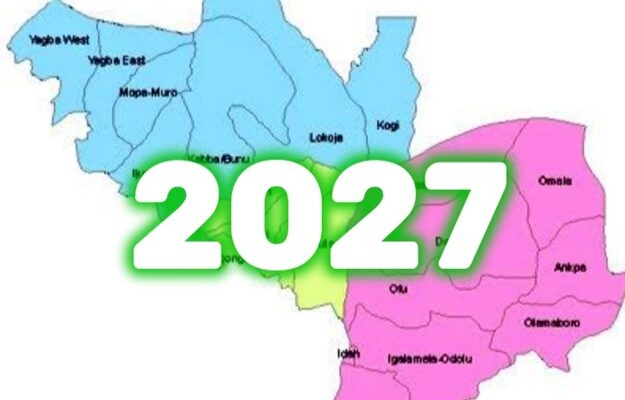
2027 AND THE CHOICE BEFORE KOGI
The 2027 election should therefore provide an opportunity for Kogi people to have a mature conversation about political equity.
The question should not simply be: Who is Igala? Who is Ebira? Who is Okun?
The more important questions should be:
Who can unite Kogi?
Who can govern fairly?
Who can develop every senatorial district?
Who can protect lives and property?
Who can create opportunities for young people?
Who can attract investment?
Who can provide competent and accountable leadership?
If an Okun candidate possesses these qualities and has the political capacity to win, then there should be nothing extraordinary about Kogi West seeking to produce the next governor.
Indeed, after years of waiting, 2027 presents an opportunity to correct an enduring imbalance and deepen the sense of belonging among the people of Kogi West.
This is not about one ethnic group defeating another.
It is about building a political culture in which no group is permanently excluded and no group permanently owns power.
The ultimate objective should be a Kogi State where an Igala man, an Ebira man and an Okun man can all genuinely say:
“This state belongs to me, and I have an equal opportunity to contribute to its leadership and development.”
That is the essence of democracy.
That is the essence of equity.
And perhaps, that is the kind of political understanding Kogi needs as it approaches 2027.
Let the Okun have their opportunity. Let competence determine the candidate. Let the people determine the winner. And let whoever emerges govern Kogi as one united state.
Kogi must move from ethnic competition to equitable inclusion; from political exclusion to shared opportunity; and from the politics of “who owns power?” to the more important question: “who can lead Kogi forward?”
– Ogbeni Mike Enimola
enimolamike19@gmail.com