
After Years of Promises, Approvals and Expectations, What Exactly Is Blocking the Road?
By Rotimi Odofin
For years, the Kabba–Egbe–Ilorin road has remained one of the most enduring infrastructure promises in the political consciousness of Kogi West and neighbouring communities.
It has been described as a strategic economic corridor—one capable of connecting communities, opening up markets, stimulating agriculture, reducing travel difficulties and strengthening commercial ties between Kogi and Kwara States.

Its importance is hardly in dispute.
What is increasingly in dispute is something more fundamental:
Why has a road of such obvious economic and strategic importance remained trapped for so long between political promises and physical reality?
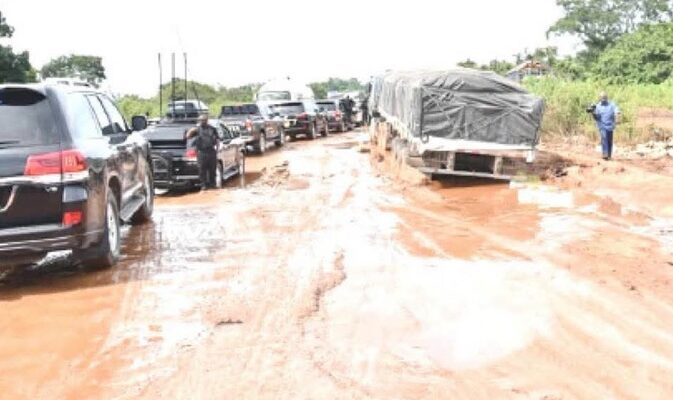
For residents along the corridor, this is no longer an abstract policy question. It is a daily reality.
Bad connectivity affects the movement of farm produce, transportation, businesses, access to healthcare, education and the general economic life of communities.
And after years of political assurances, patience is beginning to give way to questions.
FROM PROMISES TO PERFORMANCE
Successive administrations and political actors have repeatedly acknowledged the importance of the road.
The project has featured in political speeches, development conversations and campaign narratives.
But infrastructure cannot be built with rhetoric.
A road requires more than announcements. It requires approvals, appropriation, funding, procurement, contractual obligations, mobilisation, engineering work and sustained supervision.
That is where the real test begins.
The critical question is therefore no longer whether the Kabba–Egbe–Ilorin road is desirable.
The question is: what concrete steps have been taken to ensure its actualisation?
WHERE EXACTLY IS THE ROAD STUCK?
This is the point at which public curiosity becomes legitimate investigation.
Is the delay primarily a funding problem?
Are there unresolved procurement or contractual issues?
Has the required appropriation been made?
If appropriated, has the money actually been released?
Is there a federal-state coordination problem?
Are there technical, environmental or right-of-way challenges?
Has a contractor been properly engaged and mobilised?
Or is the project simply competing unsuccessfully with other infrastructure priorities?
These questions have straightforward administrative answers.
But there is another question increasingly finding its way into political conversations:
Is there more to the delay than bureaucracy?
The expression that there is a “devil” working against the project should not be interpreted literally.
In the language of politics and governance, that “devil” could simply represent bureaucratic inertia, funding gaps, institutional rivalry, political calculations, competing interests or a failure of coordination.
The important thing is not to speculate about personalities without evidence.
The important thing is to identify the actual obstacle—and hold the responsible institution accountable.
WHEN INFRASTRUCTURE BECOMES POLITICAL CAPITAL
There is another uncomfortable dimension to the controversy.
Major infrastructure projects naturally carry enormous political value.
A completed Kabba–Egbe–Ilorin corridor would generate economic benefits that could be felt across communities and electoral constituencies.
Consequently, the road can easily become attractive political currency.
Promises can generate headlines.
Announcements can generate excitement.
Campaign platforms can generate expectations.
But eventually, the electorate begins to demand something different:
Evidence.
The people want to see bulldozers, graders, engineers, construction materials and measurable kilometres of completed road.
They want to move from “the project is coming” to “the project is here.”
THE ACCOUNTABILITY GAP
Perhaps the most important issue is not who first promised the road.
It is who is currently responsible for delivering it.
That distinction matters.
Projects can survive changes in government if they are properly institutionalised, funded and contractually protected.
But when projects repeatedly reappear in political narratives without corresponding physical progress, public confidence inevitably begins to weaken.
That is when citizens start asking whether the project is being treated primarily as an infrastructure commitment or as a recurring political talking point.
Those questions should not be dismissed as political hostility.
They are questions of public accountability.
THE QUESTIONS GOVERNMENT MUST ANSWER
After years of expectations, the public deserves a transparent status report.
What is the current status of the Kabba–Egbe–Ilorin road?
Has the project received all necessary approvals?
What is its current estimated cost?
What is the funding arrangement?
Has a contractor been formally appointed?
How much has been appropriated?
How much has actually been released?
What percentage of the project has physically been completed?
What specific obstacles are currently delaying execution?
And what is the realistic completion timeline?
These are not political accusations.
They are basic questions of governance.
THE PEOPLE ARE TIRED OF “COMING SOON”
For the communities along the corridor, another promise without visible implementation will only deepen public scepticism.
The language of development must eventually give way to the evidence of development.
“Approved.”
“Captured in the budget.”
“Contract awarded.”
“Work will commence soon.”
“Mobilisation is imminent.”
These phrases may generate headlines, but they do not construct roads.
At some point, the only language that matters is physical progress.
Show the appropriation.
Show the contract.
Show the funding.
Show the mobilisation.
Show the work.
Show the timeline.
That is how public confidence is restored.
MIRAGE OR MISSION?
The Kabba–Egbe–Ilorin road deserves to be more than another recurring feature of election-season rhetoric.
It deserves a transparent implementation plan, credible financing and measurable execution.
If there are genuine financial constraints, government should explain them.
If there are technical challenges, they should be disclosed.
If bureaucratic bottlenecks exist, they should be confronted.
If institutional disagreements are responsible, they should be resolved.
And if the project is genuinely progressing, the evidence should be available for the public to see.
Because after years of waiting, the central question has changed.
It is no longer:
“Who has promised the Kabba–Egbe–Ilorin road?”
The question now is:
“Who is actually delivering it?”
Until that question receives a convincing answer backed by visible construction, the road will remain suspended between aspiration and reality.
And that leaves one uncomfortable question hanging over the entire project:
Is the Kabba–Egbe–Ilorin road finally a development mission—or merely another political mirage waiting for the next election cycle?
– Rotimi Odofin writes from Lokoja.