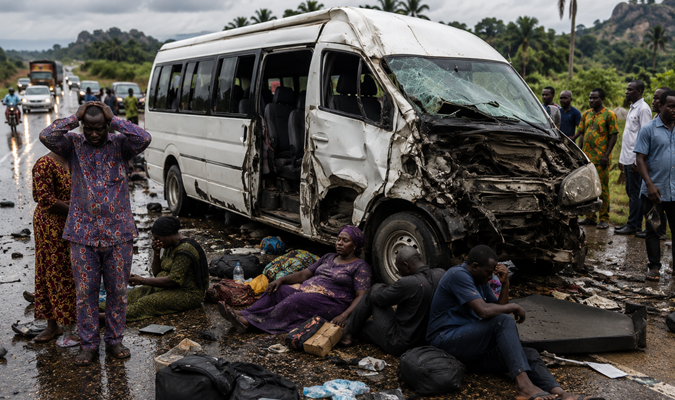

Rethinking Mass Travel, Church Obligations, and the Preservation of Human Life
By Madiba Ibrahim Lapinni
There is a painful irony that the Church must confront: sometimes, in our determination to celebrate life, honour the dead, attend ceremonies, demonstrate solidarity, or fulfil our Christian obligations, we expose the living to unnecessary danger and sometimes lose the very lives we are trying to preserve.

For many years, we have witnessed, heard about, and mourned tragic incidents involving church members travelling in groups for Christian activities. Women fellowship groups, youth organizations, choirs, men’s fellowships, clergy, church leaders and ordinary members have, at different times, embarked on journeys by road, air and water. Some of these journeys have ended safely and joyfully. Others have ended in accidents, injuries, permanent disabilities and heartbreaking deaths.
The tragedy is that these incidents are neither the first nor likely to be the last unless the Church and society deliberately rethink the culture of mass movement for church activities and introduce practical reforms capable of reducing avoidable risks.
A journey that begins with songs of praise can sometimes end with tears. A bus filled with members travelling to celebrate a wedding can return as a hearse. A delegation going to attend a burial can itself become the subject of another burial. A group travelling to comfort a grieving family can become another grieving family.
This is the painful contradiction that demands our attention. “For everything there is a season, and a time for every matter under heaven: a time to be born, and a time to die.” – Ecclesiastes 3:1–2.Death is inevitable, but avoidable death should never be accepted as inevitable.
It is important to state from the beginning that this article is not an argument against Christian fellowship, solidarity, visitation or participation in important ceremonies. Christianity is fundamentally relational. The Bible teaches us to rejoice with those who rejoice and mourn with those who mourn: “Rejoice with those who rejoice; mourn with those who mourn.” -Romans 12:15
The Church is a family. When one member suffers, others naturally want to be present. When a member celebrates a wedding, graduation, ordination, retirement, child dedication, coronation, naming ceremony or other important milestone, fellow Christians desire to celebrate with them.
Likewise, when a member dies, Christians want to stand beside the bereaved family. They want to offer prayers, financial assistance, physical presence and emotional support. This is beautiful and should not be discouraged. However, Christian responsibility must be accompanied by Christian wisdom. We are not required to prove our love by putting our lives unnecessarily at risk. The Church does not cease to be loving simply because every member cannot travel to every event.
There is wisdom in recognizing that we are a dynamic and interconnected society. People need one another. We cannot always operate in situ. We must interact, communicate, visit, celebrate, mourn and minister together. But the question is not whether Christians should travel. The real question is: must Christian’s travel in such large numbers, so frequently and under such dangerous circumstances, for every event?
Church members travel for many legitimate reasons. They travel for evangelism and film shows, conferences, conventions, burial ceremonies, weddings, naming ceremonies, child dedications, graduations, coronations, retirements, ordinations, anniversaries, thanksgiving services and other Christian activities.
The groups involved may include women’s organizations such as Zumunta Mata, Catholic Women Organization (CWO), women fellowships in Pentecostal and other denominations, men’s fellowships, youth fellowships, choirs and various denominational structures.
In churches and Christian organizations such as ECWA, ERCC, Catholic and Pentecostal bodies, organized groups frequently travel to participate in activities outside their immediate communities. Usually, members converge at a church premises or designated assembly point before departure. Some even leave their personal vehicles behind because they expect to return together after the event.
Then the journey begins. The bus may be fairly new-or dangerously old. The driver may be experienced-or exhausted. The road may be good-or filled with potholes. The weather may be favourable-or terrible. Security may be adequate-or uncertain.
The journey may proceed normally for several hours until, suddenly, a tyre bursts, a driver loses control, another vehicle collides with the bus, an obstacle appears on the road, or an act of insecurity changes everything. In a matter of seconds, celebration becomes tragedy.
The same applies to air and water transportation. A journey may begin with confidence and end with fear and uncertainty. This reality should compel the Church to ask difficult but necessary questions.
The cost of losing one life is greater than we sometimes understand; When a church bus is involved in an accident, the consequences do not end at the scene of the accident. The impact spreads. A woman who dies may leave behind children who still need their mother. A man who dies may leave a wife without a husband and children without a father. A youth who dies may be the hope of an entire family. A church leader who dies may leave an organization without experienced leadership. A breadwinner who becomes permanently disabled may create years of financial hardship for the family.
The church also suffers. The nation suffers. Productivity suffers. The emotional and psychological consequences can last for years. Consider, therefore, the irony of a church sending dozens of people to attend the burial of one member, only for the travelling delegation itself to suffer multiple deaths.
What have we gained? What have we lost? The Bible says: “So teach us to number our days, that we may apply our hearts unto wisdom.” – Psalm 90:12. Numbering our days means recognizing that human life is precious and limited. It means refusing to treat human lives casually. Christian faith does not mean recklessness.
Faith is not a substitute for caution. Prayer is not an excuse for negligence. We should pray before travelling, but we should also inspect the vehicle. We should ask God for protection, but we should also ensure that the driver is competent and rested. We should trust God, but we must not deliberately expose ourselves to preventable danger.
Do we really need to travel in large numbers? This is perhaps the most uncomfortable question the Church must answer. Why must half of a church travel to accompany the corpse of one deceased member when the burial could be adequately conducted by a smaller delegation? Why must an entire women’s fellowship travel several hundred kilometers to attend an event that could be represented by five or ten competent members? Why must every youth, choir member or men’s fellowship member be physically present at every ceremony?
Is physical presence the only evidence of love? Certainly not. There are several ways to honour, support and encourage a Christian brother or sister without requiring hundreds of people to travel.
We can provide financial assistance. We can send representatives. We can pray. We can make telephone calls. We can send messages of condolence. We can send video messages. We can participate through technology where appropriate. We can ask members within the deceased person’s locality to represent the larger church. We can organize a memorial service in the home church. We can delegate responsibilities.
In this regard, the principle demonstrated in the relationship between Moses and Jethro is instructive. Jethro advised Moses to delegate responsibilities rather than carry everything alone.
“It is not good what you are doing… You will surely wear yourselves out, both you and these people with you.”-Exodus 18:17–18
The principle is clear: Leadership does not mean doing everything personally. There is wisdom in delegation. There is wisdom in representation. There is wisdom in sending a small but capable delegation.
Perhaps the most disturbing practice is the culture surrounding burials. A church member dies in one location, and hundreds of people from another location immediately begin planning a journey.
They gather at the church. They board buses. They travel long distances. Some spend hours or even days waiting. Some sleep in the homes of the bereaved. Some leave their families, businesses and offices behind.
Some travel through insecure highways. Some return late at night. And sometimes, tragically, some never return. We must ask ourselves whether every burial requires such extensive physical attendance. Can we honour the dead without endangering the living? The answer is yes.
In many circumstances, the deceased’s local church members can take responsibility for aspects of the burial on behalf of the mother church, district, headquarters or wider organization.
A small delegation can attend. The larger congregation can hold a memorial service locally. Financial assistance can be sent. Prayers can be offered. Messages can be delivered. Technology can bridge distance. The Christian obligation to mourn does not disappear because we choose a safer method.
The problem of excessive church travelling is not confined to accidents. There is another hidden cost: family disruption. When church members, especially those with leadership responsibilities, travel frequently, their absence can affect their spouses, children, businesses and employment.
There are husbands who become deeply anxious when their wives travel long distances. Some repeatedly call to confirm that they have arrived safely. Some may make dozens of calls during a journey because they are afraid of the dangers on the road.
There are children who grow up seeing their parents constantly away for church activities. There are employers who lose productive hours. There are businesses that suffer. There are farms, offices and households that are left unattended. There are pregnant women who travel long distances and may experience medical emergencies on the road, including going into labour. These realities should not be dismissed as a lack of commitment to God. The Church should therefore encourage members to serve God without neglecting legitimate family responsibilities.
Another dimension deserves attention. In some families, a woman may accept a leadership position within a church organization that requires frequent travelling. What begins as Christian service can eventually create tension between her church responsibilities and her family obligations.
Husbands may complain about prolonged absence. Children may feel neglected. Household responsibilities may be affected. In extreme situations, family members may resent the church organization. This should make church leaders pause and reflect.
Church leadership should build families, not unnecessarily destroy them. A church organization should not measure the commitment of a member by the number of journeys that member undertakes. A person who cannot travel should not automatically be regarded as uncommitted.
A mother who stays home to care for young children is not less Christian. A husband who cannot travel because of work is not necessarily less devoted. A young person who cannot afford a journey should not be made to feel guilty. Christianity is about the heart, character, service and obedience to God-not the number of kilometers travelled.
The Church cannot ignore the realities of the environment in which it operates. Road conditions in many parts of Nigeria remain a concern. Potholes, poor road infrastructure, vehicle failures, driver fatigue, reckless driving and other hazards can increase the risks associated with long-distance travel. There are also concerns about insecurity, including kidnapping and other threats along some highways. In such circumstances, churches and Christian organizations must recognize that every unnecessary journey carries a cost and a risk. The Church should not wait for another tragedy before reviewing its policies.
It is not enough to organize a condolence committee after an accident has occurred. It is not enough to visit victims in hospital. It is not enough to organize another funeral. Prevention must become part of Christian administration.
The church needs a travel policy; This is where church leadership must demonstrate courage. Major denominations and Christian organizations should consider developing clear transportation and travel policies. Such policies could include: Mandatory vehicle inspection before long-distance journeys. No use of visibly unroadworthy vehicles. Verification of drivers’ competence and licensing. Strict prohibition of excessive speed.
Adequate rest periods for drivers. Avoidance of unnecessary night journeys. Limits on the number of people travelling for certain events. Risk assessment before major journeys. Emergency communication and response arrangements. Greater use of local representatives and delegation. Use of technology where physical presence is unnecessary. Special consideration for pregnant women, elderly members and people with medical needs.
These should not merely be suggestions. Where appropriate, they should become institutional policies. The role of church leaders; The responsibility lies heavily with those at the helm of affairs. They must be willing to cancel a journey where the security situation is unacceptable. Leadership sometimes means disappointing people in order to save lives. There will always be members who take offence when others fail to attend their events. Some may even retaliate by refusing to attend future events of those who were absent.
This mentality must change. Christian fellowship must never become a transaction: “If you attend mine, I will attend yours. “That is not the highest expression of Christian love. We should not punish people because they chose safety, family responsibilities, health or work obligations over a long-distance journey.
There is a fundamental distinction between an important journey and a necessary journey. A journey can be important without being indispensable. The Church must learn to distinguish between participation and physical presence. In the modern world, technology has given us opportunities that previous generations did not have.
Churches can livestream programmes. Messages can be recorded. Representatives can speak on behalf of larger groups. Financial contributions can be transferred electronically. Prayers can be organized locally. Video calls can connect congregations. Memorial services can be held simultaneously in different locations. Technology should not replace Christian fellowship, but it can reduce unnecessary physical movement while preserving meaningful participation.
Traditions are important, but traditions are not more important than human life.
The Bible says: “The Sabbath was made for man, not man for the Sabbath.” -Mark 2:27
The underlying principle is powerful: institutions, structures and practices should serve human beings rather than unnecessarily endanger them. Therefore, if a church rule, custom or organizational practice is causing excessive travelling, family disruption, financial hardship or unnecessary exposure to danger, it should be reviewed. The fact that something has been done for fifty years does not automatically make it wise for the next fifty.
Times change. Circumstances change. Risks change. Therefore, policies must change. The leadership of churches, Christian associations and organizations such as the Christian Association of Nigeria (CAN) and the Pentecostal Fellowship of Nigeria (PFN) should be sensitive to the times and seasons. This is therefore a call for serious reflection-not a condemnation of Christian fellowship. No Christian should feel guilty for refusing an unsafe or unnecessary journey.
The Apostle Paul tells us: “If it is possible, as far as it depends on you, live at peace with everyone.” -Romans 12:18.We can extend this principle to our organizational life: as far as it depends on us, let us make our journeys safer.
The Church must never become so accustomed to funerals that it begins to accept preventable deaths as part of Christian service. We must mourn our dead, but we must also learn from our losses. We must honour those who have gone before us by making the journey safer for those who remain. The Bible says: “I have set before you life and death, blessing and cursing. Therefore, choose life.” -Deuteronomy 30:19. That is the challenge before the Church today.
The Church must therefore revisit its customs, policies and expectations concerning mass travel. The laws and traditions of an organization must serve its people. When they no longer do so, they must be reviewed.
– Madiba Ibrahim Lapinni
09011364063