
- says “Knowledge for Self-Reliance” must apply to the institution itself, not just its graduates
In a hard-hitting address that sent ripples through the academia, the Managing Director and Chief Executive Officer of the Development Bank of Nigeria (DBN), Dr. Tony Okpanachi, has issued a stern wake-up call to public universities across the nation, declaring that capital will only flow to institutions that demonstrate the capacity to utilize it effectively.
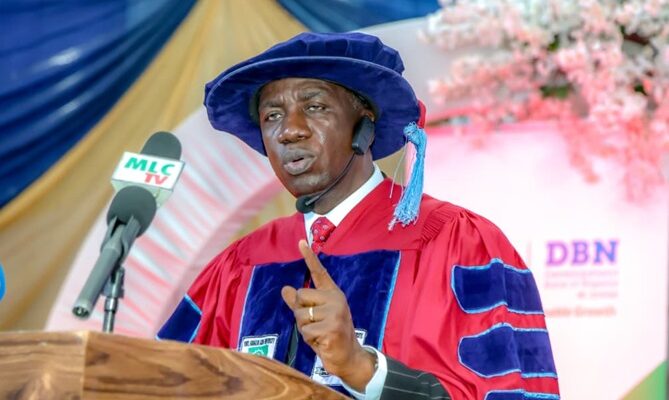
Dr. Okpanachi delivered the uncompromising warning on Monday while delivering the maiden Distinguished Personality Public Lecture of Prince Abubakar Audu University (PAAU) at the University Auditorium in Anyigba, Kogi State.
Speaking on the high-stakes theme, “The Making of a Great University: Institutions, Resources and Relevance,” the DBN chief insisted that higher institutions must immediately break away from absolute reliance on government allocations and build self-sustaining financial structures.

Anchoring his presentation on PAAU’s institutional motto, “Knowledge for Self-Reliance,” the Guest Lecturer asserted that self-reliance must no longer be treated as a mere catchphrase for graduating students, but as an urgent survival doctrine for the university itself. While clarifying that advocating for financial resilience does not excuse the government from its fundamental responsibility of funding tertiary education, Dr. Okpanachi stressed that PAAU must aggressively diversify its revenue streams to withstand economic shocks, pursue emerging opportunities, and secure its long-term future.
Reflecting on the trajectory of PAAU since its inception in 1999 as Kogi State University, the development banker noted that the institution has reached a critical juncture where survival depends entirely on strengthening core capabilities. He identified talent, resources, and governance as the three indispensable pillars of university excellence, cautioning that vast financial resources without sound governance will end up squandered, while top-tier talent deprived of institutional support will simply flee. According to him, the true measure of a great university lies not in ornamental rankings, but in its tangible ability to solve the pressing economic and social challenges of its immediate environment.
To break the cycle of financial vulnerability, the DBN boss outlined a comprehensive revenue-diversification model for PAAU. This strategic framework blends baseline allocations from the federal government and Tertiary Education Trust Fund (TETFund) with high-yield research grants, specialized consultancies, professional executive training, strategic corporate partnerships, structured philanthropy, and transparently governed campus commercial ventures. However, he sounded a note of caution, warning university authorities never to allow income-generating drives to cannibalize or overshadow the primary academic mandates of teaching, research, and community extension.
Dr. Okpanachi emphasized that attracting external capital requires uncompromising internal discipline, urging PAAU management to radically upgrade its financial and administrative systems. He noted that establishing robust project accounting, transparent procurement practices, rigorous research management, and auditable reporting structures remains the only guaranteed pathway to building investor confidence, as money strictly follows proven organizational capability.
Turning his focus to human capital, the Guest Lecturer described PAAU’s sprawling alumni network as a goldmine waiting to be tapped, pointing to the massive cohort of 26,160 graduates cleared in a single historic ceremony in January. He admonished the university to move beyond viewing alumni merely as source targets for financial donations, urging the establishment of a centralized alumni platform, a reliable graduate database, and active regional chapters to leverage their professional networks, advocacy, mentorship, and industry access.
As a roadmap for immediate action, Dr. Okpanachi handed down five mandatory priorities for the university leadership: aggressive research investment, a dedicated advancement office, a strategic resource mobilization plan, robust research-to-impact pathways, and an annual institutional report measuring concrete outcomes. He insisted that metrics such as research income, commercialized patents, graduate employability rates, and direct socio-economic impact on Kogi State must become the new scorecard for progress.
Concluding his electrifying paper, Dr. Okpanachi challenged the university community to step into a new era of global competitiveness, invoking the famous words of late economist Thandika Mkandawire: “And if Africa will have to run, the university will have to sprint.”
Earlier in his opening remarks, the Director of Advancement, Support and Linkages, Rev. Fr. Professor Nicholas Ojoajogwu Okpe, heralded the lecture as a historic benchmark in PAAU’s pursuit of global relevance, expressing confidence that the event will endure as a prestigious institutional tradition.
Concurring with the convener, the Vice-Chancellor of PAAU, Professor Salisu Ogbo Usman, described the maiden lecture as the inauguration of an indispensable intellectual platform designed to revolutionize town-and-gown collaboration. Expressing deep appreciation to Dr. Okpanachi and the Directorate of Advancement for orchestrating the landmark event, Prof. Usman reaffirmed the administration’s commitment to implementing actionable insights from the lecture to propel the university toward total institutional self-reliance.